

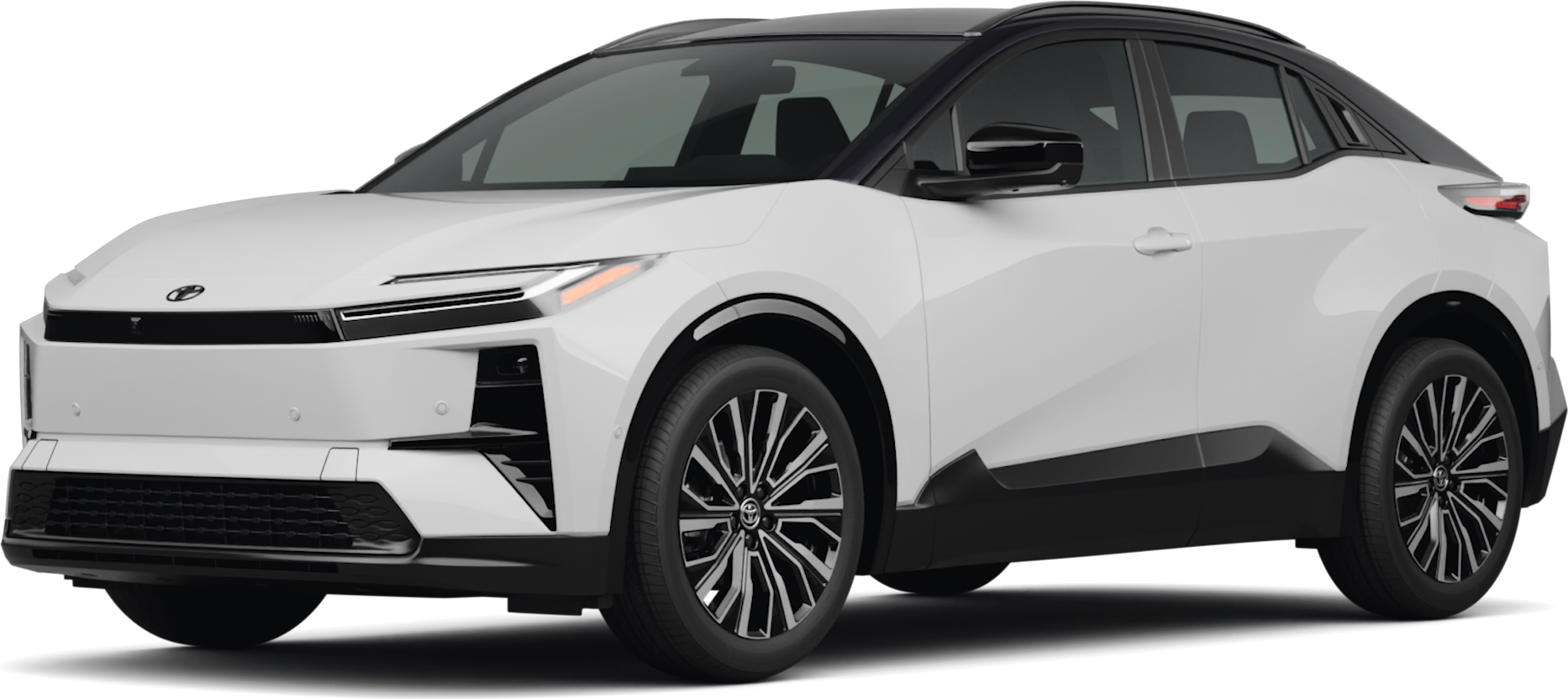
View All Media
2026 Toyota C-HR Review

Updated March 30, 2026
Pros
- Comfortable
- Quick acceleration
- Practical space
Cons
- Range could be better
- A bit noisy
What's New?
- All-new
- All-electric
The 2026 Toyota C-HR is an all-new, fully electric compact SUV with up to 287 miles of range.
The 2026 Toyota C-HR breathes new life into a nameplate last used in 2021, upgrading the former quirky subcompact into a fun, fast, all-electric compact crossover with familiar style. Now bigger, more powerful, and more capable, the 2026 C-HR aims to compete with the stalwarts of the electric SUV segment. It shares some of its underpinnings with the slightly larger Toyota bZ, but offers its own take on the segment.
We’ve spent hundreds of hours driving and evaluating this generation of compact electric SUVs, including the Toyota C-HR.
Toyota C-HR Pricing
The 2026 Toyota C-HR is priced competitively, even without federal EV incentives, starting from below the $40,000 mark.
| Trim | MSRP (including destination fee) |
| CH-R SE | $38,450 |
| CH-R XSE | $40,450 |
Driving the Toyota C-HR
The C-HR’s name stands for “compact high-rider,” but in its current evolution, it doesn’t feel like it rides all that high. If anything, it feels more like a sporty hatchback, especially once you uncork the accelerator and its 338 horsepower and 323 lb-ft of torque.
Push the go-pedal all the way to the floor, and you’ll zip from a stop to 60 mph in just 4.9 seconds. That’s about a half-second slower than the related bZ Woodland, and we’d love to see the more potent dual-motor setup used there in the C-HR, where it could arguably show even more performance thanks to the C-HR’s sportier suspension tune.
That said, raw speed isn’t what the C-HR is all about. In fact, if anything, the C-HR’s quick acceleration is just a nice perk in what is otherwise a comfortable, reasonably spacious (even for a 6-footer), efficient daily runabout. Our one gripe with the C-HR on the road is that there’s a bit more wind and road noise than we’d like, especially for longer trips.
Steering-wheel-mounted paddles let the driver adjust the brake regeneration levels, but unfortunately for fans of one-pedal driving, the C-HR’s most aggressive regen setting isn’t quite aggressive enough.
While the C-HR comes standard with Plug & Charge, a system that allows the C-HR to automatically work with a range of compatible charging networks and stations, the vehicle’s software doesn’t include a function to map your charge stops along a road trip route – and Toyota says there are no plans to implement such a system, either.
Interior Comfort
The C-HR’s interior design offers simple, open styling and clear sight lines, aside from the view over the driver’s shoulder toward the rear; the thick C-pillar can obstruct the view of traffic or obstacles when merging or reversing. Aside from that one quibble, however, the C-HR’s cabin is quite comfortable, with even 6-footers fitting in the second row, although headroom can be a bit snug.
The base C-HR SE trim is well-equipped, with heated front seats and steering wheel, fabric and SofTex simulated leather seating, an 8-way power driver’s seat, a power liftgate, rain-sensing wipers, and more. Upgrade to the XSE trim for synthetic suede-trimmed seats, 20-inch wheels, an 8-way power passenger seat, driver memory seat, and more.
Behind the rear seats, you’ll find 25.3 cubic feet of cargo space – about double what you’d get in a typical sedan’s trunk. Fold flat the 60/40 split rear seats, and the total cargo capacity expands to 59.5 cubic feet.
Tech & Safety
Standard dual wireless phone chargers, a 14-inch center screen, and four USB-C ports keep you as connected as you want to be. The driver’s display is a bit small and hard to see at times due to obstruction from the steering wheel.
Even base models come well-configured with safety features, including the Toyota Safety Sense 3.0 suite, front and rear parking assist with automatic braking, and a blind-spot monitoring system.
Upgrade to the XSE, and you’ll get even more safety equipment and tech, including lane change assist, low-speed traffic-following assist, and a surround-view camera system.
Efficiency, Battery, & Charging
The 2026 C-HR offers just one battery configuration to go with its standard dual-motor AWD setup. That battery packs 74.7 kWh of energy, enabling up to 287 miles of range for the SE model on the standard 18-inch wheels. The XSE’s 20-inch wheels are part of the reason that model’s maximum range is reduced slightly at 273 miles.
All C-HR models include a North American Charging System (NACS) charge port and DC fast charging capability, charging from 10%-80% in about 30 minutes. All C-HRs also include an 11-kW onboard charger capable of charging from 10%-100% in about 7 or 8 hours with a standard 240-volt outlet.
The C-HR’s range is fair, but not quite as good as much of its competition, including the Chevrolet Equinox (up to 319 miles) and Tesla Model Y (up to 357 miles).
Cars You May Like
We’ve Rounded Up Cars That Could Be Your Perfect Match.
2026 Toyota C-HR Deals and Incentives
0% APR | 72 months
Get 0% APR for 72 months on a new 2026 C-HR.
$319 /mo | 36 months | Due at Signing
Lease a new 2026 C-HR SE for $319 per month for 36 months with $3,999 due at signing.
2026 Toyota C-HR
KBB.com Consumer Reviews
We don't have consumer reviews for this vehicle.
Be the First to Review This Car2026 Toyota C-HR Styles
Calculate Your Budget With These KBB.com Tools
2026 Toyota C-HR Safety
Safety Features & Technology
Best EVs




More Toyota C-HR News & Information
Next week, Subaru will reveal a new electric vehicle, the 2026 Subaru Uncharted. We think it’s based on the Toyota C-HR.
Toyota spent part of this month teasing an all-new C-HR with funkier lines and a cool three-tone color scheme. Then…
With most of its designs, Toyota shoots for the middle of the road. But the Toyota C-HR is weird. The…