
- A new report from the Insurance Institute for Highway Safety (IIHS) claims the organization’s car safety tests have saved at least 50,000 lives and $538 billion.
- We’d be skeptical of an organization studying itself, but the institute’s impact on car safety is undeniable.
Fifty thousand lives. Five hundred and thirty-eight billion dollars.
That’s how the Insurance Institute for Highway Safety (IIHS) measures its impact since the organization started crash testing cars in 1995. We’d bring a healthy skepticism to any organization studying its own effectiveness. But long experience in the automotive industry has shown that IIHS testing improves car safety.
Related: What Is the IIHS?
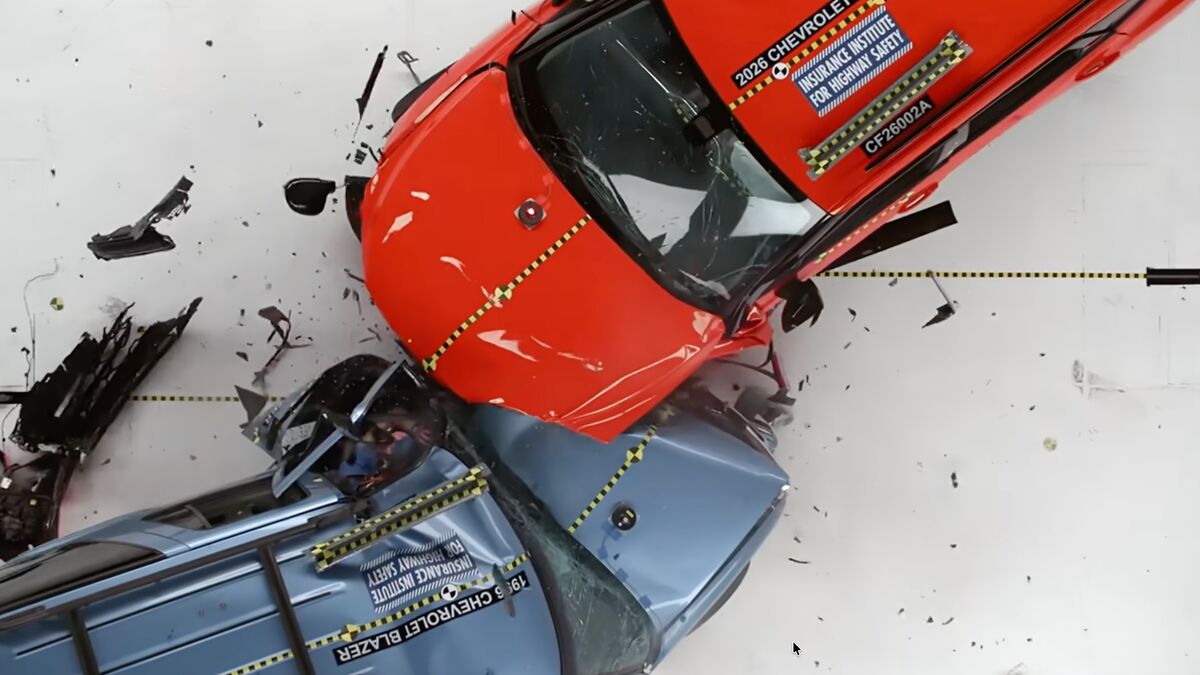
If you doubt it, the organization crashed a 2026 Chevrolet Blazer into a 1996 Blazer to demonstrate the changes 30 years have brought.
About the IIHS
- A nonprofit funded by insurance companies, the IIHS is known for its crash tests, which are more difficult to pass than government tests.
Many countries have crash-test programs. America has two.
One is the federal government’s National Highway Traffic Safety Administration (NHTSA). The other is the IIHS, a nonprofit laboratory funded by a group of insurance companies. Your car insurance company has a financial interest in making accidents rare and minimizing injuries when they do happen.
NHTSA, as a government agency, must follow a long and bureaucratic process to change its tests. The IIHS, privately funded, can add new tests and make the old ones harder whenever it wants.
IIHS engineers routinely toughen their standards, and the automotive industry responds. In recent years, for instance, the organization announced that cars could not win its respected Top Safety Pick and Top Safety Pick+ awards if automakers charged extra for better headlights.
Over the course of about two model years, KBB editors watched many automakers make their best headlights standard equipment so that they could claim the awards.
Recently, the organization added a child-sized dummy to the rear seats for some crash tests and began testing automatic emergency braking systems.
Decades of Improvements
- Five tests, the institute calculates, have saved about 50,000 lives.
- The return on investment for testing? $900 for every dollar spent.
The institute began its crash-testing program in 1995. To evaluate its effectiveness, researchers “examined the effects of five crashworthiness evaluations — the moderate overlap front, driver-side small overlap front, passenger-side small overlap front and side crash tests, as well as the roof-strength evaluation.”
Using real-world accident records, they then compared fatality rates for vehicles that scored Good, Acceptable, Marginal, or Poor in the tests. “Then they calculated the potential fatalities that would have occurred if the percentage of good-rated vehicles had not risen. The results showed that vehicle improvements made in response to these tests saved an estimated 48,352 lives from 1999 to 2024.”
They then used a formula used by the U.S. Department of Transportation to calculate the economic value of a human life. “By that measure, IIHS crash tests saved society $538 billion,” the researchers wrote.
It had about $600 million in funding during that period – roughly $900 saved for every $1 spent.
Seeing It in Action
- Crashing a 1996 vehicle into a 2026 vehicle makes the numbers visceral.
To show the impact of the numbers, researchers crashed a 1996 model year Chevrolet Blazer into its 2026 equivalent.
“The driver of the new Blazer would likely have walked away with bumps and bruises. The driver of the 1996 model would have suffered serious, potentially fatal injuries,” they note.
“The occupant compartment of the 2026 model remained intact. All but one of the injury measurements taken from the driver dummy showed minimal injury risk. The risk of injury to the driver’s right foot or lower leg was a little elevated but still in the acceptable range.”
In the older model, the impact crashed much of the cabin, “pushing the dashboard and steering column into the dummy’s lap. The fully inflated airbag hit the dummy in the chin, snapping its head back and toward the window.”
The dummy’s head detached, though the researchers note, “this isn’t likely to happen to a human driver.”