
- NHTSA updated its 5-star testing protocol to include the efficacy of driver-assist systems such as blind-spot monitoring.
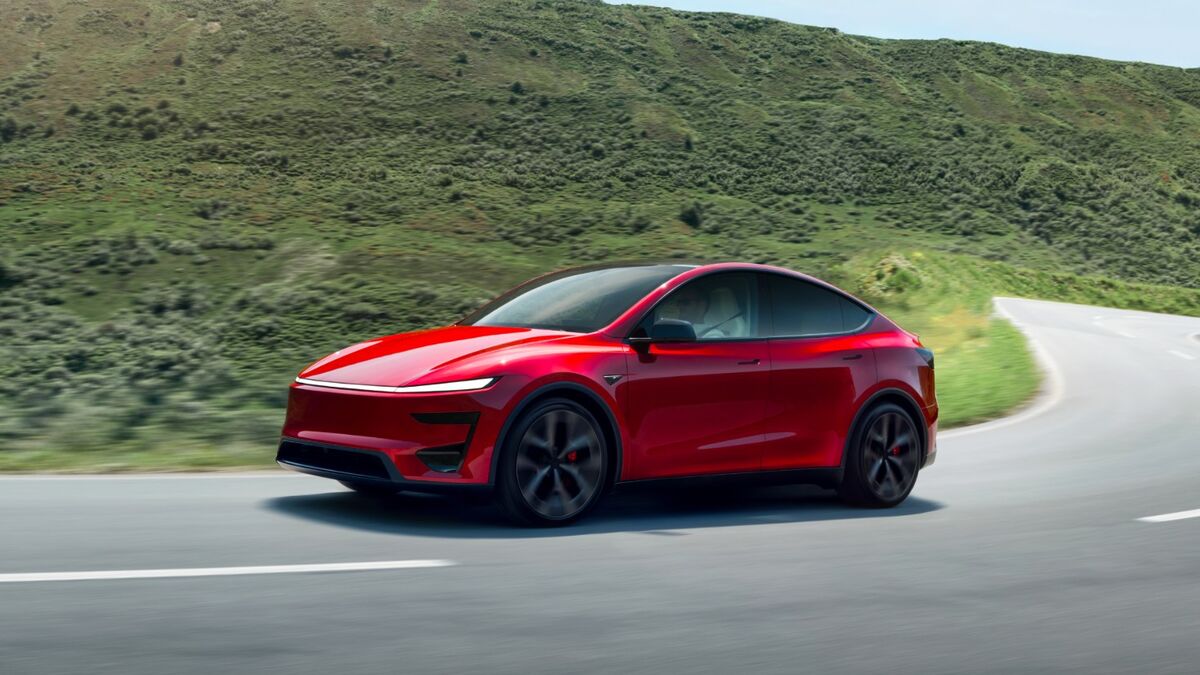
- 2026 Tesla Model Y is the first vehicle to pass the new criteria.
- The more detailed safety testing is still behind safety testing from the IIHS.
The 2026 Tesla Model Y is the first vehicle to pass a new series of tests administered by the National Highway Traffic Safety Administration (NHTSA), the federal safety agency announced Thursday. Four new tests addressing the efficacy of driver-assist systems such as pedestrian automatic emergency braking mark the first meaningful changes to the U.S. government’s 5-Star safety rating in a decade.
For the past 20 years, the 5-star rating system, also known as the New Car Assessment Program (NCAP), has been mandated on new car Monroney window stickers to show shoppers a vehicle’s relative safety based on crash tests. The four key crash tests measure two different side impact tests, a front impact test, and a rollover test. Most new vehicles earn the 5-star rating.
Now, in an effort to keep up with technology, NHTSA measures the systems intended to mitigate or prevent crashes. The aim of such technology, collectively called advanced driver assistance systems (ADAS), is to cut down on the nearly 40,000 vehicular fatalities occurring on U.S. roadways annually.
Versions of the Tesla Model Y made after Nov. 12, 2025, are the first but certainly not the last to pass the new tests, which are issued on a pass/fail rating.
“By successfully passing these new tests, the 2026 Tesla Model Y demonstrates the lifesaving potential of driver assistance technologies and sets a high bar for the industry,” NHTSA Administrator Jonathan Morrison said in a statement. “We hope to see many more manufacturers develop vehicles that can meet these requirements.”
What Do the New ADAS Tests Consist Of?
The ADAS assessed in the new battery of tests include the following four technologies prevalent as standard equipment on many new cars:
- Pedestrian automatic emergency braking: This version of automatic emergency braking also detects pedestrians, since pedestrian fatalities have increased the most in recent years. Sensors at the front of the car detect an imminent impact with a vehicle, cyclist, and pedestrian, and trigger the emergency braking system to stop the car without intervention from the driver. Most new cars have automatic emergency braking, which the U.S. government has mandated in new cars starting in 2029.
- Lane keeping assistance: Also known as lane-change or lane-centering assist, this technology stops the vehicle from drifting out of its lane by gently correcting the steering, braking, or accelerating to keep the vehicle in its lane.
- Blind spot warning: Also known as blind-spot monitors, the system alerts a driver through audio, visual, or haptic feedback when another vehicle is approaching in the driver’s blind spot. It’s intended to prevent the driver from an unsignaled lane change into traffic.
- Blind spot intervention: An enhancement from blind-spot warnings, this system will actually prevent the driver from ignoring the blind-spot warning and gently apply the brakes or steering wheel to prevent the driver from changing lanes.
Until now, the technology had only been recommended by NHTSA. Next year, two more tests will be added for automatic emergency braking, and pedestrian versions of the same test at both day and night.
How Does NHTSA Testing Relate to IIHS Testing?
NHTSA’s testing follows the lead set by the nonprofit Insurance Institute for Highway Safety (IIHS). Funded by the insurance industry, the independent IIHS issues the industry’s most coveted safety awards, dubbed Top Safety Pick (TSP) and Top Safety Pick+ (TSP+). The criteria to earn those awards change every other year or so as more automakers’ vehicles fall into compliance. Currently, the IIHS conducts eight tests, including two for automatic emergency braking with vehicles and pedestrians in day and night, as well as at different speeds.
Since testing such vehicle systems is expensive, both IIHS and NHTSA test a limited number of new or redesigned high-volume selling vehicles each year. For the 2026 models, which can number anywhere from 250 to 350, depending on nameplate classifications, NHTSA plans to crash-test 39 models; it will only test the ADAS on 10 models, in addition to the 2026 Tesla Model Y, which is not only the best-selling EV but one of the top 10 selling vehicles in the U.S.
Why Tesla?
Tesla has been under fire from NHTSA for its controversially named Full Self-Driving (FSD) moniker for its autonomous drive system, which relies on many of the technologies underpinning ADAS. Currently, more than 3.2 million Tesla vehicles with FSD are under investigation by the NHTSA for unreliable visibility in fog, dust, or with sun glare. Unlike many rival semi-autonomous or autonomous systems, Tesla relies solely on cameras and not more expensive radar or lidar detection. Essentially, NHTSA is probing if the system can tell when it can’t see. The current engineering analysis is often the last step before a recall.
The updated testing is mirrored by a new look on NHTSA’s website.