
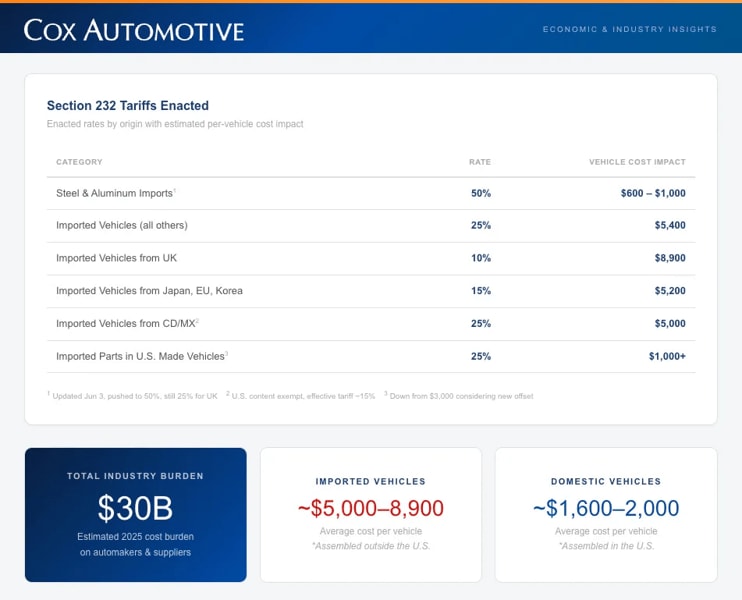
- In the first full year, tariffs cost the automotive industry an estimated $30 billion.
- The average price increase for an imported car is now $5,000 to $8,900 compared to last year.
- The average price increase for a vehicle assembled in the U.S. is now $1,600 to $2,000 compared to last year.
In the year since the Trump administration’s tariffs were imposed, the automotive industry has incurred an estimated $30 billion in additional costs, according to data released Monday by Kelley Blue Book parent Cox Automotive. Those costs have been passed on to consumers and dealers, with the average suggested retail price increasing 10.4%.
Imported vehicles have seen the highest rise in pricing, estimated to be $5,000 to $8,900 per vehicle. Domestic vehicles are not exempt from the tariff burden. Due to tariffs on supply imports, such as steel and aluminum, domestic vehicle costs have increased $1,600 to $2,000 per vehicle.
On the sunny side of Section 232 of the Trade Expansion Act of 1962, more automakers are investing in domestic production.
“[Automakers] aren’t shifting production out of goodwill — the tariff made the alternative unsustainable,” wrote Jonathan Gregory, Senior Director, Economic and Industry Insights at Cox Automotive.
Relief Might Be Long Way Off
Price relief might be a long way off since the tariffs have no sunset clause. That means they can’t be revoked until the next president takes office, the Trump administration changes its mind, or there is some sort of court action.
The comprehensive report quantifies what many people have been asking about the net effects of the controversial tariffs on consumer products and, specifically, cars. For the first time, who’s paying what is becoming clearer, though still murky.
Automakers had been folding in some of the tariff costs into destination fees, which are tacked on to the sales price of new cars but can evade the marketing of a new car price. Earlier this month, we reported on destination fees of 2026 model reaching new highs, including a $2,795 fee on most full-size trucks and SUVs produced by GM and Ford. GM in particular increased destination fees 40% in one year on the popular Chevrolet Silverado. Based on sales volume from 2025 to 2026, that fee increase on the Chevy Silverado and GMC Sierra would net GM $748.8 million in extra revenue.
Even though the list price has increased 10.4%, consumers are paying just 5.9% more. That’s based on a 37-week window measuring the price differences between model year 2025 and 2026 vehicles. Dealers have absorbed the other 4.5% through “dealer negotiation and competitive pressure.” In other words, discounts, according to Gregory. This is even more prominent for dealers of imported cars.
Few Affordable New Cars
In addition to higher prices across the board, the result is more pressure and less availability of affordable new cars. And that problem is expected to continue.
“Entry-level buyers are being structurally pushed to the used market,” Gregory reported. “No [automaker] is investing in a domestically assembled vehicle priced to fill the affordability gap.”
On the flip side, more automakers are committing and investing in domestic production. Domestic production increased 4.9% in the measured time frame, rising to 54.4% of domestic production of all new cars sold.
Toyota and Stellantis recently announced multi-billion dollar investments in the U.S., and automakers such as Honda and Hyundai are maximizing U.S. production at existing facilities. Those investments typically take years to bear fruit, or cars, so it remains to be seen if the 25% tariff is a net positive and for whom in the longer term.
“The 25% tariff has achieved its stated goal of incentivizing domestic production,” Gregory said. “The cost of that achievement — higher prices, fewer choices, and a shrinking affordable market — is now measurable in the data.”