
- Infiniti will launch four new models, one each year until 2030.
- Nissan’s premium brand turnaround includes a hybrid SUV and two body-on-frame SUVs.
- Infiniti Q50 sports sedan returns in 2027.
Infiniti is back. That’s the messaging for Nissan’s premium brand as it expands from two core models to five over the next few years, aiming to nearly double volume by 2030 after years of contraction.
The company plans four new models, including a sports sedan inspired by the new Nissan Skyline, exclusive to the Japanese market; a hybrid SUV related to the forthcoming Rogue Hybrid; and two more rugged 2-row and 3-row SUVs with a truck-like body-on-frame platform. The planned cadence is one new vehicle every year.
So why now, and what happened?
“There were many mistakes,” Nissan President and CEO Ivan Espinosa explained to a roundtable of journalists at the brand’s headquarters in Yokohama, Japan, on Tuesday. One was creating a dedicated vehicle architecture with the expectation that sales would jump in two years from 100,000 vehicles annually to 250,000 units. “It was a bit of a wild bet, I will say.”
A second mistake was a “lack of continuity and consistency in product and investment,” said Espinosa, who has worked for Nissan for more than 20 years and was promoted as CEO last April to helm the turnaround. After some shaky financial years, the shuttering of factories, layoffs of 20% of the workforce, failed merger talks, and rumors of bankruptcy, Infiniti suffered.
“One of the casualties was Infiniti,” Espinosa said.

Just Two Models Today, but Growth has Returned
Down to just two models, the best-selling QX60 3-row SUV and the QX80 full-size SUV, Infiniti sold 52,846 units in 2025. However, the worst appears to be behind Infiniti, which claimed 18 consecutive months of growth to end 2025. In five years, Infiniti executives expect sales to nearly double, with an annual target volume of 100,000 units in the U.S. in 2030.
Nissan’s new plan incorporates mixed powertrains, more shared architecture, and, most notably, a recommitment to more rugged body-on-frame platforms. Infiniti will launch five new models, one per year, starting with the QX65 SUV on sale now.
“We will have a minimum of five cars in the store, which is the minimum we need to grow Infiniti back again,” Espinosa said. “Then maybe we’ll invest more.”
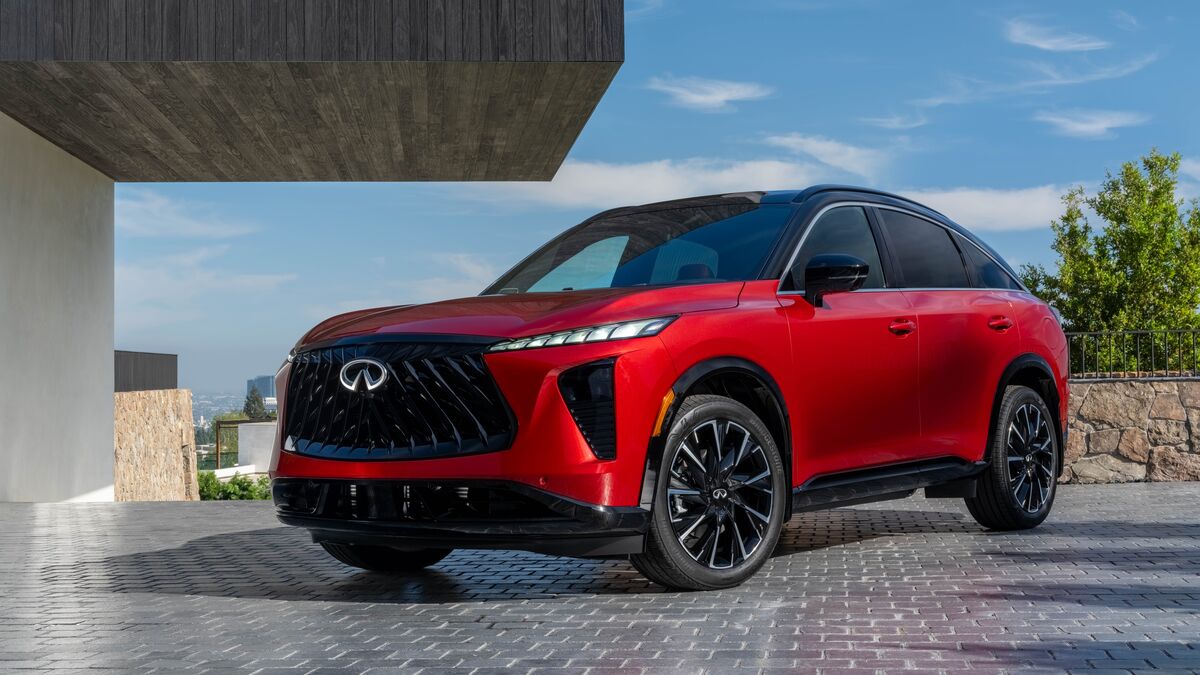
Infiniti’s growth strategy starts this spring with the QX65 SUV.
Infiniti QX65
New in body style only, the QX65 is essentially a sportier-looking version of the QX60 with two rows of seats instead of three. Evoking the sporty, rear-drive FX35 from Infiniti’s past, the QX65 copies German automakers such as BMW in rounding off the roofline in the way of the X6 to the boxier X5. The five-seat SUV shares the same 268-horsepower turbocharged 2.0-liter 4-cylinder engine with variable compression.
Infiniti Q50
The company launched its Q50 midsize sedan in 2014 and discontinued it after two generations in 2024, another casualty of the waning interest in sedans in the U.S. Yet, it was a sporty sedan that helped launch Infiniti in the U.S. in 1989 with the Q45. Technically a full-size sedan rivaling the Lexus LS as well as the BMW 7 Series, the Q45 put Infiniti on the map with its 278-hp V8 and active suspension. The Q50, arriving in the U.S. in 2027, will share much with the latest Nissan Skyline teased during the Nissan Vision press event this week. Exclusive to the Japanese market but bearing one of Nissan’s most venerated nameplates (even though it was started by Prince Motor Company in 1957 before Nissan acquired it in 1967), the 14th-generation Skyline will likely have the 420-hp twin-turbo 3.0-liter V6 that currently powers the Nissan Z Nismo sports coupe. Expect that powertrain to carry over to the top end of the new Q50, probably a 2028 model.
Infiniti QX50
Infiniti discontinued the underwhelming QX50 and related QX55 early in 2025. The lack of a compact SUV, which is the most popular model by volume for car shoppers, might be Infiniti’s most glaring absence. The next QX50, expected to arrive in 2028, should be a luxury version of the new Nissan Rogue Hybrid, which debuts the brand’s third-generation e-Power hybrid system in the U.S.
A hybrid version of the QX50, or an entirely new model, would certainly stand out. The Acura RDX, Lincoln Nautilus, and Volvo XC40 lack hybrid options without a plug, leaving the Lexus NX to stand alone as a hybrid compact SUV.
2-Row SUV and 3-Row SUV
The least detailed but possibly most exciting development at Infiniti in the next few years will be the introduction of two new body-on-frame vehicles based on the resurrected Nissan Xterra, which returns in 2028 with both new V6 and V6 hybrid options. Unlike more comfortable unibody SUVs such as the QX60, a body-on-frame, or “frame,” vehicle has a more durable, adaptable construction suited for off-roading, towing, and other heavy-duty activities. These two new vehicles, one with two rows of seats and the other with three rows, will be smaller than Infiniti’s only current body-on-frame model, the QX80 full-size SUV, which has three rows.
Nissan will build both alongside the Xterra in Nissan’s Canton, Mississippi, plant, where it builds the Frontier midsize truck and built the Titan full-size truck until its 2024 discontinuation. That plant once planned to build new EVs, starting in 2028, but those plans have changed.
If the plans for this product mix remain on track, the lineup would reach seven models, not the five core models that Infiniti executives see as the optimal product mix.
As to which of the four midsize SUVs, including the QX60 and QX65, will make the cut long term, that’s up to the customer. “Not all four of them will coexist,” Ponz Pandikuthira, Nissan senior vice president, chief product and planning officer, said in a separate discussion. “They may at the beginning, but then we’ll let the market decide.”