
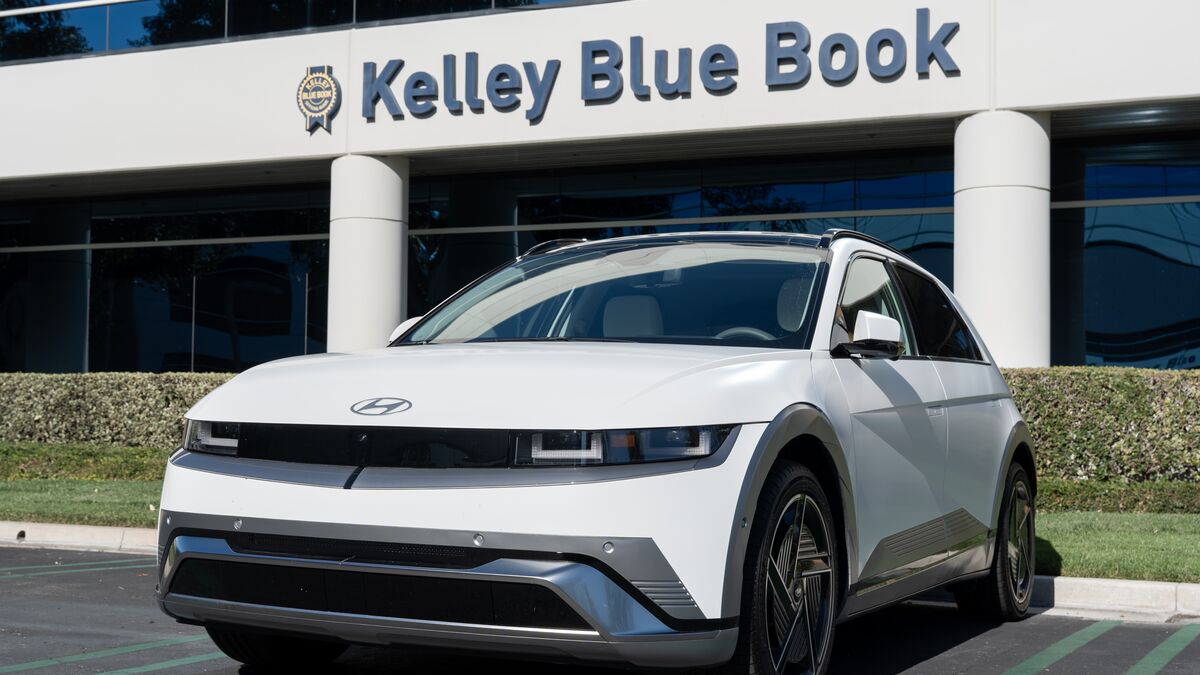
Kelley Blue Book Senior Editor Mike Danger has a growing family. Honestly, we’re not sure how he manages to balance his work and home lives so seamlessly. He recently took a long road trip in a 2026 Hyundai Ioniq 5, Kelley Blue Book’s 2026 Electric Vehicle Best Buy award winner. Ride along with Danger and his family, and he’ll share tips and tricks for managing your EV experience.
What Is the Hyundai Ioniq 5?
The 2026 Hyundai Ioniq 5 is a 2-row EV SUV. It’s available in five trim levels: SE Standard Range, SE, SEL, Limited, and XRT. All of the trims share the same basic dimensions. The differences come in the battery capacity and range, driven wheels, and other features. The base trim SE Standard range comes with a 63-kWh lithium-ion battery and a 245-mile range estimate, while the SE, SEL, XRT, and Limited have an 84-kWh battery and a 318-mile range estimate with rear-wheel drive (RWD). All-wheel drive (AWD) is available on SE, SEL, and Limited, and standard on XRT. “One of my favorite unexpected features was the outlet below the rear seat that let me plug in AC-powered gadgets,” said Danger. This outlet, standard on the top-trim Limited model, is what’s known as vehicle-to-load (V2L) capability, a benefit EV owners learn to cherish.
The Danger family found the Ioniq 5’s charging capabilities to be an asset on a road trip. Thanks to Hyundai’s 800-volt EV architecture, the Ioniq 5 can use DC fast charging stations at effectively double the charging speed of older 400-volt systems. “And it’s cool that the Ioniq 5 has an NACS charging port so it can use the Tesla Supercharger network,” said Danger. NACS is the North American Charging System. Several manufacturers, including Hyundai, have adopted NACS compatibility over the past two years, making road trips much easier with faster, more abundant charging stations. Using the NACS connector on an Ioniq 5 SE Standard Range at a 150-kW DC fast charging station, you can go from 10 – 80% charge in 24 minutes. Not fast enough for you? If you can find a 250-kW charging station with a CCS plug, you’ll juice up from 10 – 80% in 20 minutes. Compare those figures to the 5 hours 40 minutes of charging time at Level 2. While you can still fill up a conventional gas tank in five minutes, the gap is closing. A 20-minute stop for charging seems reasonable on a road trip, where a family might spend that much time at a rest stop and on a snack shopping spree, regardless of how they fuel their vehicle.
New 2026 Hyundai IONIQ 5 Prices
|
Retail Price
|
Fair Purchase Price (22314)
|
|||
|---|---|---|---|---|
$36,600 |
$36,600 |
|||
$39,100 |
$38,200 |
|||
$41,400 |
$40,700 |
|||
$46,675 |
$46,200 |
|||
$47,875 |
$47,500 |
|||
$48,325 |
$48,000 |
How Many People Can the Ioniq 5 Carry?
The Ioniq 5 has seating for five. Danger’s family, as you saw in the video, installed a rear-facing child seat and a front-facing booster in the second row, using the Lower Anchors and Upper Tether Anchor LATCH connectors for safe operation. You should be able to fit a weekend’s worth of luggage and accessories for five people in the 26.3 cubic feet of space behind the second row. “I was impressed with the interior space and cargo room in the Ioniq 5,” said Danger. “We were able to fit a good amount of stuff without feeling cramped. And I only forgot to pack a few things we needed to stop and get along the way.”
How Much Does It Cost to Drive an Ioniq 5 Per Mile? Is That Cheaper Than Gas?
Average charging costs vary from state to state. It’s almost always cheaper to charge at home than at a public charging station. “I try to plan ahead and charge at home overnight before we leave for a long drive,” Danger says. “Not only does it make the first part of our trip easier, but it also saves us money.”
As of May 27, 2026, electricity costs average $0.417 per kWh at public charging stations in the U.S., according to AAA. The Hyundai Ioniq 5 SEL (the extended-range model) has an 84 kWh battery capacity, so charging it from empty to 100% would cost about $35. The EPA reports that the all-wheel drive (AWD) Ioniq 5 has a range of up to 290 miles. Some quick math says that’s about $0.12 per mile.
For a rough comparison, the 2026 Chevrolet Equinox with front-wheel drive (FWD) is a gas-powered car that’s about the same size as the Ioniq 5. It uses 87-octane (regular) gas, which the AAA says averages $4.459 per gallon on May 27, 2026. The Equinox has a 14.8-gallon gas tank, which would cost about $66 to fill from empty. If we calculate the Equinox’s range based on its highway fuel economy of 29.0 mpg, it should be able to travel up to 429 miles on a full tank of gas. A quick calculation shows it to be about $0.15 per mile, or 25% higher than the Ioniq 5 can travel on electricity.
Stretching this calculation to its limit, our hypothetical 1,000-mile road trip in a 2026 Ioniq 5 would cost about $120 in electricity using only public charging stations. It would cost about $150 in gas in the 2026 Chevrolet Equinox.
In California, where both gas prices and charging rates are high, the 1,000-mile trip in the Equinox would use gas at $6.094 per gallon for a per-mile cost of $0.21 and a trip total of $210, while the Ioniq 5 would use electricity at $0.464 per kWh for a per-mile cost of about $0.13 per mile or $130 for the trip. The gas trip is 38% more expensive than the EV trip in this case.
Which EVs Compete With the Hyundai Ioniq 5?
While the Ioniq 5 was a good choice for Danger and his family on this road trip, there are other EV options. The Tesla Model Y is a popular choice. In RWD form, it has a longer range (321 miles) and more cargo space than the Ioniq 5 (74 vs. 58.5 cubic feet with the second row folded flat), but it starts at $41,630, including destination and order fees, which is over $5,000 higher than the Ioniq 5’s starting price. Other competitors include the Kia Niro EV, Ford Mustang Mach-E, and Chevrolet Equinox EV.
We always point to Hyundai’s warranty when we discuss the Ioniq 5. The basic 5-year/60,000-mile warranty is just the start. A 10-year/100,000-mile limited powertrain warranty and a 10-year/100,000-mile battery warranty set the standard and should provide peace of mind for potential buyers.
Hyundai builds the 3-row Ioniq 9 for families who have outgrown the Ioniq 5. Who knows? Maybe the Danger family will need more space for their next EV road trip.
| 2026 Hyundai IONIQ 5 | |
| Popular Powertrains | |
| Drive Wheels | RWD |
| Range | 245 miles |
| Charging Time | 6.3 hours |
| Towing Capacity | N/A |
| Payload Capacity | N/A |
| Ground Clearance | 6.1 inches |
| Horsepower | 168 hp |
| Torque | 258 lb-ft |
| Specs | |
| Basic Warranty | 5 years/60,000 miles |
| Powertrain Warranty | 10 years/100,000 miles |
| Battery Warranty | 10 years/100,000 miles |
| NHTSA Overall Safety | Not rated |
| Max Seating Capacity | 5 |
| Wheelbase | 118.1 inches |
| Overall Length | 183.3 inches |
| Width With Mirrors | 74.4 inches |
| Width Without Mirrors | N/A |
| Height | 63.0 inches |
| Turning Diameter | 39.4 feet |
| Headroom, Front | 39.8 inches |
| Headroom, 2nd Row | 38.7 inches |
| Headroom, 3rd Row | N/A |
| Legroom, Front | 41.7 inches |
| Legroom, 2nd Row | 39.4 inches |
| Legroom, 3rd Row | N/A |
| Shoulder Room, Front | 57.7 inches |
| Shoulder Room, 2nd Row | 57.7 inches |
| Shoulder Room, 3rd Row | N/A |
| Cargo Behind Last Seat | 26.3 feet |
| Cargo Behind Second Seat | N/A |
| Cargo With All Seats Down | 58.5 feet |
| Available Bed Lengths | N/A |
Specification table reflects the typical configuration of vehicles shown.