

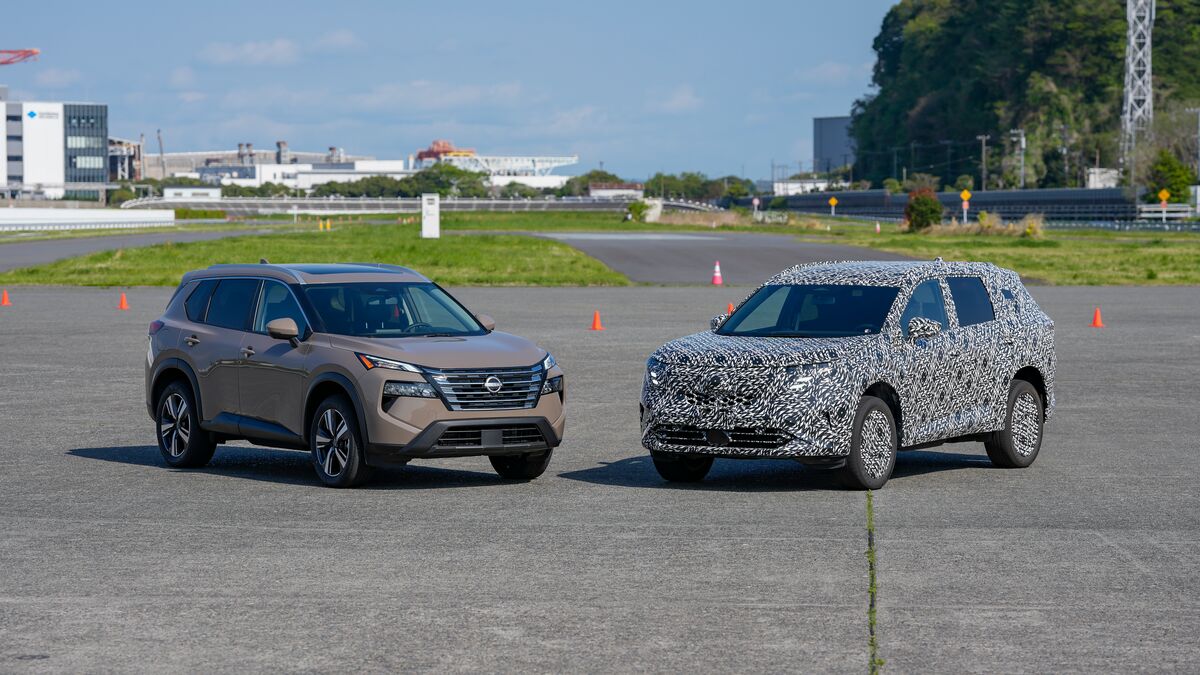
- First drive in two controlled laps at Nissan’s test facility showed a smoother, quieter Rogue.
- The 2027 Nissan Rogue Hybrid goes on sale this fall, alongside the existing gas-only Rogue.
- Nissan’s third-generation e-Power hybrid system makes its debut in North America.
Nissan is catching up. When the new 2027 Nissan Rogue Hybrid goes on sale this fall, the brand’s bestseller will finally be able to square off against segment-leading compact SUVs such as the Toyota RAV4 and Honda CR-V Hybrid. That’s just the tip of the sales peak, though. Hybrid versions of the Hyundai Tucson, Kia Sportage, Jeep Cherokee, Subaru Forester, and even the Mazda CX-50 pose existing challenges for the new Rogue. Can it compete?
In a brief first drive consisting of two laps in Nissan’s Grandrive test facility in Oppama, Japan, last week, the new Rogue Hybrid proved to be a quieter, smoother, more refined Rogue. The short answer is yes. If Nissan can deliver 40 mpg at about $35,000, it’ll be priced right and could deliver a driving experience unlike that of its rivals.
“We’re coming late to the party, so we better offer something others don’t have,” Nissan’s Ponz Pandikuthira, Senior Vice President, Chief Product & Planning Officer, explained to Kelley Blue Book. He estimated a target price of $35,000, without destination fee, when it goes on sale this fall.
“Some of this is nuanced, but if you want a sophisticated hybrid that feels like an EV but isn’t tied to the grid, there’s no one else offering that,” he added.
Mechanically, the 2027 Nissan Rogue Hybrid e-Power is different than rivals, but don’t let the e-Power bit confuse you. This does not require a plug. You fill it at a gas station with unleaded fuel just like every other hybrid crossover except for the CX-50, because Mazda recommends premium gas.
The “e-Power” is just more e-marketing, like the brand’s e-Pedal regenerative braking system that provides one-pedal driving, similar to an electric vehicle (EV). That’s different than most other hybrid SUVs, too, but more on that later. We don’t want to e-xhaust you.

Nissan’s Hybrid e-Power System
What’s different about Nissan’s e-Power hybrid system? It’s a series hybrid, which means that the engine never powers the wheels directly. Instead, it acts as a generator for the small 2.1-kWh battery, which then feeds two electric motors, one driving each axle. Thus, all-wheel drive (AWD) is standard. Rivals use a parallel setup, which basically means power comes from the motors at low speed, the engine at high speed, and a blend of both at certain thresholds.
The series hybrid system also differs from an extended range electric vehicle (EREV) such as the old Chevy Volt, and it’s different from the 2026 Nissan Rogue PHEV (plug-in hybrid) that launched earlier this year. No plug means no worries, in a way.
The idea with a series hybrid is that you get the jolt of torque off the line as in an electric car, greater efficiency around town when the engine runs less, and yet it has the long-distance convenience of a gas car.
In our back-to-back testing of the 2026 Nissan Rogue, the new Rogue Hybrid proved quicker and more responsive. It won’t take your breath away, but there’s also none of the lag you get in the 201-horsepower turbocharged 1.5-liter 3-cylinder engine in the gas-only Rogue.
The Rogue Hybrid e-Power will use a new, modified version of that engine but without variable compression. Even though Nissan touts its Hybrid e-Power system as a third-generation iteration, this version was made for the U.S. market. The same system was launched in the European market last year in the Nissan Qashqai.
Nissan claims the largest-capacity rear motor in the segment, but official specs haven’t been released to corroborate that claim.
Efficient, But How Efficient?
Changes to the thermal efficiency, as well as a larger turbocharger in the 3-cylinder, delivered low engine noise at both low and cruising speeds.
The changes also portend greater efficiency. The front-wheel-drive (FWD) Qashqai rates 52 mpg equivalent on the European testing cycle, which is notoriously generous compared to U.S. EPA ratings.
The downside of a series hybrid compared to a more mechanically complex parallel hybrid system is that it is less efficient at highway speeds.
“I know we’ll do at least 40 mpg in urban driving conditions,” Pandikuthira told us in an interview. “The combined [fuel economy] might be 38 or 39 mpg.”
The gas-only Rogue has a continuously variable automatic transmission (CVT) that routes power to the front wheels for an impressive EPA-rated 32 mpg combined, or all four for 31 mpg.
And Somehow More Dynamic?
The Rogue Hybrid has an electronically controlled transmission, so the control modules redistribute torque both between the axles and then again via torque vectoring at each wheel to optimize traction.
During our pair of laps, the Hybrid seemed more planted on a couple of higher-speed downhill turns, but the sample size was small. In both vehicles, there was enough body lean to remind you that you’re in a tall-riding SUV.
The new platform for the Rogue Hybrid appears to be larger than the current Rogue, but that’s only by the eyeball test. The interior was blanketed in black cloth, so the only visible bits were a new piano-key gear selector at the base of the center stack instead of the mouse-like gear controller in the console of the current Rogue.
An additional advantage of the dual-motor AWD setup is how the regenerative braking system acts to limit both squat on brisk starts and dive during hard braking. It felt slightly more even in those instances than the gas-only Rogue.
One-Pedal Driving in the Nissan Rogue Hybrid
Even though it’s not an EV like the brand’s discontinued Ariya or the redesigned Nissan Leaf, which won Kelley Blue Book’s Best New Model for 2026, the Rogue Hybrid features Nissan’s convenient one-pedal driving function. Activate the e-Pedal button, and the Rogue can come to a full stop without ever touching the brake. This also recharges the battery, limiting fuel use and saving you money. The “B” setting in the gear panel also acts as a more aggressive regen-brake setting.
When the vehicle comes to a stop, the hydraulic brakes activate to keep it stopped, so you don’t have to. It’s a small thing, but commuters in stop-and-go traffic should appreciate it.
| Base Hybrid AWD Model | Price with Destination Fee | Combined MPG |
| 2026 Toyota RAV4 LE AWD | $34,750 | 43 mpg |
| 2026 Honda CR-V AWD Sport Hybrid | $38,580 | 37 mpg |
| 2026 Hyundai Tucson Hybrid Blue SE (AWD standard) | $34,050 | 38 mpg |
| 2026 Kia Sportage Hybrid S AWD | $34,285 | 35 mpg |
| 2026 Ford Escape Hybrid Activ AWD | $33,245 | 39 mpg |
| 2026 Mazda CX-50 Hybrid Preferred (AWD standard) | $36,645 | 38 mpg |
| 2026 Subaru Forester Hybrid Premium (AWD standard) | $36,180 | 35 mpg |
| 2026 Jeep Cherokee (AWD standard) | $36,995 | 37 mpg |
The 2027 Nissan Rogue Hybrid arrives late to the market, especially given spiking gas prices now. In addition to competing with the Jeep Cherokee, Toyota RAV4, and Honda CR-V Hybrid, it’ll also have to contend with the Subaru Forester Hybrid, Mazda CX-50 Hybrid, and hybrid and plug-in hybrid versions of the Hyundai Tucson and Kia Sportage.
If Nissan can get the AWD Rogue Hybrid (and drop the e-Power confusion) to 40 mpg and start it around $35,000, its late arrival will be easy for shoppers to forgive.