
The first few examples of something are rarely the peak of the form. I had to tell myself this over and over as I drove the 2026 Hyundai Ioniq 9 Calligraphy.
There are very few 3-row electric vehicles (EVs) outside the luxury class. The Ioniq 9, the angular Kia EV9, and the quirky Volkswagen ID. Buzz are pretty much the whole class, unless you want to spend Cadillac Vistiq/Rivian R1S money. The Toyota Highlander, now all-electric, will hit dealerships soon.
That may be the entire field of 3-row EVs for quite some time, as Ford, General Motors, and others have paused their own plans after the end of federal EV tax incentives.
So I wouldn’t expect the Ioniq 9 to check nearly every box. It’s too early for automakers to be really good at making these.
And yet.
A week in Hyundai’s all-new 3-row electric SUV left me deeply impressed. I drove it around the Washington, D.C. metro area, including some highway driving and plenty of time in traffic, and walked away thinking the Ioniq 9 feels like the product an automaker makes after years of refinement in a new class. For a freshman effort, this is stunning work.
Which Trim Level
Hyundai builds the Ioniq 9 in six trim levels. My tester was the Calligraphy model, usually Hyundai’s top-of-the-line, deluxe-with-everything variant. For 2026, the company will also sell a limited number of Calligraphy Design models with unique wheels for a slightly higher price, and for 2027, the Black Ink takes the Calligraphy to new heights of style and equipment.
While the Calligraphy is mostly a matter of high-end materials and creature comforts, I should note that it seats only six, thanks to a pair of second-row captain’s chairs. Those who need seating for seven will need to select the SEL or a lower model, as those come with a second-row bench seat.
New 2026 Hyundai IONIQ 9 Prices
|
Retail Price
|
Fair Purchase Price (92620)
|
|||
|---|---|---|---|---|
$60,555 |
$58,700 |
|||
$64,365 |
$61,900 |
|||
$67,920 |
$65,900 |
|||
$72,850 |
$71,100 |
|||
$76,590 |
$74,600 |
|||
$78,090 |
$75,700 |
Favorite Feature
Cars are design objects. Some drivers care little about looks or just want a car that attracts little attention. Some of us, however, want a car that feels unique.
Since the 2021 introduction of the Ioniq 5, Hyundai has consistently done some of the most interesting design work in the automotive industry – particularly with its EVs.
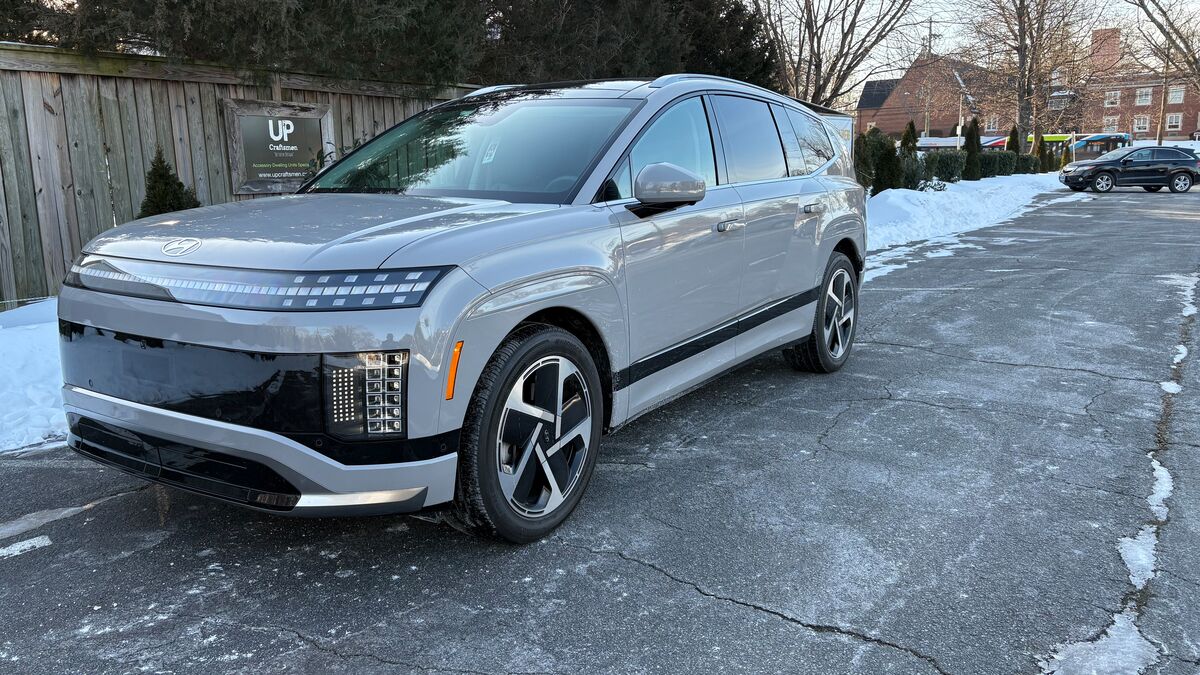
You could never mistake the Ioniq 9 for a competitor. In a year when most SUVs are boxy and rugged, designed to look at home with a rooftop tent and a bike rack, the Ioniq 9 looks like a Star Trek shuttle.
Pixelated exterior lighting gives it an 8-bit sense of humor.
That special feeling carries over into the cabin, where two-color seating (green and dove gray in my tester) and a dashboard material that looks a bit like countertop granite lend it a design flair you just don’t find in most competitors.
What It’s Like to Drive
I had the Ioniq 9 during a historic snowstorm that paralyzed much of the DC region. It didn’t slow me down at all. Standard all-wheel drive (AWD) and the evenly distributed weight you get from a large battery under the floor of an EV made it stunningly grippy on icy roads.
The weather limited my ability to test the car in every drive mode. From testing other Hyundai EVs, I know that the company’s drive modes are typically quite granular – Sport feels radically quicker than Normal, while Eco helps stretch the battery.
But icy roads let me confidently tell you that the Ioniq 9 is unusually sure-footed in the snow.
The Calligraphy model’s 422-horsepower powertrain may be overkill for many buyers – the mid-range 303-hp powertrain is likely more than enough.
Braking is confident and progressive, and handling is light for such a big vehicle.
Interior Comfort and Technology
From the driver’s seat, the Ioniq 9 is comfortable. Hyundai’s H-Tex upholstery isn’t real leather, but it is one of the most convincing faux leather materials on the market. Even the base S model gets heated front seats. In SEL and Calligraphy versions, they’re also ventilated.
The driver faces a pair of 12.3-inch screens: one for the driver’s instruments and the other a central touchscreen, mounted together one a single curved surface. It gives the cabin a sophisticated look, but leaves the steering wheel blocking your view of portions of the screen.
I appreciated a pair of wireless phone chargers. Passengers did, too.
Second-row captain’s chairs include an extendable ottoman. They’re heated and ventilated as well.
Storage nooks are everywhere, including a smart center console with a drawer usable by second-row passengers.
The third row, however, is much smaller and likely suitable only for small children.
Limitations
One minor complaint: the Ioniq 9’s unique tapered shape limits rearward visibility. The view in the rearview mirror shows as much of the interior trim as it shows of the road behind.
Key Considerations
The Ioniq 9 sits in a very small class, and its main competitor, the Kia EV9, is a close cousin that uses many of the same parts. If you’re shopping for a 3-row EV in 2026, you are quite likely to end up test-driving these two. Buyers should be aware that, while they are styled quite differently, they share the same platform.