
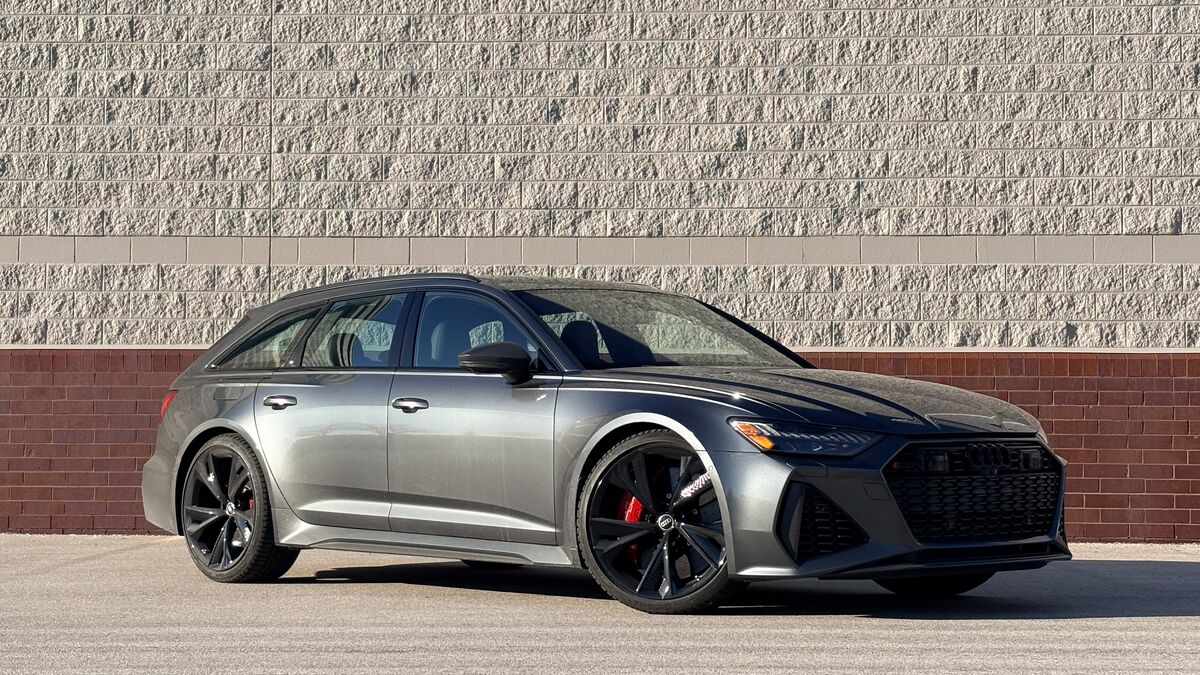
- The 2026 Audi RS 6 Avant wagon stands out for its stately utility and stunning performance.
- Our test model cost $162,865, including more than $30,000 in options.
- Despite that, the RS 6 Avant might be the best wagon money can buy.
The assignment was simple: Transport three adults and one tween with two suitcases each to the airport for a weeklong European spring break.
The problem: I had a $162,865 sports car.
The solution: The 2026 Audi RS 6 Avant performance wagon.
Everything fit. The only hiccup was the gurgled protests of two passengers during the on-ramp merge. The long nose lifted, the prodigious rear end squatted, and squeals of delight and consternation erupted, split evenly along age lines. Zero-to-60 mph in 3.3 seconds behind a roaring twin-turbo 4.0-liter V8 engine will do that.
I wasn’t trying to upset my precious cargo. We had to pass a lumbering semi. It was just a second. The car made me do it. The pedal seemed to have a mind of its own. Really.
In this trade, we’re supposed to temper our enthusiasm. To find fault in service of the potential owner. To pick nits.
Forget that. I love this car. This station wagon. If I had the means, I would buy it. If you do, and you need the utility, you really should. And if you need to store it in the Chicagoland area in the summer, I got a guy.
Winter, too. Quattro. Anytime, really.
The Twin-Turbo Beating V8 Heart of the RS 6 Avant
There’s nothing new for the 2026 model year. Audi must’ve gotten past the tariff quagmire to get the few test models out to journalists and blip the enthusiast radar before the stunning performance wagon retreats from U.S. shores.
Launched here for the 2021 model year, the RS 6 Avant Performance received a performance injection for the 2024 model year. Audi’s venerable twin-turbo 4.0-liter V8 benefited from larger turbochargers and more boost pressure, which increased the output to 621 horsepower and 627 lb-ft of torque (up 30 hp and 37 lb-ft). Coupled with a quicker shifting 8-speed automatic transmission and a slight reduction in weight, leaving the airport was a kind of takeoff of its own.
Flip it into Dynamic mode, let loose the warbling baffles on the $1,000 RS Sport Exhaust, feel the engine beat through your own heart, and the interstate passes like a runway.
Technically, the RS 6 Avant’s lone competitor, the BMW M5 Touring, is quicker to 60 mph at 3.1 seconds. But its 717-hp plug-in hybrid powertrain adds considerable weight that’s felt in the corners. That’s where the RS 6 Avant most impresses.

Grip for Days
Off the highway and onto a serpentining frontage road at dawn, the RS 6 Avant inspired track day fantasies. Glimmers of sun broke through the seasonal gloom. The asphalt was cool but the Continental SportContact 7 summer tires were warm.
With rear-axle steering and a revised center differential, the RS 6 cuts corners in the best possible way. Laying off the throttle into a turn, the amount of grip encourages a quick exit. Maybe I got too eager or maybe it was the degree of rear-axle steering, but just as the rear end started to squirrel, it snapped back in line with all four fat tires (285/30 R22s front and back) sticking firmly to the ground. On roads unencumbered by traffic, it made me want to keep pushing it without ever coming close to the thresholds you should only test on a track.
Therein lies one charm: You’ll probably exceed your own limitations before the car comes close to hitting its own.
Except for one straight-line test, I never fully tested the $9,000 ceramic brake package. It’s worth noting, however, that up front, those red 10-piston calipers clamp down on 16.5-inch ventilated rotors that are so big they could be heavy metal drum cymbals.
Bang the drum. It’s the kind of car you make excuses to drive, and go out of your way while driving.
While the ride is on the firm side, the adaptive air suspension lets you behave and function like a seemingly well-adjusted member of the community. It never comes close to teeth chattering or requiring chiro appointments. And most importantly, drive modes such as Comfort dial back the performance lurking within. The wagon looks regal and stately, so you could pull up to church or the school drop off with the whole family, and only the keenest eyes would note the big red calipers and the fat dual exhaust pipes.
The classic design extends inside, to lesser effect. On the one hand, since the wagon is essentially six years old, it lacks the panorama of screens in newer luxury models. The 12.3-inch digital instrument cluster stands out, especially with Audi’s excellent navigation graphics in its virtual cockpit. Then there’s a 10.1-inch touchscreen for media and nav that sits above an 8.8-inch touchscreen for climate controls. The issue is not all that touchy screen real estate; it’s all the surrounding gloss-black plastic.
Is the RS 6 Avant Really Worth $162,895?
One other nit: The test model had $30,000 worth of options, including a $2,000 option that included a fancy version of adaptive cruise control. C’mon, man. Then there’s the $1,300 gas guzzler tax: not an option. C’mon, G-man. If it were an SUV, it would escape such EPA mandates.
That is the biggest question: For $133,295 as the entry point, is there a better performance SUV with the same utility? Nah. For $162,865, it opens up the entire Porsche catalog, but the Cayenne Turbo GT eclipses $200,000. Both the Bentley Bentayga and the Lamborghini Urus use an iteration of this family of engine, but cost considerably more and target different demographics. Both beg for attention. The RS 6 Avant abides, until you tell it otherwise.
It’s this dual nature that makes the RS 6 Avant so appealing. From airport shuttles to Costco runs, it enables you to function like a normal person even as you conceal your true love.