

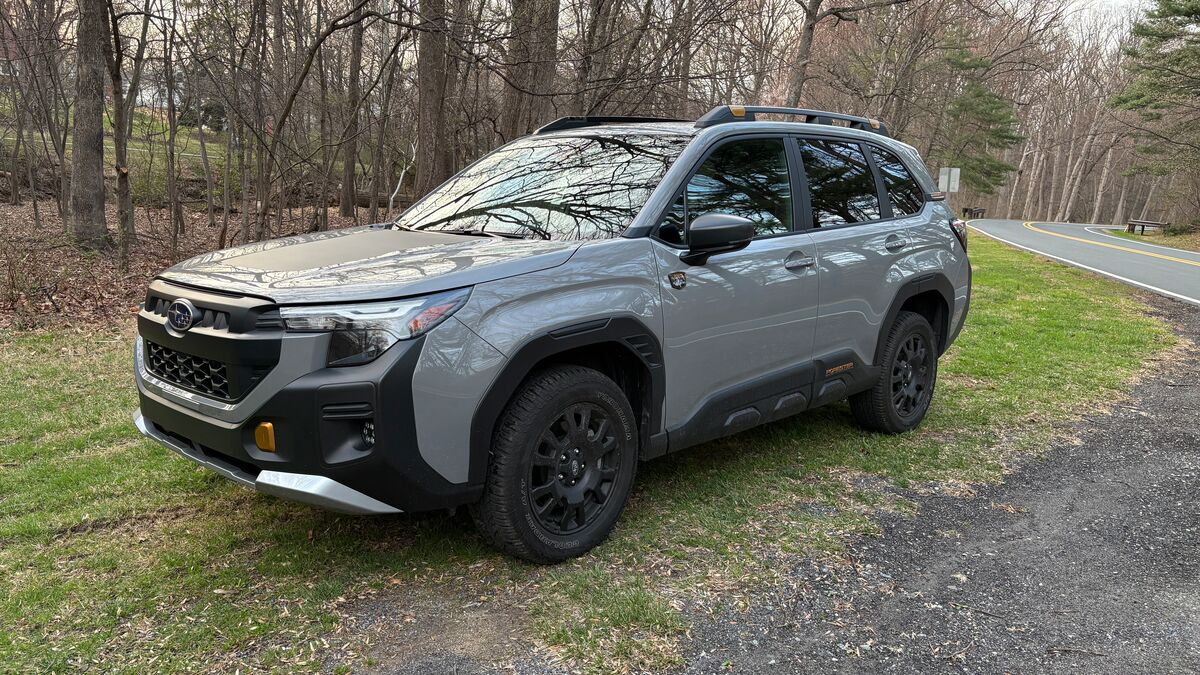
The problem with fashion trends is that some people carry them off well, and some don’t. Some of you make 2026’s wide pants thing work. I do not.
The automotive world has fashion trends as surely as actual fashion does. The dominant trend this year is the off-road trim. Automakers are taking ordinary compact SUVs that suit family life well, lifting them a bit, fitting all-terrain tires and a few useful bits of trail gear, and giving them trim names that sound like trekking pole brands.
Toyota has its Woodland models. Honda makes TrailSport trims. Even Mitsubishi now has Trail Editions.
Some are reasonably priced and filled with thoughtful touches that actually would prove useful on the trail. Some are me in wide pants. And many are the most expensive version of an otherwise affordable car.
Into that market wade (literally, sometimes) Subaru’s Wilderness models. I spent a week driving the 2026 Subaru Forester Wilderness around suburban Washington, D.C., and, to put its claims to the test, down some unimproved West Virginia logging roads.
The verdict? As you might have predicted, Subaru is well-positioned to build a soft-roader trim that actually does what it says on the tin. The Forester Wilderness retains all the day-to-day livability of the Forester and adds the kind of trail gear that shows designers actually drove it in the mud.
Subaru wears this trend better than most.
Best of all, it sits near the middle of the Forester price range.
Which Trim Level
Subaru builds the Forester in six gas-powered trim levels and four hybrid trims. For 2026, there is no hybrid Wilderness model, but there will be one for the 2027 model year. While some brands price their off-road models higher than other trims, the Forester Wilderness comes in $3,000 less than the top-of-the-line Touring model. It sits 0.6 inch higher than other Foresters for added ground clearance and gets all-terrain tires, extra terrain modes, hill descent control, and similar trail gear. Some of those additions are thoughtful touches, like a matte hood decal that reduces glare.
New 2026 Subaru Forester Prices
|
Retail Price
|
Fair Purchase Price (92620)
|
|||
|---|---|---|---|---|
$31,445 |
$29,300 |
|||
$34,835 |
$32,200 |
|||
$37,555 |
$35,100 |
|||
$37,945 |
$35,500 |
|||
$39,145 |
$36,500 |
|||
$39,835 |
$37,000 |
|||
$43,045 |
$39,900 |
Favorite Feature
The car safety experts at the Insurance Institute for Highway Safety (IIHS) conducted a fascinating study not long ago that confirmed something you probably know intuitively if you’ve been driving for a while: cars are getting harder to see out of.
Comparing the 1997 and 2023 editions of the same cars, they found that you simply see less of the world around you from the driver’s seat of today’s vehicles than drivers saw 25 years ago. Today’s designs give you too little window.
The 2026 Forester, however, has outstanding visibility. A high seating position and upright windows let you see more of the road out of this than out of any other car I’ve driven in years. I consider this a safety feature.
What It’s Like to Drive
Almost every Subaru follows the same formula and has for decades. The company has kept it for a long time because it works.
A low-mounted 4-cylinder boxer engine, a little flatter than most, keeps the car’s center of gravity a touch lower than what you get with most rivals. That, combined with standard symmetrical all-wheel drive (AWD), makes the car feel unusually planted and grippy.
The engine makes 180 horsepower, which is slightly lower than most competitors. It’s adequate for every job you might give it, but if you test drive this against its major competitors, you’ll notice it accelerates a tiny bit slower. It probably won’t be enough to bother you.
On the Wilderness trim, that power gets to the ground through grippy Yokohama Geolandar all-terrain tires. I couldn’t break them loose on muddy logging roads, though I’m sure you could in more technically challenging off-road terrain.
Do note, however, that over the life of the car, you’ll have to replace the tires with a similar all-terrain set to keep that level of performance. They cost a bit more than commuter tires and transfer a bit more noise to the cabin on pavement, though it’s not enough to pose a problem.
Interior Comfort and Technology
Supportive, relatively comfortable front seats face a dashboard that will look familiar to anyone who’s driven a recent Subaru but strange to those who’ve test-driven other 2026 model-year SUVs.
Subaru leans into rugged and proven designs, which can leave it behind the curve on some trends. Most competitors now mount the driver’s instrument screen and touchscreen together up high. Subaru keeps them separate, with the central touchscreen mounted in portrait orientation fairly low on the dash. That means you’ll look down to see entertainment and climate settings in this car, which you wouldn’t in a similar Chevrolet or Honda SUV.
Subaru has changed that in the more-recently updated Outback, so I wouldn’t be surprised to see the screen move up next time they redesign the Forester. But, for now, it’s low.
Materials throughout the cabin are designed for easy cleaning, a blessing in an off-road trim. Subaru’s StarTex vegan leather alternative is everywhere. It’s waterproof and easy to care for. Rubber floor mats are cut with a topographic map pattern, which is also found on the speakers.
Wilderness models get copper accents inside and out. Many automakers have settled on yellow or orange for that role. The copper feels a little more upscale.
You’ll need to learn to speak a little Subaru to drive. Drive modes, for instance, are controlled by steering wheel buttons labeled S# and [I]. Those mean “Sport” and “Intelligent” (a fuel-saving mode). A button labeled AVH (O) is brake hold. X-Mode controls terrain settings. It’s a new language, but once you get it down, it’s simple enough.
Second-row passengers get USB-C ports and air conditioning vents, and the cargo hold is spacious – a result of that boxy Forester shape.
Limitations
The Forester, in non-Wilderness form, is quite capable of the sort of dirt-road driving and bouncing down to a muddy kayak put-in that many Subaru owners do. You don’t need to buy the Wilderness edition for that. A less-expensive trim would do the job for almost everyone.
Key Considerations
That said, the Forester Wilderness is a real value among off-road trims of compact SUVs. Its sticker price is $2,200 higher than that of the Forester Sport. Adding a good set of all-terrain tires, all-weather floormats, and anti-glare graphics to a Forester Sport would probably cost you nearly that much. With the Wilderness, you also get a lifted suspension, an upgraded transmission cooler to help it tow, and two additional drive modes, Snow/Dirt and Deep Snow/Mud. I think you get more than you pay for here.