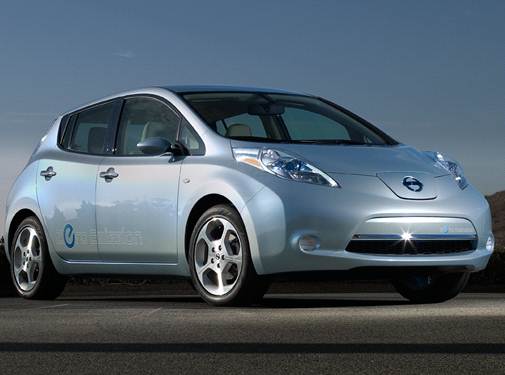
Used 2011 Nissan LEAF SL Hatchback 4D


Pricing
Sign Up for Pricing Updates
Stay up to date by tracking the KBB.com Fair Purchase Price.
Values and Prices
Fair Purchase Price is determined by collecting thousands of actual consumer vehicle purchase prices, plus data from national vehicle registration databases and several other reliable third-party sources.
Estimated Values
Condition | Trade-In Value | Private Party Value | ||
|---|---|---|---|---|
Excellent | $600 | $2,600 | ||
Very Good | $600 | $2,475 | ||
Good | $600 | $2,325 | ||
Fair | $600 | $1,975 |
Estimated Trade-In Values for the 2011 Nissan LEAF SL Hatchback 4D range from about $600 to $600 depending on vehicle condition. Estimated Private Party Values range from about $1,975 to $2,600 depending on vehicle condition. Valid for ZIP Code 43085 through 9/19/2026.

2011 Nissan LEAF SL Hatchback 4D Depreciation
Login or create a new account to see your vehicle depreciation forecast data.


2011 Nissan LEAF SL Hatchback 4D Annual Depreciation
Year | Vehicle Depreciation* | Resale Value | Trade-In Value | ||
|---|---|---|---|---|---|
2023 | $1,506 | $3,319 | $1,206 | ||
2024 | $408 | $2,911 | $710 | ||
2025 | $383 | $2,528 | $562 | ||
Now | $203 | $2,325 | $600 |

Unlock Forecast
2-Year Forecasted Depreciation
*Depreciation for the last 12 months of the private party resale value.
2011 Nissan LEAF SL Hatchback 4D Depreciation
Annual Depreciation is an estimation of what your vehicle's value might be over time based on an average of similar vehicles. Estimations are calculated by comparing Kelley Blue Book Private Party Values of vehicles similar to yours over time, as well as forecasts from Manheim Auction data comparing current and projected auction values against current Kelley Blue Book Private Party and Trade-In Values. This is not a guarantee of actual depreciation. Local weather conditions, market factors and driver performance will also impact your vehicle's actual depreciation.
Already Own This Car?
Calculate Your Budget With These KBB.com Tools
Specifications
Dimensions, Weights & Capacities
Max Seating Capacity | 5 | ||
|---|---|---|---|
Overall Length | 175.0 inches | ||
Wheel Base | 106.3 inches | ||
Width with mirrors | 69.7 inches |
Exterior
Alloy Wheels | Available | ||
|---|---|---|---|
Fog Lights | Available | ||
Number of Doors | 4 doors | ||
LED Headlights | Available | ||
Rear Spoiler | Available |
Fuel Economy
City | 106 MPGe | ||
|---|---|---|---|
Combined | 99 MPGe | ||
Highway | 92 MPGe |
Mechanical
Drivetrain | FWD | ||
|---|---|---|---|
1 speed | Available |
Performance
Horsepower | 107 hp | ||
|---|---|---|---|
Torque | 207 foot pounds | ||
Engine | AC Electric Motor | ||
Estimated Electric Range | 84 miles | ||
Charge Time (240V) | 7 hours | ||
Battery Capacity | N/A |
Warranty
Basic | 3 years / 36000 miles | ||
|---|---|---|---|
Corrosion | 5 years / Unlimited miles |
2011 Nissan LEAF SL Hatchback 4D Standard Features


2011 Nissan LEAF
KBB.com Review
Kbb.com Expert Rating
No question that card-carrying Greenies who think EVs are the future and the future is now will love the new Nissan LEAF. Others will simply have to decide if a vehicle with its admirable cost-to-benefit ratio makes the most sense as a second or third commuter car or as a substitute for a conventional hybrid.
Drivers with unpredictable daily schedules, long commutes and/or budgets that will support only one car will be better off with a standard compact/mid-size vehicle, some type of hybrid – or the LEAF’s high-profile but pricier rival for eco plaudits, the Chevrolet Volt.