Used 2020 Hyundai Tucson

View All Media
2020 Hyundai Tucson Review

By Joe Tralongo
Updated June 01, 2021
Pros
- Handsome styling
- Generous standard content
- Strong safety scores
- 10-year/100,000-mile powertrain warranty
- Apple CarPlay/Android Auto
Cons
- Not a true off-road-capable compact SUV
- Not very quick
- Interior on the smaller side
- Best equipment reserved for most expensive trims
- Some driver assists standard on competitors are optional
What's New?
- The 2020 Hyundai Tucson carries over with no major changes of note.
#11 in Best Compact SUVs of 2020
The 2020 Hyundai Tucson is a compact SUV offering the ride comfort, handling and fuel economy of a small car, but in a more versatile design aimed at those with a more active lifestyle. The Tucson shines brightly in the areas of safety and standard equipment, not to mention its unbeatable 10-year/100,000-mile powertrain warranty.
However, when it comes to power, the Tucson falls short of the benchmarks set by the Mazda CX-5 and Ford Escape that both offer the option of a high-output turbocharged engine.
And, while the Tucson does offer features like adaptive cruise control and auto high beams, they are optional and only offered on the top trims.
The Tucson isn’t as roomy as a Honda CR-V or Toyota RAV4, and, unlike the Subaru Forester, isn’t really designed for any kind of serious off-road use.
2020 Hyundai Tucson Pricing
2020 Hyundai Tucson pricing starts at $12,900 for the Tucson SE Sport Utility 4D, which had a starting MSRP of $24,690 when new. The range-topping 2020 Tucson Ultimate Sport Utility 4D starts at $16,300 today, originally priced from $33,040.
Original MSRP | KBB Fair Purchase Price (national avg.) | |||
|---|---|---|---|---|
$24,690 | $12,900 | |||
$26,140 | $14,050 | |||
$28,490 | $14,750 | |||
$29,240 | $15,800 | |||
$30,390 | $15,500 | |||
$33,040 | $16,300 |
The Kelley Blue Book Fair Purchase Price for any individual used vehicle can vary greatly according to mileage, condition, location, and other factors. The prices here reflect what buyers are currently paying for used 2020 Hyundai Tucson models in typical condition when purchasing from a dealership. These prices are updated weekly.
Which Model is Right for Me?
17-inch alloy wheels
Lane-keeping assist
Forward-collision avoidance assist
7-inch touch screen
Apple CarPlay/Android Auto
Blind-spot collision warning
Rear cross-traffic collision warning
8-way-power driver’s seat with 2-way-power lumbar
Proximity key
Heated front seats
2.4-liter engine
18-inch alloy wheels
Dual-zone automatic climate control
Rear-seat vents
Second-row USB outlet
19-inch wheels
Infinity premium audio
Wireless charging
LED headlights
Hands-free liftgate
18-inch alloy wheels
Surround View monitor
Leather seating
Heated steering wheel
Power front-passenger seat
Panoramic sunroof
8-inch navigation touch screen
Smart Cruise Control with Stop & Go
Ventilated front seats
Heated rear seats
Driving the Hyundai Tucson
From a driver’s point of view, the 2020 Hyundai Tucson feels very much like driving a compact car. The ride is comfortable, the cabin quiet and the overall handling more than adequate, although the electric power steering is somewhat vague. The Tucson’s suspension is designed to take curves with confidence, but it’s not as dialed-in as in a Mazda CX-5 or Ford Escape.
Moving up to the Sport trim with its 19-inch wheels does somewhat diminish the ride quality and increase sound levels, so be sure to test drive a few versions to see which suits you best.
When it comes to acceleration, even the optional 2.4-liter engine upgrade is nothing to write home about. Delivering only 181 horsepower, this engine lags far behind its turbocharged rivals. Power for low-speed passing maneuvers is there when you need it, thanks in part to the excellent 6-speed automatic, but don’t expect any kind of neck-snapping passing maneuvers once up to speed.
RELATED: Best Compact SUVs of 2020
Selecting Sport mode from the drive settings tweaks the responses of the throttle and transmission for a little more fun.
Interior Comfort
Hyundai’s new Tucson touts a recently freshened interior, with a large infotainment touch screen, instrument cluster and design for the leather-covered seats in the Limited and Ultimate trims. The sensible dash houses simple controls for the climate and audio systems. At night, those controls are backlit in soft blue lighting. The digital display doesn’t overload the driver with too much information.
Even if they’re not class-leading roomy, the rear seats are comfortable enough, and the luggage area’s adjustable floor also includes storage for the cargo cover. With the rear seats in place, cargo space is 31 cubic feet. When folded, 61.9.
Exterior Styling
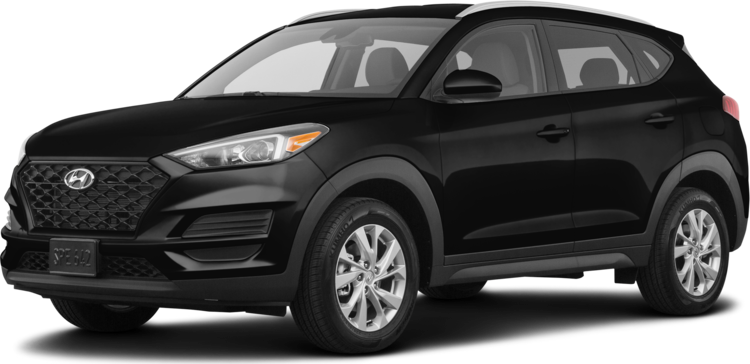
The 2020 Hyundai’s Tucson’s clean compact-SUV look is arguably easy on the eye, especially if you’re a fan of Audi’s styling approach. There’s nothing wrong with a mainstream marque paying homage to something upscale and successful. It makes the commute more bearable and lets the owner feel good about his smart purchase. The Tucson also brings some fresh alloy-wheel designs and new paint colors.
Beneath the styling is a chassis that uses more than 50-percent high-strength steel, contributing to the Tucson’s excellent safety credentials. SE and Value models ride on 17-inch wheels, while the SEL, Limited and Ultimate move up to 18s. The Sport trim rolls on massive 19-inch wheels.
Favorite Features
HANDS-FREE SMART POWER LIFTGATE
Like power windows and air conditioning, once you’ve experienced the Tucson’s Hands-Free Smart Liftgate, you’ll never want to drive a vehicle without it. No need to wave your foot under the bumper, simply approach the rear of the car with the key fob in pocket, wait a few seconds and the tailgate magically opens.
YES ESSENTIALS STAIN PROTECTION
Cloth upholstery can be like a stain sponge when kids and coffee are involved, which is why the Tucson’s Yes Essentials seat fabric is such a brilliant addition to an already nice cabin. Beyond repelling stains, the fabric also helps deflect the build-up of odors and static electricity.
Standard Features
A generous equipment level for the money has long been a hallmark for Hyundai. In ascending order, the 2020 Hyundai Tucson trim levels are: SE, Value, SEL, Sport, Limited and Ultimate. The SE starts off with a 164-horsepower 2.0-liter 4-cylinder engine, front-wheel drive, 17-inch alloy wheels, heated/power-folding side mirrors, 6-way manually adjustable driver’s seat, Bluetooth and all the new additions mentioned above.
The obviously but aptly named Value trim adds blind-spot monitoring, 8-way power-adjustable driver’s seat, heated front seats, satellite radio, and keyless entry/ignition. LED headlights and an Infinity audio system come in at the Sport level, while the Limited trim has leather seating surfaces, a heated steering wheel and a 360-degree monitor. The Ultimate gets an 8-inch infotainment touch screen, navigation, adaptive cruise control and a panoramic sunroof.
Factory Options
All-wheel drive is optional on every trim level. The bigger 181-horsepower engine goes into the SEL trim and above. It’s only the top Limited and Ultimate trims that are eligible for most of the more desirable features. These include pedestrian detection for the forward-collision mitigation system, driver-attention monitoring, rain-sensing wipers, panoramic sunroof, wireless-device charging and heated rear seats.
Engine & Transmission
The base SE and Value Edition of the 2020 Hyundai Tucson compact SUV employ a 2.0-liter 4-cylinder engine making 164 horsepower. It does its job, but not in any particularly refined manner. The rest of the range is propelled by a 2.4-liter 4-cylinder engine producing 181 horsepower. Both engines connect to a 6-speed automatic transmission.
All-wheel drive (AWD) is available with either engine, replacing the standard front-wheel-drive (FWD) setup. AWD Tucson models offer a “lock” feature, enabling a 50/50 torque split between the front and rear wheels for better grip in slippery conditions.
2.0-liter inline-4
164 horsepower @ 6,200 rpm
151 lb-ft of torque @ 4,500 rpm
EPA city/highway fuel economy: 23/28 mpg (FWD), 22/25 mpg (AWD)
2.4-liter inline-4
181 horsepower @ 6,000 rpm
175 lb-ft of torque @ 4,000 rpm
EPA city/highway fuel economy: 22/28 mpg (FWD), 21/26 mpg (AWD)
New Hyundai Tucson Deals and Incentives
0% APR | 60 months
Get 0% Financing for up to 60 months on a new 2026 Tucson Plug-in Hybrid SEL for well qualified buyers.
$4000 Total Cash
Get up to $4000 Total Savings on a new 2026 Tucson Plug-in Hybrid SEL.
$329 /mo | 36 months | Due at Signing
Closed end lease for a new 2026 Tucson Plug-in Hybrid SEL for $329/mo for 36 months with $3999 due at lease signing for well-qualified lessees.
2020 Hyundai Tucson
KBB.com Consumer Reviews
Trending Topics in KBB.com Consumer Reviews
2020 Hyundai Tucson Values and Prices
Style | Trade-In Value | Private Party Value | Fair Purchase Price | ||
|---|---|---|---|---|---|
$8,100 | $11,800 | $12,900 | |||
$9,200 | $12,850 | $14,050 | |||
$9,250 | $13,500 | $14,750 | |||
$10,700 | $14,500 | $15,800 | |||
$10,150 | $14,250 | $15,500 | |||
$10,250 | $14,950 | $16,300 |

2020 Hyundai Tucson Depreciation
Login or create a new account to see your vehicle depreciation forecast data.


2020 Hyundai Tucson Annual Depreciation
Year | Vehicle Depreciation* | Resale Value | Trade-In Value | ||
|---|---|---|---|---|---|
2023 | $3,381 | $15,677 | $14,066 | ||
2024 | $3,300 | $12,377 | $10,886 | ||
2025 | $1,730 | $10,647 | $9,306 | ||
Now | + $1,103 | $11,750 | $8,450 |

Unlock Forecast
2-Year Forecasted Depreciation
*Depreciation for the last 12 months of the private party resale value.
2020 Hyundai Tucson Depreciation
Annual Depreciation is an estimation of what your vehicle's value might be over time based on an average of similar vehicles. Estimations are calculated by comparing Kelley Blue Book Private Party Values of vehicles similar to yours over time, as well as forecasts from Manheim Auction data comparing current and projected auction values against current Kelley Blue Book Private Party and Trade-In Values. This is not a guarantee of actual depreciation. Local weather conditions, market factors and driver performance will also impact your vehicle's actual depreciation.
Already Own This Car?
Calculate Your Budget With These KBB.com Tools
Specifications
Dimensions, Weights & Capacities
Curb Weight | 3309 lbs. | ||
|---|---|---|---|
EPA Passenger | 102.2 cu.ft. | ||
EPA Total Interior | 133.2 cu.ft. | ||
Fuel Capacity | 16.4 gallons | ||
Front Head Room | 39.6 inches | ||
Front Leg Room | 41.5 inches | ||
Max Seating Capacity | 5 | ||
Overall Length | 176.4 inches | ||
Front Shoulder Room | 57.1 inches | ||
Towing Capacity, Maximum | 1500 lbs. | ||
Trunk or Cargo Capacity | 61.9 cu.ft. | ||
Turning Diameter | 34.9 feet | ||
Wheel Base | 105.1 inches |
Exterior
Alloy Wheels | Available | ||
|---|---|---|---|
Number of Doors | 4 doors | ||
Privacy Glass | Available | ||
Roof Rails | Available | ||
Rear Spoiler | Available |
Fuel Economy
City | 23 mpg | ||
|---|---|---|---|
Highway | 28 mpg | ||
Combined | 25 mpg |
Mechanical
Drivetrain | FWD | ||
|---|---|---|---|
Transmission Type | Automatic | ||
6 speed | Available | ||
Recommended Fuel | Regular | ||
Hill Descent Control | Available | ||
Hill Start Assist | Available |
Performance
Horsepower | 161 @ 6200 RPM | ||
|---|---|---|---|
Torque | 150 @ 4700 rpm | ||
Engine | 4-Cyl, 2.0 Liter |
Warranty
Basic | 5 years / 60000 miles | ||
|---|---|---|---|
Powertrain | 10 years / 100000 miles | ||
Corrosion | 7 years / Unlimited miles |
Comfort & Convenience
Entertainment
Interior
Seating
Security
Technology
2020 Hyundai Tucson Safety
Safety Features & Technology
Forward-collision avoidance assist
Forward-collision avoidance assist
This system will warn the driver of an impending collision with the vehicle ahead. Should the driver take no action, the system will automatically apply the brakes and bring the car to full stop. On the Ultimate trim, the system includes pedestrian-detection technology.
Blind-spot collision warning
Blind-spot collision warning
Standard on the Value and higher trims, BCW can detect vehicles in the driver’s blind spot and produce a visual alert in the side mirror. If the driver doesn’t correct the vehicle, an audio warning will sound.
High-beam assist
High-beam assist
Offered only on the Ultimate trim, this feature will automatically toggle between low and high beams whenever it detects oncoming nighttime traffic.
Driver-attention warning
Driver-attention warning
Continuously monitors the driver’s habits and when it detects drowsy or inattentive driving, warns first with an audio alert followed by a warning message in the instrument cluster.
Crash Test Rating
Compare to Similar Vehicles
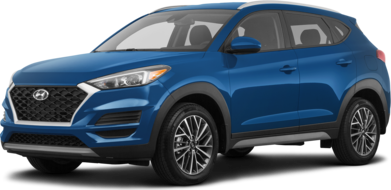 Used 2020 Hyundai Tucson | 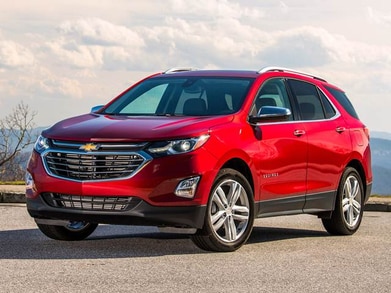 Used 2020 Chevrolet Equinox | 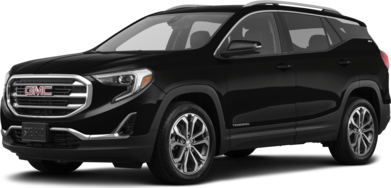 Used 2020 GMC Terrain | 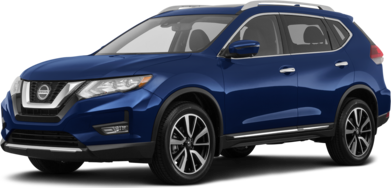 Used 2020 Nissan Rogue | ||
|---|---|---|---|---|---|
| Price | $12,900 | $13,650 | $14,100 | $14,950 | |
| KBB.com Rating | 4.2 | 4.4 | 4.4 | 4.3 | |
| Consumer Rating | 3.9 | 3.9 | 3.9 | 4.1 | |
| Fuel Economy | City 23/Hwy 28/Comb 25 MPG | City 26/Hwy 31/Comb 28 MPG | City 26/Hwy 30/Comb 27 MPG | City 25/Hwy 32/Comb 27 MPG | |
| Fuel Type | Gas | N/A | N/A | N/A | |
| Safety Rating | 5.0 | 5.0 | 5.0 | 4.0 | |
| Seating Capacity | 5 | 5 | 5 | 5 | |
| Basic Warranty | 5 years or 60000 miles | 3 years or 36000 miles | 3 years or 36000 miles | 3 years or 36000 miles | |
| Horsepower | 161 @ 6200 RPM | 170 @ 5600 RPM | 170 @ 5600 RPM | 170 @ 6000 RPM | |
| Engine | 4-Cyl, 2.0 Liter | 4-Cyl, Turbo, 1.5 Liter | 4-Cyl, Turbo, 1.5 Liter | 4-Cyl, 2.5 Liter | |
| Drivetrain | FWD | FWD | FWD | AWD |
2020 Hyundai Tucson Rankings
More Hyundai Tucson News & Information
Updates on the all-new 2027 Tucson include eye-catching styling, AI-assisted tech features, and more interior space.
The 2026 Hyundai Tucson compact SUV comes with three available powertrain options. Which one is best for you?
The 2026 Hyundai Tucson stands out from other compact SUVs with its long warranty, extra space, and intuitive controls.
FAQs
How much is a 2020 Hyundai Tucson lease?
Leasing may be a good option if you’re the type who doesn’t put a lot of miles on your car and likes to trade up every few years. While offers may differ regionally, the Tucson SE lease generally runs around $250 a month for 36 months with a $2,500 down payment.
Is the 2020 Hyundai Tucson AWD?
The 2020 Tucson is pulled by its front wheels, although all-wheel drive (AWD) can be ordered on any trim for about $1,400. The Tucson’s AWD system is an on-demand type, meaning the car remains pulled by its front wheels until traction is needed, at which point all four wheels are put to use. However, the Tucson’s AWD can be locked so that it permanently splits power 50/50 front to rear.
Which is bigger, the Hyundai Santa Fe or Hyundai Tucson?
The Santa Fe is much larger than the Tucson. The Tucson in considered a compact SUV and competes against the Ford Escape, Kia Sportage, Mazda CX-5 and Nissan Rogue, while the Santa Fe is more like a Chevrolet Blazer, Nissan Murano or Ford Edge.
Is the 2020 Hyundai Tucson safe?
Yes, it is. In fact, in the latest testing, the Insurance Institute for Highway Safety (IIHS) gave the Tucson its highest rating of Good in every category and named it a Top Safety Pick + candidate.
Is the 2020 Hyundai Tucson a good vehicle?
Yes, the 2020 Hyundai Tucson is a good car. Its Kelley Blue Book rating of 4.2 out of 5 is within 10% of our average rating.
What is the MPG for a 2020 Hyundai Tucson?
2020 Hyundai Tucson city/highway fuel economy ratings range from 21/26 mpg to 23/28 mpg, depending on trim and equipment.
How much should a 2020 Hyundai Tucson cost?
Used 2020 Hyundai Tucson prices currently range from $12,900 for the SE Sport Utility 4D to $16,300 for the Ultimate Sport Utility 4D when purchasing from a dealership, depending on a range of factors like equipment, mileage, and condition.
What's the cheapest Hyundai Tucson?
The cheapest 2020 Hyundai Tucson is the SE Sport Utility 4D, with a Kelley Blue Book Fair Purchase Price of $12,900.
Is the 2020 Hyundai Tucson reliable?
The 2020 Hyundai Tucson is part of the 3rd-generation Tucson, which our owners give an above-average reliability rating of 4 out of 5.