

View All Media

Electric Variation Available
2024 Hyundai Kona Review

By Russ Heaps
Updated January 30, 2025
Pros
- Outstanding value
- Bar-setting warranty
- Class-leading space
Cons
- Pricing increase
- Uninspired base engine
What's New?
- Totally redesigned
The second-generation Hyundai Kona is a more-refined reimagining of this value-laden small SUV first introduced for the 2018 model year. Engineered as an urban warrior, its focus is providing relatively inexpensive, user-friendly transportation to those living or working in the concrete jungle. However, it’s also completely at home cruising cross-country freeways. With a base powertrain providing impressive fuel economy and adequate grunt for everyday duties, the Kona seats four comfortably (five in a pinch) yet still offers a fair amount of cargo room. Its remarkable features-to-price ratio and generous warranty make it a compelling value in its segment. Key rivals include the Volkswagen Taos, Mazda CX-30, Honda HR-V, and Subaru Crosstrek. Hyundai also makes a fully electric (EV) Kona variant, which we review separately.
We’ve spent hundreds of hours driving and evaluating this generation of subcompact SUVs, including the Hyundai Kona.
What's New for 2024
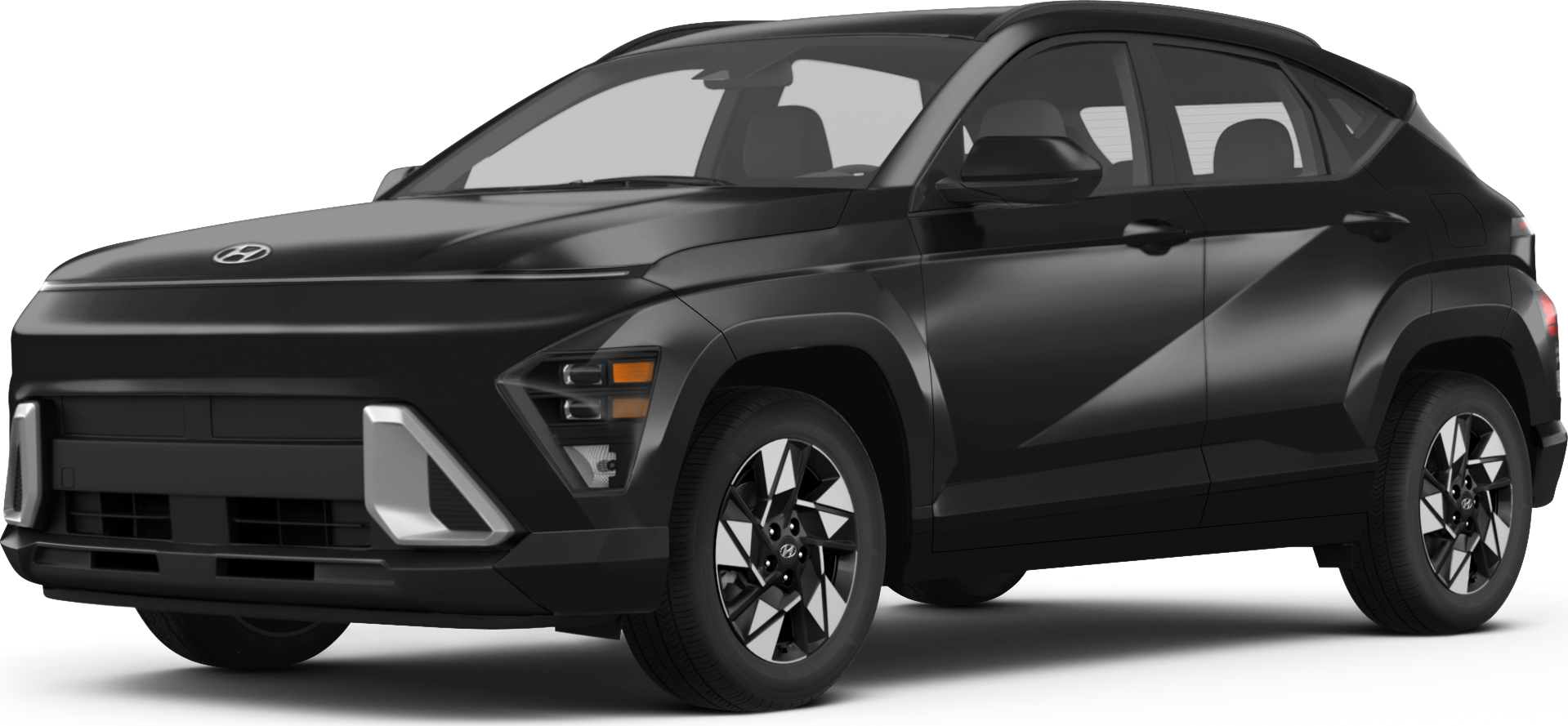
For 2024, Hyundai released the second generation of the Kona. Redesigned inside and out, the Kona receives a boost in overall length (+5.9 inches) and a longer wheelbase (+2.3 inches). It’s taller and wider, too. The exterior is more dynamic. We especially like the eye-catching horizontal signature light spanning the width of the nose. All this stretching of the exterior has increased rear-seat legroom by 3.0 inches, mitigating one of the outgoing model’s biggest shortcomings relative to the competition. Software updates and improvements are now accomplished with over-the-air (OTA) technology. Hyundai’s most recent infotainment system provides the interface for smartphones and other devices. Moreover, it features a 12.3-inch touchscreen, which is the second half of the available dual-screen setup featuring a separate 12.3-inch digital driver information screen. Four USB-C ports are scattered around the cabin. Every trim level now has high-beam assist as standard. Another new addition is dual-zone automatic climate control for the SEL and higher grades.
Increasing the already generous array of advanced driver assistance features is the available Remote Smart Parking Assist, allowing drivers to pull into and out of tight spaces remotely using their smartphones from outside the vehicle. For the first time, a hands-free power rear liftgate is available. Hyundai has also bolstered the services provided through its Bluelink+ technology.
2024 Hyundai Kona Pricing
2024 Hyundai Kona pricing starts at $19,450 for the Kona SE Sport Utility 4D, which had a starting MSRP of $25,625 when new. The range-topping 2024 Kona Limited Sport Utility 4D starts at $22,400 today, originally priced from $33,175.
Original MSRP | KBB Fair Purchase Price (national avg.) | |||
|---|---|---|---|---|
$25,625 | $19,450 | |||
$26,975 | $19,850 | |||
$32,175 | $22,300 | |||
$33,175 | $22,400 |
The Kelley Blue Book Fair Purchase Price for any individual used vehicle can vary greatly according to mileage, condition, location, and other factors. The prices here reflect what buyers are currently paying for used 2024 Hyundai Kona models in typical condition when purchasing from a dealership. These prices are updated weekly.
These prices are about mid-pack for the segment. In fact, the Honda HR-V has the same $24,100 entry-level price. The Jeep Renegade ($29,200 estimated) is more, while the Chevrolet Trailblazer ($23,100) is less. If you want a smaller Hyundai, pick the $20,300 (est.) Venue, or go bigger with the Tucson ($27,250).
Before buying the Hyundai Kona, check the Kelley Blue Book Fair Purchase Price to know what you should really pay. To date, the Hyundai Kona has a better-than-average track record for retaining its value. The segment’s residual-value champ is the Subaru Crosstrek, but the Kona does better than many others.
Power, Ride, And Handling
Both of the Kona’s traditional, internal combustion engines are carryovers from 2023. We’ve spent a lot of time in the 2023 Kona and hoped Hyundai would find a way to goose the output from the entry-level mill, but it was not to be. Therefore, the base engine remains the 147-horsepower 4-cylinder, which is about average for the segment. Hyundai further limits the thrills by mating this engine with an automatic transmission engineered for better fuel economy, rather than performance. It does achieve better-than-average mileage, though.
If you want more spirit, the N Line and Limited trims use a 195-horsepower turbocharged 4-cylinder to rotate the wheels. Hyundai marries this turbocharged engine with a normal 8-speed automatic transmission.
Generally, we find the Kona to be a pleasant, efficient, and relatively roomy small SUV. The seats are firm and supportive enough to keep the fatigue factor low, even on trips of eight hours or more. The steering is responsive while the brakes provide a decent amount of feel. We find that the regular cruise control tasked with maintaining a set speed with the non-turbo 4-cylinder engine struggles mightily on hills, with the speed often dropping 5-to-7 mph or even more. This isn’t a major concern in Florida or Nebraska but can be a hassle in more undulating regions.
The Kona’s tidy size is a joy when parking or even reacting to changes in traffic patterns. It’s the ideal size for crowded venues like city parking garages.
Fuel Economy
As you might expect, the boost in the 2024 Hyundai Kona’s dimensions and weight have somewhat impacted its mileage. The differences aren’t huge for the non-turbo; however, the turbo-4 suffers a more significant hit. With front-wheel drive (FWD), the non-turbo 4-cylinder delivers a combined 31 mpg (28 city, 35 highway), representing a 1 mpg drop from the prior year. With AWD, this same engine gets a combined 28 mpg (27 city, 29 highway), also down from 2023. Within the segment, only the front-wheel-drive Nissan Kicks delivers better mileage, and that’s only by 1 mpg.
The FWD turbo-4 posts a combined 28 mpg (26 city, 32 highway), down from 32 mpg combined (29 city, 35 highway). With AWD, the combined number is 26 mpg (24 city, 29 highway). This is a 3 mpg drop across the board. Additional fuel economy information is available on the EPA’s website.
High-Tech Interior
“Less is more” comes to mind when characterizing the remade interior. Hyundai keeps it simple. The 12.3-inch touchscreen is standard in every new Kona. Available with the SEL Convenience Package, N Line, and Limited is a 12.3-inch digital driver’s information display. The two screens sit side by side, spreading across more than half of the instrument panel. Located beneath one long glass panel, they appear to be one continuous display.
Much of the added exterior length translates into more rear legroom, stretching it to 38.3 inches. This puts it up there with the segment leaders: Kia Soul (38.8 inches) and Chevy Trax (38.7 inches). Total passenger volume (101.2 cubic feet) is also at the head of the class. At 63.7 cubic feet, the Kona’s total cargo capacity is a little better than average for its class. It’s 25.5 cubic feet of cargo room behind the second-row seat is about average. New for 2024 is a storage rack for the removable cargo shelf. It’s located on the second-row seatback.
Back to the Future Exterior
Hyundai has radically changed the looks of the 2024 Hyundai Kona. This may have something to do with initially designing the latest version as an electric vehicle (EV). Unlike many vehicles offering gas and electric variants, the Kona’s internal combustion version was adapted from the EV, not the other way around. Most consumers tend to want their EVs to look at least somewhat futuristic, and the new Kona does. Having said that, Hyundai managed to retain the proportional value of the newest Kona despite growing and radically styling it.
Our Favorite Features And Tech
Dual 12.3 displays
Covered by a continuous layer of glass, the available 12.3 digital driver-information display and the standard 12.3-inch touchscreen appear to be a single display spanning half the width of the dashboard.
All-wheel drive
This is optional in all 2024 Kona variants (except the EV), providing optimum grip and traction in the wet and dry. It also means that Hyundai fits a multi-link rear suspension, improving ride quality in the bargain.
Hyundai Bluelink
For 2024, Hyundai is providing a free lifetime subscription to its connected services for the Kona’s original owner. Those services include automatic collision notification, roadside assistance, remote start/climate settings, stolen vehicle location/slowdown, and panic notification. This feature is standard on all trim levels.
Over-the-air updates
For the first time, Hyundai will provide over-the-air updates (OTA) for Kona software enhancements.
Wireless Apple CarPlay/Android Auto
Cable-free smartphone integration is standard in the two lower trims. Irritatingly, it’s not available in the N Line and Limited grades. However, wired Apple CarPlay/Android Auto are still included. The good news is that one of the first over-the-air software updates will bring wireless connectivity to the upper trims, too.
Dual-zone automatic climate control
Beginning with the SEL grade, dual-zone automatic climate control is standard. A set-it-and-forget-it system, it separates the cooling and heating function into right and left zones. Once the temperature for each zone is set, the system automatically maintains that temperature.
Engine & Transmission
The gas-powered Kona models derive their go from one of two 4-cylinder engines. The better-selling of the two is a normally aspirated 4-cylinder bolted to a fuel-managing automatic transmission. This is the powertrain making the go in the lower SE and SEL trims. Getting to 60 mph from a standstill has been clocked at around 9.2 seconds. This isn’t the slowest in the segment. For example, the Honda HR-V requires more than 9.5 seconds, while the Chevrolet Trailblazer needs nearly 10 seconds. On the other hand, the Toyota Corolla Cross has clocked it in just over 8.0 seconds.
A more performance-oriented turbocharged 4-cylinder handles the thrust duties in the N Line and Limited trims. It gets a normal 8-speed transmission. Opting for the turbo scrubs nearly two full seconds from the non-turbo’s zero-to-60 time.
New for 2024, transmission gear selection is shift by wire with the control located on a steering column-mounted stalk.
Industry-Leading Warranty
Highly touted, Hyundai provides limited bumper-to-bumper warranty protection for five years or 60,000 miles. Its powertrain warranty, covering 10 years or 100,000 miles, is arguably the industry’s benchmark. Moreover, Hyundai also tosses in complimentary scheduled maintenance for three years or 36,000 miles.
Safety
A 2024 Top Safety Pick+ by the Insurance Institute for Highway Safety (IIHS), the Hyundai Kona also provides a full array of standard advanced safety features, like blind-spot monitoring, rear cross0traffic alert, lane-keeping assist, lane-departure warning, and more.
New Hyundai Kona Deals and Incentives
3.49% APR | 60 months
Get 3.49% Financing for up to 60 months on a new 2026 KONA SEL PREMIUM AWD for well qualified buyers.
$1000 Total Cash
Get up to $1000 Total Savings on a new 2026 KONA SEL PREMIUM AWD.
$279 /mo | 36 months | Due at Signing
Closed end lease for a new 2026 KONA SEL PREMIUM AWD for $279/mo for 36 months with $3999 due at lease signing for well-qualified lessees.
2024 Hyundai Kona
KBB.com Consumer Reviews
Trending Topics in KBB.com Consumer Reviews
2024 Hyundai Kona Values and Prices
Style | Trade-In Value | Private Party Value | Fair Purchase Price | ||
|---|---|---|---|---|---|
$15,650 | $17,750 | $19,450 | |||
$16,550 | $18,150 | $19,850 | |||
$18,100 | $20,500 | $22,300 | |||
$19,450 | $20,400 | $22,400 |

Style | Trade-In Value | Private Party Value | Fair Purchase Price | ||
|---|---|---|---|---|---|
$17,900 | $18,650 | $20,300 | |||
$17,300 | $20,300 | $22,100 | |||
$20,900 | $22,000 | $23,900 |
2024 Hyundai Kona Depreciation
Login or create a new account to see your vehicle depreciation forecast data.


2024 Hyundai Kona Annual Depreciation
Year | Vehicle Depreciation* | Resale Value | Trade-In Value | ||
|---|---|---|---|---|---|
2024 | - | $25,625 | $25,625 | ||
2025 | $6,351 | $19,274 | $17,221 | ||
Now | $1,524 | $17,750 | $15,650 |

Unlock Forecast
2-Year Forecasted Depreciation
*Depreciation for the last 12 months of the private party resale value.
2024 Hyundai Kona Depreciation
Annual Depreciation is an estimation of what your vehicle's value might be over time based on an average of similar vehicles. Estimations are calculated by comparing Kelley Blue Book Private Party Values of vehicles similar to yours over time, as well as forecasts from Manheim Auction data comparing current and projected auction values against current Kelley Blue Book Private Party and Trade-In Values. This is not a guarantee of actual depreciation. Local weather conditions, market factors and driver performance will also impact your vehicle's actual depreciation.
Already Own This Car?
Calculate Your Budget With These KBB.com Tools
Specifications
Dimensions, Weights & Capacities
Curb Weight | 3005 lbs. | ||
|---|---|---|---|
EPA Passenger | 101.2 cu.ft. | ||
EPA Total Interior | 126.7 cu.ft. | ||
Fuel Capacity | 12.4 gallons | ||
Front Head Room | 39.9 inches | ||
Front Leg Room | 41.7 inches | ||
Max Seating Capacity | 5 | ||
Minimum Ground Clearance | 6.7 inches | ||
Overall Length | 171.3 inches | ||
Front Shoulder Room | 56.8 inches | ||
Trunk or Cargo Capacity | 63.7 cu.ft. | ||
Turning Diameter | 34.8 feet | ||
Wheel Base | 104.7 inches | ||
Gross Vehicle Weight Rating (GVWR) | 4090 lbs. | ||
Width with mirrors | 71.9 inches |
Exterior
Alloy Wheels | Available | ||
|---|---|---|---|
Number of Doors | 4 doors | ||
Roof Rails | Available | ||
LED Headlights | Available | ||
Rear Spoiler | Available |
Fuel Economy
City | 29 mpg | ||
|---|---|---|---|
Highway | 34 mpg | ||
Combined | 31 mpg |
Mechanical
Drivetrain | FWD | ||
|---|---|---|---|
Transmission Type | Automatic | ||
Recommended Fuel | Regular | ||
Hill Descent Control | Available | ||
Hill Start Assist | Available |
Performance
Horsepower | 147 @ 6200 RPM | ||
|---|---|---|---|
Torque | 132 @ 4500 rpm | ||
Engine | 4-Cyl, 2.0 Liter |
Warranty
Basic | 5 years / 60000 miles | ||
|---|---|---|---|
Powertrain | 10 years / 100000 miles | ||
Corrosion | 7 years / Unlimited miles |
Entertainment
Interior
Seating
Security
Technology
2024 Hyundai Kona Safety
Safety Features & Technology
Compare to Similar Vehicles
 Used 2024 Hyundai Kona |  Used 2024 Nissan Kicks |  Used 2024 Toyota Corolla Cross |  New 2026 Hyundai Kona | ||
|---|---|---|---|---|---|
| Price | $19,450 | $17,400 | $23,400 | N/A | |
| KBB.com Rating | 4.8 | 4.2 | 4.5 | 4.8 | |
| Consumer Rating | 3.7 | 4.0 | 4.1 | 3.7 | |
| Fuel Economy | City 29/Hwy 34/Comb 31 MPG | City 31/Hwy 36/Comb 33 MPG | City 31/Hwy 33/Comb 32 MPG | City 28/Hwy 35/Comb 31 MPG | |
| Fuel Type | Gas | N/A | N/A | Gas | |
| Safety Rating | N/A | N/A | N/A | 4.0 | |
| Seating Capacity | 5 | 5 | 5 | 5 | |
| Basic Warranty | 5 years or 60000 miles | 3 years or 36000 miles | 3 years or 36000 miles | 5 years or 60000 miles | |
| Horsepower | 147 @ 6200 RPM | 122 @ 6300 RPM | 169 @ 6600 RPM | 147 @ 6200 RPM | |
| Engine | 4-Cyl, 2.0 Liter | 4-Cyl, 1.6 Liter | 4-Cyl, 2.0 Liter | 4-Cyl, 2.0 Liter | |
| Drivetrain | FWD | FWD | FWD | FWD |
2024 Hyundai Kona Rankings
More Hyundai Kona News & Information
Hyundai redesigned the Kona inside and out for the 2024 model year, and it enters its second generation fully caffeinated…
The Hyundai Kona keeps a low profile, but it’s quietly one of the most all-around appealing cars on the market.…
The Hyundai Kona subcompact SUV is a mini lineup all its own, with gas-powered and electric versions, plus a high-performance…
FAQs
Is the 2024 Hyundai Kona a good vehicle?
Yes, the 2024 Hyundai Kona is a good car, as reflected by its above-average Kelley Blue Book rating of 4.8 out of 5.
What is the MPG for a 2024 Hyundai Kona?
2024 Hyundai Kona city/highway fuel economy ratings range from 26/32 mpg to 29/34 mpg, depending on trim and equipment.
How much should a 2024 Hyundai Kona cost?
Used 2024 Hyundai Kona prices currently range from $19,450 for the SE Sport Utility 4D to $22,400 for the Limited Sport Utility 4D when purchasing from a dealership, depending on a range of factors like equipment, mileage, and condition.
What's the cheapest Hyundai Kona?
The cheapest 2024 Hyundai Kona is the SE Sport Utility 4D, with a Kelley Blue Book Fair Purchase Price of $19,450.