
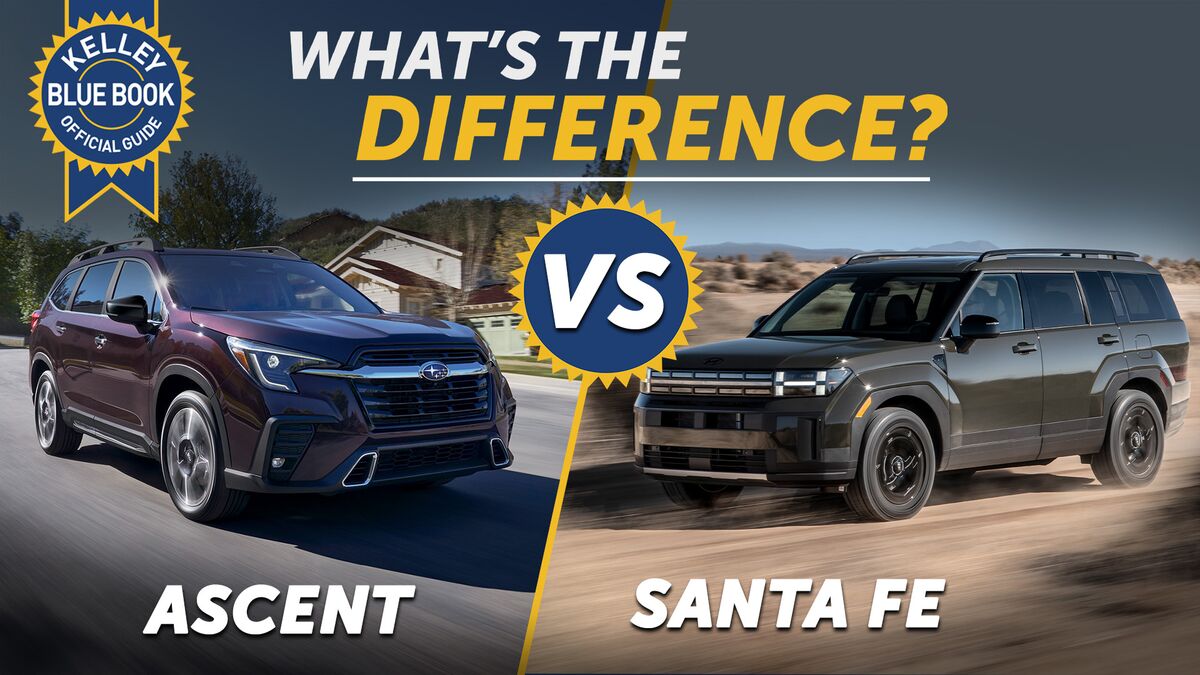
The 3-row SUV is one of the most popular new car choices, and brands such as Hyundai make two different ones of different sizes that may better accommodate families even if it confuses shoppers. Subaru’s largest vehicle, the Ascent, is a 3-row SUV that’s much more straightforward.
Hyundai redesigned the 2026 Palisade and made its largest vehicle even larger in the process. Hyundai followed a similar approach when it redesigned the Santa Fe, making it boxier, larger, and roomier, and more accommodating for a third row than its predecessor. Hyundai also introduced a hybrid option with the Santa Fe.
Introduced in 2019, the Subaru Ascent splits the difference in size between the Palisade and the Santa Fe. By the tape, it’s slightly smaller than the Palisade, but inside it has nearly the same volume and space as the Santa Fe. If size is your main concern, look to the Palisade. For Subaru attitude and the Santa Fe vibe, keep reading.
Here’s how these popular 3-row SUVs compare.
2026 Subaru Ascent
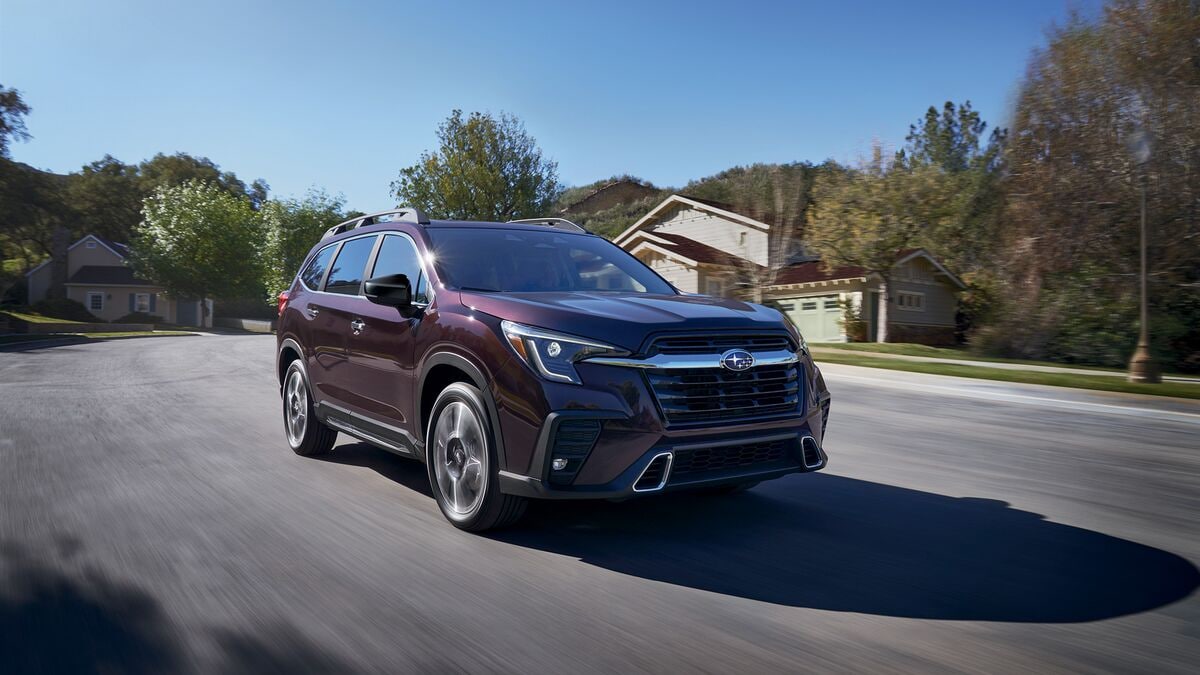
Rumors of the Ascent’s demise to an electric vehicle are as common as rumors of its overdue redesign. Neither are happening in the next year. Launched in 2019, the Ascent shows its age when it comes to its infotainment system and touchscreen interface, but it also upholds Subaru’s excellent reputation for safety, reliability, and standard all-wheel-drive (AWD) assurance.
Subaru Ascent Highlights
Off-road capability: Subaru’s Symmetrical AWD system combines with its 260-horsepower turbocharged 4-cylinder engine to sit low and flat in the vehicle, giving it a relatively low center of gravity despite its high 8.7 inches of ground clearance. The setup gives the Ascent a greater degree of on-road comfort and stability that, combined with full-time AWD, relies on power and torque going to all four wheels unless one is slipping.
The off-road advantage for the Ascent is in the raised ground clearance so you don’t scrape rocks, ruts, or roots, and its X-Mode low-speed traction control system that includes hill descent control. X-Mode automatically adjusts throttle, transmission, and braking responses, as well as torque distribution between the wheels. This is helpful not just for climbing around the ruts off-road, but also in deep snow or mud. Certain models have a more refined Dual Mode setting with a Deep Snow/Mud setting. Whichever one you choose, you won’t need to select an off-road model, since every Subaru Ascent is.
EyeSight safety system: The Subaru Ascent has eyes in its head, or so it appears. Two cameras set in the rearview mirror housing face forward and scan a broad sweep of the horizon to capture more data for its safety systems. Standard driver-assist features include automatic emergency braking, adaptive cruise control, blind-spot monitoring, and lane-keep assist. These features and excellent crash protection result in a Top Safety Pick+ from the Insurance Institute for Highway Safety. It’s the highest independent safety rating a vehicle can receive. The Santa Fe also earns this accolade.
One safety edge for the Ascent is its vast greenhouse, or glass enclosure, that includes a wide and tall front windshield that seems as if you’re driving a fishbowl.
Towing: Every Ascent can tow up to 5,000 pounds, and Trailer Stability Assist comes standard. Most Santa Fe models tow 3,500 pounds, though the off-road-leaning XRT trim maxes out at 4,500 pounds. Accessorizing the Ascent for that adventure vibe is easier too, with roof rails and dealer-installed Thule parts ranging from a cargo carrier to a camping awning or a bike hitch. The kids call it Subarumaxxing.
Read our Subaru Ascent Expert Review or see 2026 Subaru Ascent for sale near you
2026 Hyundai Santa Fe
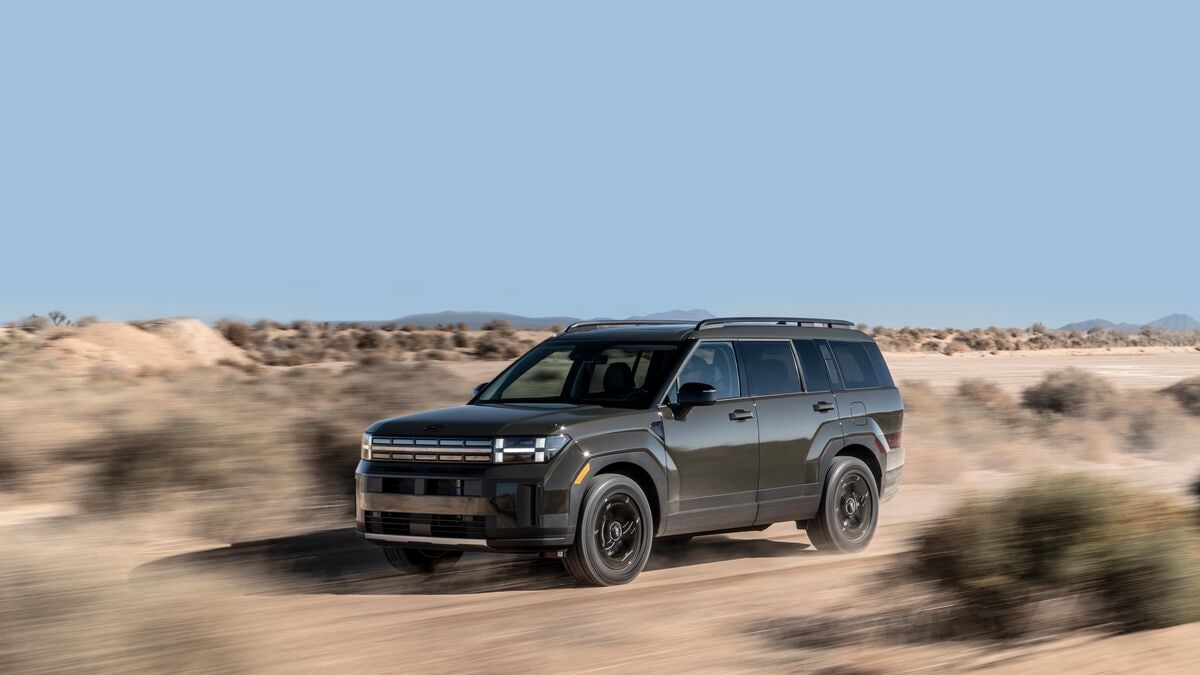
The Hyundai Santa Fe strikes the most Subaru profile it can muster, with blocky square wheel arches covered in black cladding. Its roof rails are pronounced, and its boxiness evokes classic SUV design from a bygone era. Yet the pixelated H shapes stamped on everything, from the lower front grille to the headlights and taillights, give its boxiness some playfulness.
Starting at $36,650, the Santa Fe shapes up as a better value versus the $42,245 Ascent, but adding AWD for $1,850 and conveniences that are standard on the Ascent, such as heated front seats that are power adjustable and a leather-wrapped steering wheel, bring the prices much closer to parity.
2026 Hyundai Santa Fe Highlights
Hybrid option: The biggest difference between these two midsize SUVs happens under the hood. The Santa Fe uses a turbocharged 4-cylinder engine rated at 277 hp, but a 231-hp Santa Fe Hybrid is a smoother, quieter, and much cheaper option over the long haul. The hybrid upcharge is only $1,350, but the EPA rates it at 36 mpg combined (AWD is 34 mpg combined) versus 24/23 mpg combined (FWD/AWD) for the non-hybrid Santa Fe. The EPA estimates you’d recoup that $1,350 sticker price upcharge in less than two years at the pump. The Ascent tops out at 22 mpg combined.
Dual storage console: Both SUVs excel at optimizing interior storage space, with the Ascent offering 19 cupholders to the Santa Fe’s 17. The Santa Fe handles space better, however. A dual glovebox creates simple storage solutions for the passenger, and an open lower console stows handbags, devices, and curiosities like books. A favorite feature sits under the elbow rest with a deep console that also opens up with a drawer to second-row passengers. These small but thoughtful touches make family life easier.
Easy seats: Whereas the Subaru Ascent relies on manual straps to set up and fold down the third row and a two-step latch to fold the second-row seats, Hyundai has available power seats that are much easier to fold. Even in its standard configuration, the pull straps in the third row automatically collapse the headrests. Either way, access to all seats of the Santa Fe is easier.
Read our Hyundai Santa Fe Expert Review or see 2026 Hyundai Santa Fe for sale near you
New 2026 Subaru Ascent Prices
|
Retail Price
|
Fair Purchase Price (43085)
|
|||
|---|---|---|---|---|
$42,245 |
$39,000 |
|||
$49,335 |
$46,000 |
|||
$50,445 |
$46,400 |
|||
$52,615 |
$48,000 |
|||
$53,445 |
$49,200 |
New 2026 Hyundai Santa Fe Prices
|
Retail Price
|
Fair Purchase Price (43085)
|
|||
|---|---|---|---|---|
$36,650 |
$35,300 |
|||
$39,190 |
$38,000 |
|||
$43,640 |
$41,800 |
|||
$46,200 |
$44,200 |
|||
$49,200 |
$47,600 |
The Kelley Blue Book Fair Purchase Price for any individual used vehicle can vary greatly according to mileage, condition, location, and other factors. The prices here reflect what buyers are currently paying for New 2026 Subaru Ascent vehicles and New 2026 Hyundai Santa Fe vehicles in typical condition when purchasing from a dealership. These prices are updated weekly. The manufacturer’s suggested retail price (MSRP) quoted includes the destination fee, but does not include tax, license, document fees, and options.
Specifications
| 2026 Subaru Ascent | 2026 Hyundai Santa Fe | |
| Popular Powertrains | ||
| Engine | 2.4-liter turbo 4-cylinder | 2.5-liter turbo 4-cylinder |
| Towing Capacity | 5,000 pounds | 3,500 pounds |
| Horsepower | 260 hp @ 5,600 rpm | 277 hp @ 5,800 rpm |
| Torque | 277 lb-ft @ 2,000 rpm | 311 lb-ft @ 4,000 rpm |
| Transmission | automatic, cvt w/lineartronic, high torque & 8-speed manual mode | automatic, 8-speed w/shiftronic |
| Fuel Economy | 19 city/26 highway/22 combined mpg | 20 city/29 highway/24 combined mpg |
| Specs | ||
| Basic Warranty | 3 years/36,000 miles | 5 years/60,000 miles |
| Powertrain Warranty | 5 years/60,000 miles | 10 years/100,000 miles |
| NHTSA Overall Safety | 5 stars | 5 stars |
| Max Seating Capacity | 7 | 7 |
| Wheelbase | 113.8 inches | 110.8 inches |
| Overall Length | 196.8 inches | 190.2 inches |
| Width | 85.9 inches | 74.8 inches |
| Height | 71.6 inches | 67.7 inches |
| Turning Diameter | 38.0 feet | 37.9 feet |
| Headroom, Front | 41.2 inches | 41.1 inches |
| Headroom, 2nd Row | 40.0 inches | 40.6 inches |
| Headroom, 3rd Row | 36.2 inches | 37.7 inches |
| Legroom, Front | 42.2 inches | 44.4 inches |
| Legroom, 2nd Row | 38.6 inches | 42.3 inches |
| Legroom, 3rd Row | 31.7 inches | 30.0 inches |
| Shoulder Room, Front | 61.1 inches | 59.5 inches |
| Shoulder Room, 2nd Row | 60.3 inches | 58.1 inches |
| Shoulder Room, 3rd Row | 57.2 inches | 53.5 inches |
| Cargo Behind Last Seat | 17.8 feet | 14.6 feet |
| Cargo Behind Second Seat | 43.5 feet | 40.5 feet |
| Cargo With All Seats Down | 75.6 feet | 79.6 feet |
Specification table reflects the typical configuration of vehicles shown.
Conclusion
The choice between these two 3-row SUVs is a matter of personal taste. Both earn top safety marks and have great outward vision. Though showing its age, the Subaru Ascent puts its rugged boot forward as a more versatile adventurer. It may benefit from its age, too, with higher reliability ratings. It can’t match the Santa Fe’s more efficient powertrain options, or its space-optimized interior.