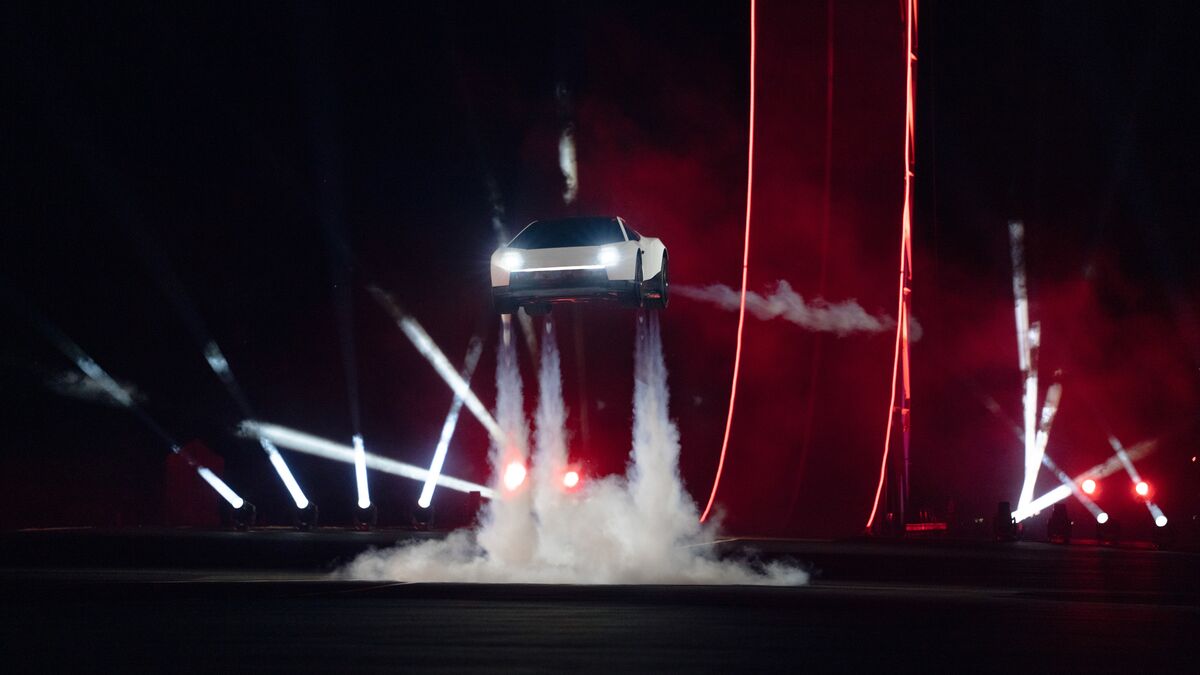
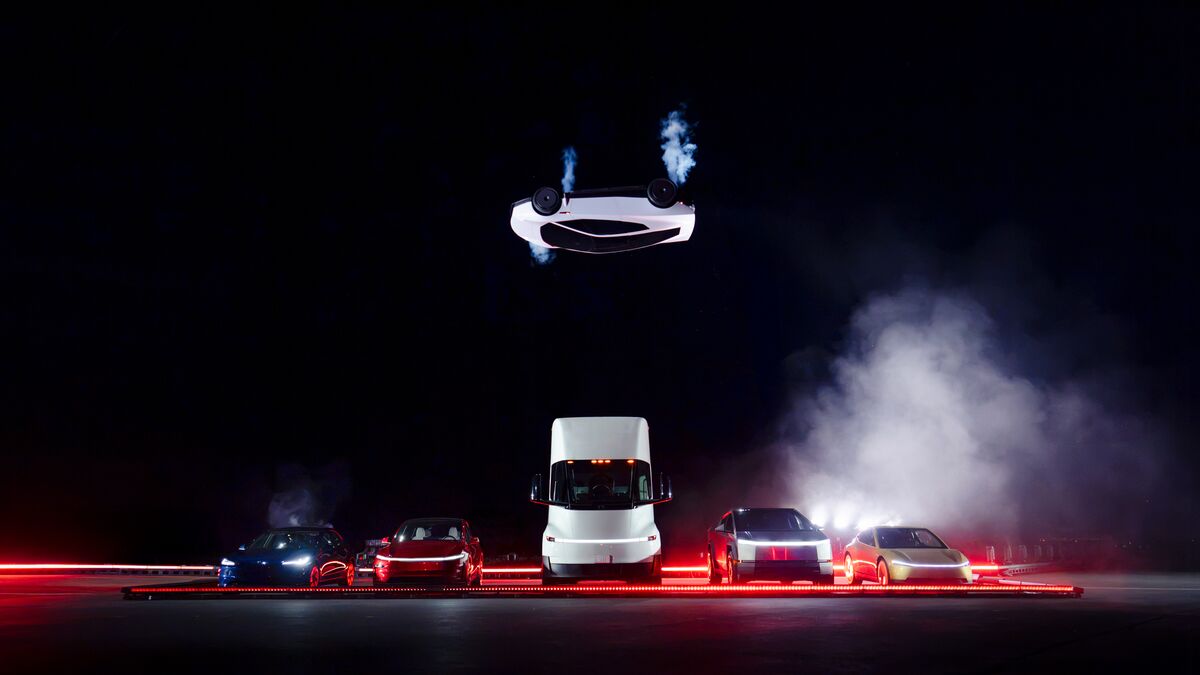
- Tesla revealed a car last night that can fly, flip, land safely (without a human in it), and drive upside down.
- The version you see in web videos is real, but not something you can buy. There will be a milder version for sale, but Tesla won’t name a price or even promise to deliver it…ever.
It flies. It can drive straight up a vertical surface. It can drive upside down. It gets from zero to 60 mph in 0.81 seconds, but might be capable of more.
You can’t buy it. It’s not clear that anyone can. But it sure is fun to watch.
Tesla last night hosted a spectacular reveal of a…well…a product capable of things no car has ever done.
We’re challenged to call the new Tesla Roadster a car because the version performing dramatic stunts on stage isn’t road-legal anywhere and won’t be sold to many people.
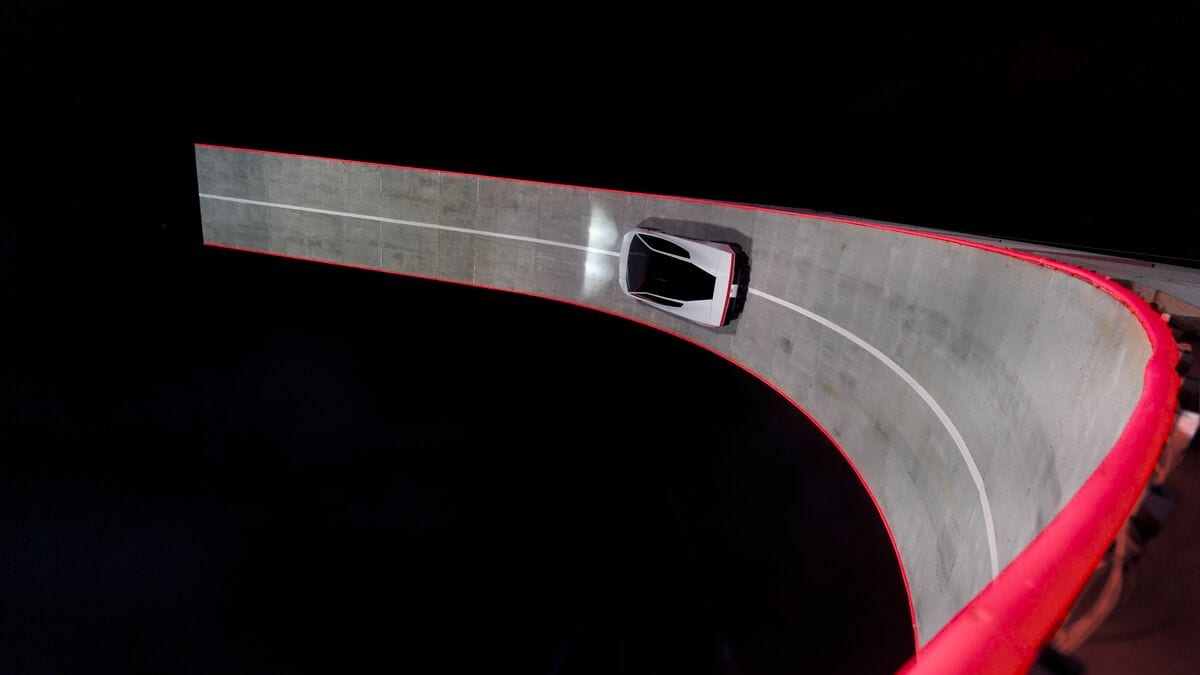
There will, however, be two versions sold to the public. One will be an exceptional high-performance car with looks inspired by exotic aircraft, a zero-to-60 time that might make it the quickest car built yet, and many questions beyond that.
One will have limited ability to do some of the things shown in the demo, be sold to a select few, and may be limited to track use.
The flying one? “Invitation only” and price undisclosed.
Let’s dive into the facts and questions about the new Tesla Roadster, and examine why CEO Elon Musk might put heavy effort into a car that nearly no one can buy.
The Basics on All Three
- There’s a real car here, plus a track toy and a stunt car for videos.
The Tesla Roadster is a 2-seater exotic sports car, and inherits the name of Tesla’s first product, an open-top 2-seater sold from 2008 to 2012. The original Roadster demonstrated Tesla’s first generation of electric vehicle (EV) technology and helped introduce the idea to American drivers.
The resurrected Roadster was promised long ago – Musk first promised a reborn Roadster in 2017 and has since delayed the model many times.
Tesla has been vague on mechanical details – not unusual for the company. Musk said the Roadsters have a steer-by-wire yoke, with brakes and throttle also electrically controlled.
The company hasn’t revealed many specifications.
The new version comes only in white, taking “inspiration from aerospace techniques that provide UV and cryogenic protection when exposed to the harshness of space.” Gold-glazed windows, too, are a nod to space travel.
Kelley Blue Book’s Jordan Schiefer notes, “The new design is much more angular, somewhat mixing the Cybercab design with a hint of Cybertruck and James Bond’s submarine Lotus Esprit. But notably, no longer a roadster by conventional definition. It’s almost entirely different from the Roadster unveiled in 2017, which now seems to be a concept model never slated for production.”
The only interior color scheme is white with gray microsuede accents. The seating position is not adjustable – the seats are molded into the car’s frame for weight savings.
First, the Flying Version
- The one you see in videos performing aerial stunts? “Invitation only” and not road legal anywhere.
Tesla executives devoted most of last night’s reveal event to an incredible series of stunts performed by a remotely operated car.
“Just to be clear, that is not a real human,” Musk explained as the doors opened to reveal a figure dressed in a white tracksuit and a helmet that did not move.
The car drove up a 90-degree incline at a slow speed, hung suspended upside down from the ceiling, then dropped, rolled, and landed on all four wheels. Cold-gas rocket thrusters – think of the can of air you use to clean your keyboard, but powerful enough to lift thousands of pounds into the air – made the car maneuver like a SpaceX rocket at landing.
Tesla calls this version the Roadster Rocket, and says it will be sold only by invitation. The company won’t reveal a price or how to get on the invite list.
It works thanks to two innovations. One is an old idea in the racing world – a system of powered fans that suck the car to the road.
The idea first appeared in the 1970s Can-Am racing series, where the Chaparral 2J used vacuum power to increase downforce and hold higher speeds through turns. It was remarkably fast when it worked, but it rarely worked long enough to finish a race, and all major racing series banned the idea almost immediately.
We still see it today on another non-street-legal track toy, the McMurtry Spéirling, known for its 1.55-second zero-to-60 time and demonstrations of hanging upside down on ceilings.
The Roadster’s Rocket trim, however, has an additional trick the Spéirling lacks — those rocket thrusters. An engineer on stage with Musk explained that they work thanks to a 600-liter tank of compressed air, and Musk noted that the car can recharge its own air tank. Neither revealed how much energy that process takes.
Ten nozzles let it hover, roll in the air, and push air out the rear to boost acceleration. In testing at the event, Tesla claimed to hit 60 mph in 0.81 seconds, and Musk said, “We anticipate being able to do better than that.”
The Rocket won’t be legal to drive on public roads anywhere, Tesla admits. “I should say that this is not necessarily a safety-optimized car,” Musk said. “But it takes the fun meter to 11 out of 10.”
Second, the Maybe-Legal-Somewhere Version
- Tesla will let you reserve a version with a few rocket thrusters, but won’t promise it’s legal where you live.
You may be able to order the mid-level Roadster trim. Called Thrust, it has the suction system and thruster facing the rear of the car to boost acceleration. It lacks the thrusters underneath that lift the car and let it roll.
You can place an order for the Roadster Thrust on Tesla’s website today. It requires $5,000 up front and another $245,000 within 10 days. That does not appear to be the final price – just a deposit.
It may or may not be drivable on public roads. States set traffic laws, and it isn’t clear today whether any state will permit a car with rocket thrusters on public roads, even if the driver agrees to use them only on a track.
Third, The Road-Legal Version
- The Roadster Performance – the one you can buy – may threaten the world’s quickest production cars.
Finally, there’s the Roadster Performance. This one, Tesla says, is “road ready.”
The company hasn’t revealed range or power figures, but promises a zero-to-60 time of under 1.6 seconds.
That is possible without thrusters. The fastest rating of any road-legal car today belongs to the Rimac Nevera, a similar electric vehicle with a demonstrated time of 1.74 seconds and several acceleration records, both forwards and backward.
The Roadster may threaten those records, though Tesla will need to allow witnessed and measured testing by outside observers.
You can reserve the Roadster Performance today with $5,000 due immediately, another $45,000 within 10 days, and no promise of a delivery date.
Much Still Up in the Air
- Price, delivery date, and most specifications remain unknown. The fine print even says buyers may never get a car.
Reservation holders are signing up for many questions.
A reservation agreement listed on Tesla’s website explains, “The estimated Purchase Price of the vehicle, if provided, is only an estimate. We are still working on what options, features and hardware the vehicle will have and so cannot confirm the exact price just yet.”
The company won’t say when it will be delivered, either. Or, incredibly, if it will be.
The agreement reads, “You understand that Roadster is still under development at the time you entered into this Agreement and so we cannot guarantee when your vehicle will actually be delivered or if it will be delivered.”
On stage, Musk suggested deliveries will begin in 2028.
What This Is Really About
- Tesla, Musk says, is getting out of the car business. So the Roadster may be mostly about selling a cutting-edge image.
Why show off a car with no fixed price, no delivery date, and virtually no specifications?
Musk has admitted that sales of the car won’t meaningfully impact Tesla’s bottom line. He has told investors on many occasions that the company intends to exit the consumer car business, believing its future success depends on robotics and selling autonomy technology to other companies.
But Tesla’s stock regularly trades at a price-to-earnings ratio of 350 or more – an indication that belief in its future possibility is more important to investors than day-to-day revenue.
There’s an old term in the automotive industry for a car an automaker builds, essentially, to show off – “halo car.”
For more conventional automakers, a halo car shows what they’re capable of in hopes that customers will buy more practical models from the same company. A gorgeous and race-winning Corvette, old car industry wisdom says, sells a lot of Equinoxes.
The Roadster will no doubt convince some people to buy a Model Y. But if Musk truly intends to make Tesla a technology company that once sold cars, even Model Y sales are ultimately unimportant. What matters is the image of the company as groundbreaking.
A flying car – even one no one can buy that can only “fly” under strict conditions and mostly appears on stage – could sell some stock as the company transitions to entirely different lines of business.