

If there’s one thing that can help prolong the life of your car, it’s regular maintenance. Ignoring seemingly minor car care tasks can lead to big problems down the road. And when we say big problems, we mean expensive ones. Think of it this way: If you stopped brushing and flossing your teeth, you could end up facing thousands of dollars in dental work down the line. Those simple, affordable tasks keep your teeth in good shape, and cars aren’t so different.
If you have a set of screwdrivers and a tire gauge, there are plenty of basic car care tasks that you can do right at home by yourself. Other, more complicated tasks are going to require a mechanic’s assistance. Don’t neglect any of these. Paying for an oil change now is going to be a whole lot cheaper than dealing with a failed engine later. Consider it your car’s personal hygiene routine.
Car Care That Is DIY
There are definitely some car maintenance tasks that are better left to your mechanic, but there are plenty that you can do yourself, right at home. These tasks don’t require any specialized equipment or complicated skills, and they can make a world of difference in keeping your vehicle in tip-top shape.
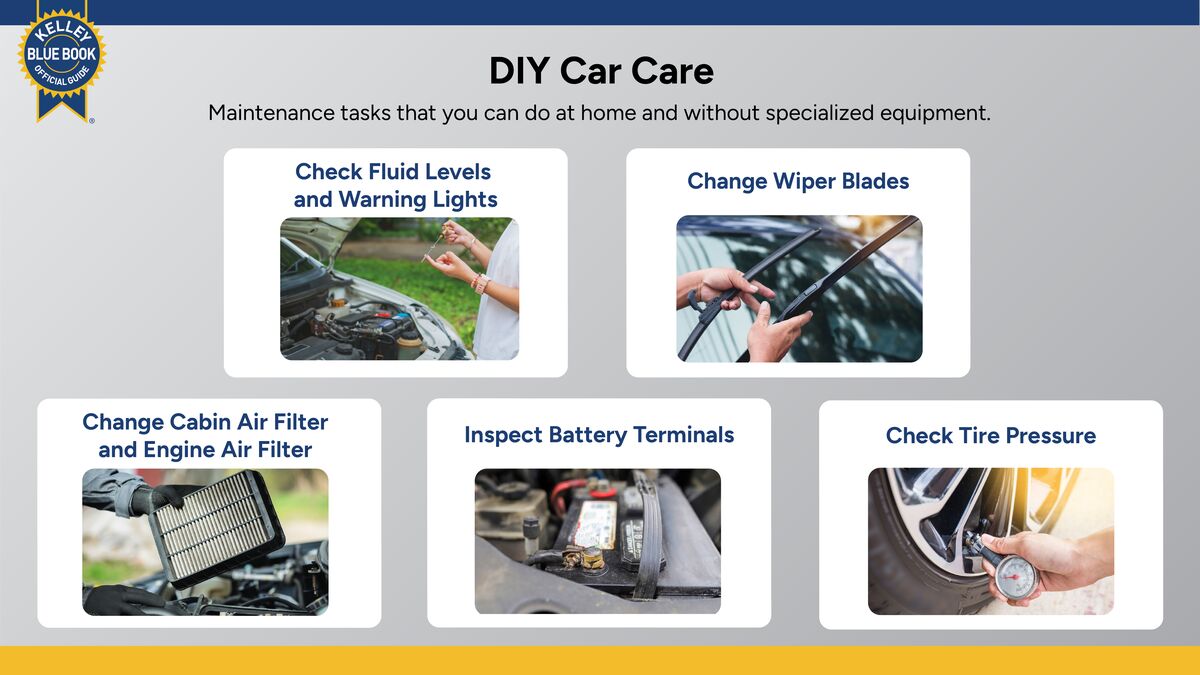
Check your fluid levels and warning lights
Check your car’s fluid levels at regular intervals. Make sure your oil level is within the appropriate range for your car, and top it off if needed. Also check your windshield washer fluid, engine coolant, brake fluid, transmission fluid, and power steering fluid (if your car uses it). If you notice issues with any of these, like a very low level of one fluid, or any odd smells, make an appointment with your mechanic for further investigation.
When you’re inside your car, keep an eye on your warning lights. It’s easy to tell yourself, “I’ll get to it later,” but “later” can very quickly snowball into a bigger problem. Don’t delay addressing alerts when they pop up.
Change your wiper blades
The last thing you want is to get caught in the first storm of the season only to realize that your windshield wiper blades are warped or cracked. It can lead to very dangerous situations if your wipers can’t sufficiently clear your windshield. Replacing your wiper blades is a simple task that you can do by yourself, with major implications for keeping you safe on the road.
Change your filters (cabin air and engine air)
A dirty air filter can reduce fuel economy, hurt engine performance, and contribute to higher engine emissions. In most cars, replacing your cabin air filter and your engine air filter are tasks that you can easily do yourself. You’ll have to buy the appropriate filter for your make and model, either online or from a local car parts store, but generally all you will need is a screwdriver.
There are some models where these replacements are a bit more complicated, and in those cases you might want to have your mechanic help out when they do your oil change, but if you’re able to do it yourself for your particular vehicle, you can definitely save yourself some money.
Inspect your battery terminals
A quick visual check of your battery can help alert you to issues early on. This way, you can replace the battery before a dead one leaves you stranded somewhere. When you’re checking your other fluids, give your battery a close look. A white, blue, or greenish dust around your battery terminals is corrosion, and can prevent your battery from working properly. You can disconnect your battery and clean the terminals yourself, or ask your mechanic to take a look.
To keep an eye on your battery’s health, you can also buy a voltmeter (also called a multimeter) for less than $30. These devices help measure electrical flow, and if you notice an issue, you can take action before it leads to a bigger battery problem.
Keep an eye on your tire pressure
Keeping your tires properly inflated is essential to the health of your car, and your safety. Driving with low or uneven tire pressure can lead to problems that start with decreased fuel economy or uneven tread wear, and which can balloon into problems like less-responsive steering or even tire blowouts. Checking your air pressure regularly only takes a few minutes and can help prevent big problems. Make sure that you are filling your tires to the appropriate range, which will be printed on the tire itself and also usually on a sticker inside the driver’s side door.
Modern cars employ a tire pressure monitoring system (TPMS) that will alert you to any tire pressure issues, but these systems can tend to be a little finicky. We recommend that you always keep a physical tire gauge on hand for confirmation.
EXPLORE: Car Maintenance Information Center
Car Care Best Left to the Pros
Certain maintenance tasks require specialized equipment or skills. In these cases, your trusty mechanic should have your back — you just need to be diligent about getting your car to them regularly. Regular oil changes are perhaps the single most important maintenance item for car longevity. We’ve all heard tales of cars going 200,000 or 300,000 miles (or more!) with not much work beyond regular oil changes. While it’s not a guarantee for a long car life, oil changes, along with these other maintenance items, will go far toward keeping your car healthy. Keeping a regular maintenance schedule also helps catch bigger issues before they grow, as your mechanic will have more opportunities to touch and diagnose your car.
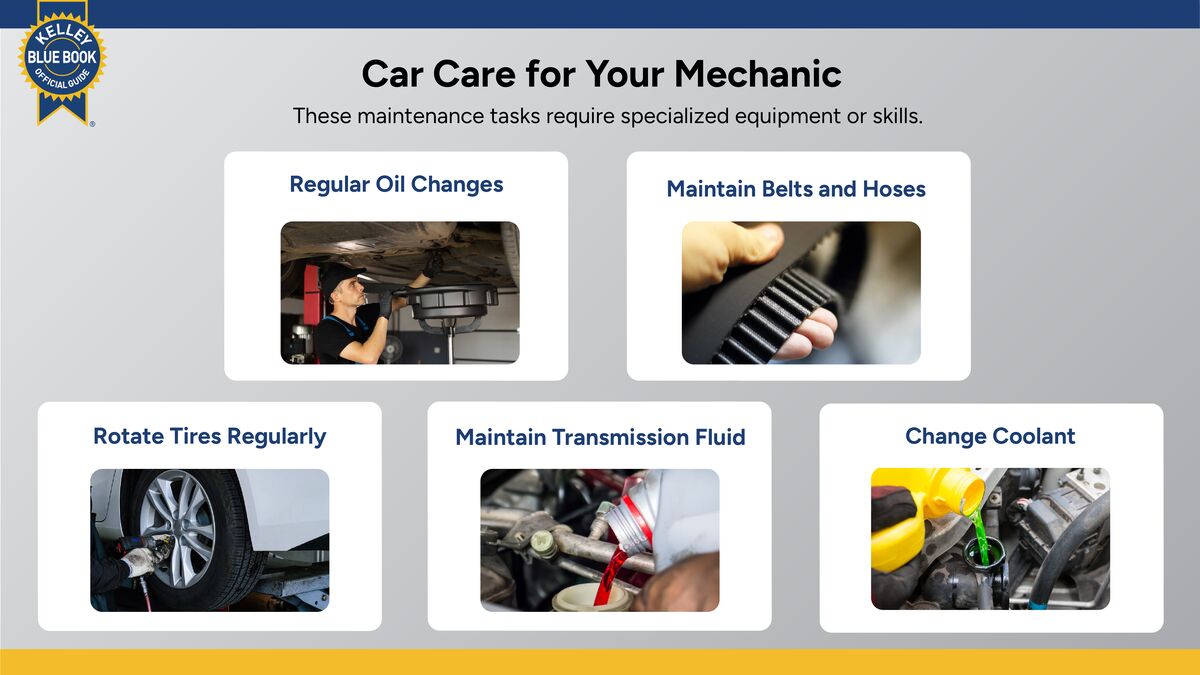
Get regular oil changes
Change your car’s oil and filter at the intervals recommended in the owner’s manual. In most cases, that is every 5,000, 7,500 or 10,000 miles. Some car owners swear by an every-3,000-mile oil change. Oil lubricates the car’s engine parts and disperses heat. It is critical — we cannot stress this enough. Neglecting your oil can lead to sludge buildup, which is a quick path to major engine issues.
Some people are able to change their own oil at home, but if you don’t want the hassle, find a good local mechanic who can regularly service your car. If your vehicle is under certain types of leases or warranties, your dealer will perform this maintenance.
Inspect and replace belts and hoses at regular intervals
Your car has hoses and belts that serve different functions but are all critically important to keeping your car running. The timing belt, serpentine belt, radiator hoses, and heater hoses are all rubber parts, and they don’t last forever. You’ll know you have an issue if, for example, you start to hear a loud squeal every time you start your car. But ideally, it won’t get this bad before you act. If a belt breaks while driving, it can be catastrophic.
All belts and hoses should be replaced at the intervals recommended by the manufacturer. While you’re under the hood checking your fluids or battery, you can also eyeball these components to see if you notice any visual issues, like cracks. Your mechanic should also be doing regular visual inspections when your car is in for service. Replacing something like a timing belt isn’t cheap, but it’ll still be thousands less than rebuilding your engine.
Rotate your tires regularly
Tires are expensive, and you want them to last. While you can maintain their air pressure on your own, you’ll need your mechanic to help you rotate your tires. Regular tire rotation helps ensure that your tires wear evenly. This extends the lifespan of the tires and helps them maintain optimal traction. Your owner’s manual will say when the tires should be rotated and alignment checked.
Maintain your transmission fluid
Having the proper amount of transmission fluid is critical because it cools the transmission, lubricates moving parts, and smooths the shifts between gears. However, the fluid deteriorates over time. Check the owner’s manual for details on when to change your car’s transmission fluid. Frequent stop-and-go driving or pulling a trailer accelerates deterioration. Under those conditions, the transmission’s operating temperature rises, putting a strain on the transmission’s components and the fluid. Automakers recommend more frequent fluid replacement in these cases.
If the fluid turns dark or has a burnt smell, this could indicate that it needs to be changed or that the transmission is developing mechanical issues. Check the fluid level when the engine is running. To avoid transmission failure, only use the fluid recommended by the automaker.
Change your coolant
Coolant is essential for regulating your engine temperature, and like all car fluids, it doesn’t last forever. Coolant has rust inhibitors that break down over time. Rust and corrosion can build up and harm an engine, plug a thermostat, or damage a water pump. Some automakers recommend a coolant change every 30,000 miles, while others suggest over 100,000 miles. Always check the owner’s manual for your vehicle’s specific recommendations.
Other Car Care You Shouldn’t Neglect:
While the 10 tips above are among the most critical to maintaining the longevity of your car, we also have a few honorable mentions to consider:
- Replace your brake pads: The typical range for a brake pad replacement is between 25,000-50,000 miles. This range will depend significantly on where and how you drive, but when it’s time, don’t neglect this critical safety item.
- Replace spark plugs: Spark plug replacement intervals vary widely. Some indicators that it might be time for spark plug replacement are rough idling, engine misfires, or sluggish acceleration.
- Maintain your Air Conditioning System: If you live in a climate where AC is essential, you’ll want to keep an eye on your system. If you’re feeling handy, you can even DIY some of your own AC care.
- Rear differential service: While not as commonly talked about as other maintenance tasks, draining and replacing the gear lubricant to keep the axle components cool and working smoothly is important for your vehicle. Follow your manufacturer’s guidelines for this service.
- Maintain your power steering fluid, if needed: Older vehicles and some new models have a hydraulic power steering pump that is lubricated by power steering fluid. The pump’s reservoir has a screw-type cap that lifts off, so the fluid level can be checked. If the pump runs dry, it can fail and require a replacement costing hundreds of dollars. A few symptoms of a power steering problem are squealing noises when turning the steering wheel or heavy or stiff steering. Newer vehicles have electric power steering; there are no fluids.
Like flossing every day, once you’re in the habit of doing regular car maintenance, it becomes second nature and just another part of your lifestyle. Your teeth, and your car, will thank you.