

Towing capacity is more complex than a single number in pounds might suggest. Whether you’re looking for a full-size truck to tow your boat, or the best towing SUV to take your family on vacation and pull the camper you’ll stay in, there’s a series of terms and concepts you’ll need to understand to make the right decision. We’ll break them down.
What Is Towing Capacity?
Your vehicle’s towing capacity is the maximum amount of weight it can safely pull, which changes based on how it’s configured, how much weight it’s already carrying, and how you distribute and control the load you’re towing.
While manufacturers will publish a towing capacity for each vehicle they build, it’s important to note that those calculations typically assume the vehicle is carrying only a driver. If you plan to tow a travel trailer and bring along your family and all the associated gear for a weekend away, the manufacturer’s calculations will not be accurate for your load.
How Manufacturers Determine Towing Capacities: What Is SAE J2807?
Previously, each truck maker had its own formula for determining what its trucks could tow, making it almost impossible for truck shoppers to compare vehicles.
Eventually, the Society of Automotive Engineers (SAE) established its SAE J2807. In a nutshell, it’s a code of performance requirements and testing protocols for establishing a tow vehicle’s gross combined weight rating (GCWR), which we’ll define below. It also sets the procedures for establishing a vehicle’s trailer weight rating. It became the industry standard beginning with the 2013 model year.
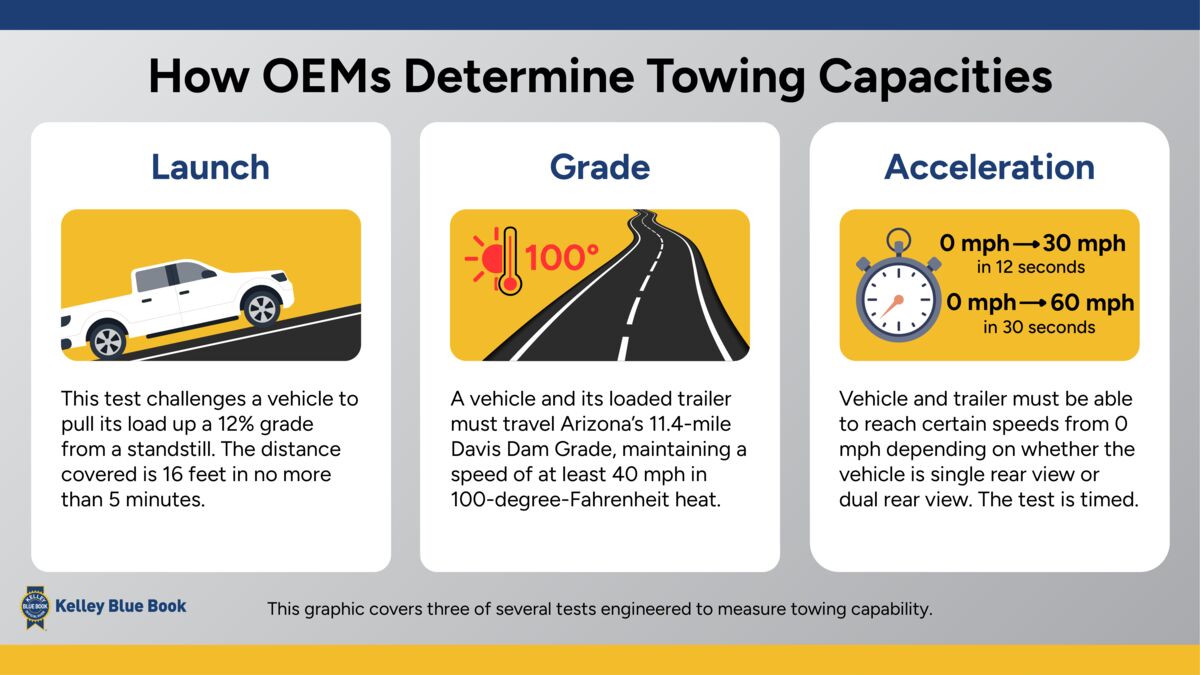
Several tests were engineered to measure a truck’s towing capability. Here are three:
- Launch: This timed test challenges a vehicle to pull its load up a 12% grade from a standstill. The distance covered is 16 feet in no more than 5 minutes. The vehicle must go forward up the hill and then reverse up the hill.
- Grade: A vehicle and its loaded trailer must travel Arizona’s 11.4-mile Davis Dam Grade, maintaining a speed of at least 40 mph in 100-degree-Fahrenheit heat.
- Acceleration: Vehicle and trailer must reach 30 mph from a standstill in 12 seconds (single rear wheel) or 14 seconds (dual rear wheel) on flat pavement. They must accelerate from zero to 60 mph in 30 seconds (SRW) or 35 seconds (DRW). Finally, the truck and trailer are timed as they accelerate from 40 mph to 60 mph. The time limits are 18 seconds (SRW) and 21 seconds (DRW).
RELATED: Maximum Towing Capacity For Every Truck
How to Calculate Towing Capacity
To calculate your vehicle’s towing capacity, you’ll need to know the full GCWR, or the gross combined weight rating, of the vehicle you plan to tow with and the trailer you plan to tow, together with all the cargo each will carry, from people to wiper fluid.
Then you’ll need to know your tow vehicle’s curb weight — the weight of the tow vehicle itself when filled with gas and all the other fluids it consumes while driving.
Subtracting the curb weight plus the vehicle’s payload from the GCWR gives you the vehicle’s towing capacity. Manufacturers will stress that you should never exceed your car or truck’s towing capacity. We would add that, for safety reasons, it’s best to keep a buffer and avoid getting within 20% of that total.
Loads shift. People miscalculate. And, cars brake suddenly. For many reasons, driving a vehicle that strains at the absolute limits of its capability isn’t a good thing.
RELATED: Best SUVs for Towing: Everything You Need to Know
GVWR vs. Towing Capacity
Your tow vehicle’s Gross Vehicle Weight Rating (GVWR) and its towing capacity are different figures. GVWR is the maximum total weight a vehicle can safely operate, including passengers, fuel, cargo, and the tongue weight of anything being towed. Towing capacity is the maximum total weight that can be pulled horizontally on the frame via the tow hitch.
All the Towing Capacity Terms You Need
Towing comes with its own lingo, which can be intimidating at first. But all the terms boil down to simple measurements, and there’s no need to memorize them. You can always look them up again here.
Braked Towing Capacity: Some trailers come equipped with their own brakes, so that stepping on the vehicle’s brake pedal activates the trailer’s brakes at the same time. A vehicle can tow a much heavier load if the trailer operates with its own brakes.
Curb Weight: Total weight of a vehicle and all the fluids it requires to function without people or cargo inside.
Dry Weight: How much a vehicle weighs with no cargo and none of the fluids it requires to function: gasoline, oil, wiper fluid, or any other consumables.
Gross Axle Weight Rating (GAWR): The maximum amount of weight one axle can support. This number will almost always show differences between the front and rear axles.
Gross Combined Weight Rating (GCWR): Also known as gross combined vehicle weight rating. It is the weight your tow vehicle is rated to handle when fully loaded with a trailer and all cargo.
Gross Vehicle Weight Rating (GVWR): The maximum amount of weight a vehicle can hold, including the weight of the vehicle itself.
Gross Trailer Weight (GTW): Total weight of your trailer and its cargo. It is crucial that you never even attempt to tow a GTW higher than your towing capacity.
Payload: The amount of weight a tow vehicle is rated to carry in its cabin and bed.
Tongue Weight: Also known as TW, tongue weight is the downward force exerted on the trailer hitch by the load being hauled.
Towing Capacity: The maximum amount of weight the vehicle can safely pull.
Trailer Hitch Classes
Once you know the various weights and capacities of your tow vehicle and trailer, you’re not done. The next step is to understand the device that connects them. Tow hitches operate within their own physical limits.
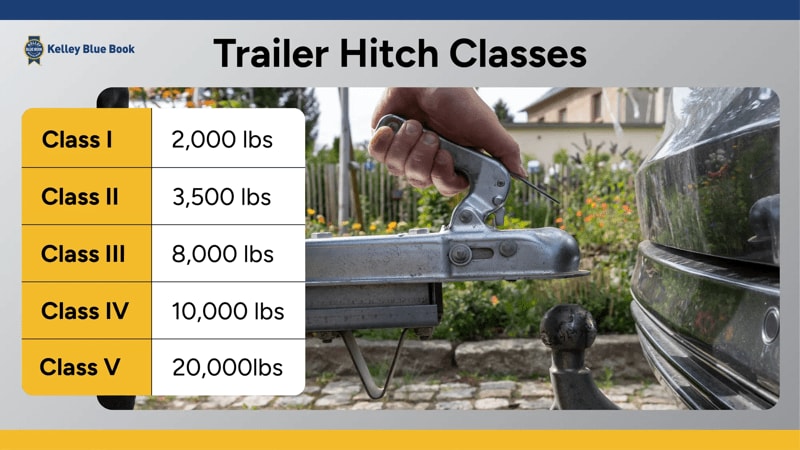
Trailer hitches are divided into five classes.
- Class I: Generally used for small and midsize cars and crossovers, Class I hitches can pull up to 2,000 pounds and generally withstand a tongue weight of 200 pounds. You might use a Class I hitch to carry a small cargo tray or pull a small tent camper or personal watercraft.
- Class II: Generally used for large cars, crossovers, and minivans, Class II hitches can pull up to 3,500 pounds and withstand a tongue weight of 350 pounds. You might use a Class II hitch to tow a small boat on a trailer.
- Class III: The most common hitch, Class III hitches can pull up to 8,000 pounds and support a tongue weight of up to 800 pounds. They are well-suited for vans, SUVs, and pickup trucks for general-purpose towing.
- Class IV: Generally used on full-size vans, trucks, and SUVs, Class IV hitches can pull up to 10,000 pounds and withstand a tongue weight of 1,000 pounds. They are the smallest class of hitch usable with loads heavy enough to require weight distribution. You might use a Class IV hitch to tow a large boat, a larger camper, or a utility trailer carrying a load of lawn equipment.
- Class V: These hitches can pull up to 20,000 pounds and are used only with full-size trucks or SUVs specifically configured for towing heavy loads. Class V can withstand a tongue weight of up to 2,000 pounds. You might use a Class V hitch to tow a horse trailer or multi-car trailer.
How Do I Know What I Can Tow?

Unfortunately, it’s not easy to find the towing capacity of some vehicles. The weight a vehicle can pull is affected by its engine, transmission, and suspension, among other factors. Most vehicles powerful enough to tow heavy loads offer a selection of each of those components. Truck manufacturers also offer towing packages that can change axle ratios and tire types, and include factory-installed hitches.
Thankfully, many truck and SUV manufacturers today post a sticker on the driver’s door jamb that includes much of the necessary towing information, such as GVWR and GAWR.
RELATED: What Are Trailer-Towing Technologies?
Similar charts are almost always found inside your vehicle’s owner’s manual. But accurately reading them requires knowing which equipment package your car or truck has, which is not always clear when you’ve bought a used one.
Most truck and SUV manufacturers maintain websites that can provide that information based on your vehicle’s vehicle identification number (VIN), such as Ram’s Towing Calculator.
Class of Vehicle and Towing Capacity
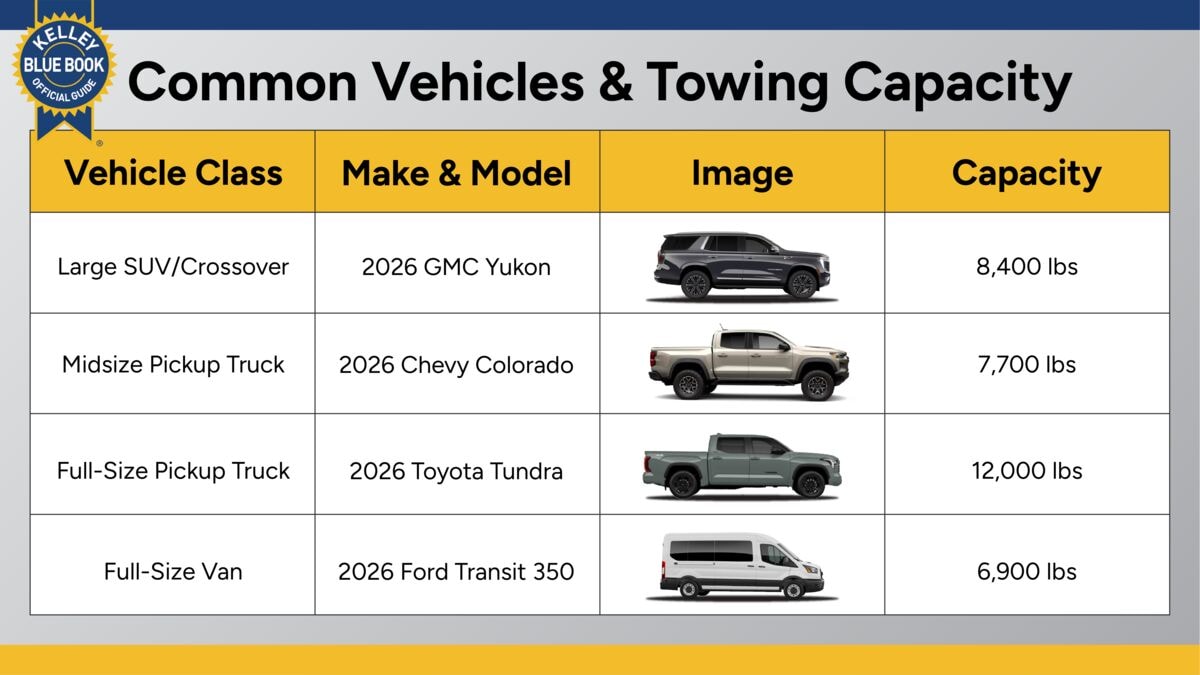
See below for the vehicle class and some typical vehicle towing capacities for gasoline-only models.
Subcompact SUV/Crossover
- 2026 Subaru Crosstrek: up to 3,500 pounds
- 2026 Jeep Compass: up to 2,000 pounds
Small SUV/Crossover
- 2026 Toyota RAV4: up to 3,500 pounds
- 2026 Ford Escape: up to 3,500 pounds
Midsize SUV/Crossover
- 2027 Kia Telluride: up to 5,000 pounds
- 2026 Nissan Pathfinder: up to 6,000 pounds
Large SUV/Crossover
- 2026 GMC Yukon: up to 8,400 pounds
- 2026 Ford Expedition: up to 9,600 pounds
Midsize Pickup Truck
- 2026 Nissan Frontier: 7,150 pounds
- 2026 Chevy Colorado: 7,700 pounds
Full-Size Pickup Truck
- 2026 Toyota Tundra: 12,000 pounds
- 2026 Chevy Silverado 1500: 13,300 pounds
Heavy-Duty Pickup Truck
- 2026 Ford F-350 Super Duty: 40,000 pounds (gooseneck)
- 2026 Ram 3500 HD: 36,610 pounds (gooseneck)
Full-Size Van
- 2026 Ford Transit 350: 6,900 pounds (cargo van)
How Much Towing Capacity Do I Need?
You need more towing capacity than the heaviest weight you plan to pull. Your tow vehicle must be capable of hauling its own weight, the weight of everyone and everything inside it, the weight of the trailer it’s pulling, and the weight of everything on the trailer. It must be capable of pulling all of that weight combined and be equipped with a hitch that can do the same. And that load must be balanced, keeping in mind both the horizontal force required to move the load and the vertical weight the load places on the hitch and the assembly that mounts it to the vehicle’s frame.
Can I Tow a Small Travel Trailer With My Car?
Most likely, yes, depending on the trailer’s weight. Check the owner’s manual or your manufacturer’s online tools to determine your vehicle’s towing capacity.
Here’s a rough guide to the weights of some common loads by trailer type.
| Type of Trailer | Empty Weight (est.) | Typical GVWR (loaded) | Typical Tongue Weight (loaded) |
| Canoe/Kayak Trailer | 100 to 400 pounds | 200 to 800 pounds | 30 to 120 pounds |
| Motorcycle Trailer | 100 to 600 pounds | 800 to 3,000 pounds | 120 to 450 pounds |
| Dolly for Towing Car | 400 to 800 pounds | 3,000 to 5,000 pounds | 450 to 750 pounds |
| Open Utility Trailer | 400 to 1,200 pounds | 2,000 to 7,000 pounds | 300 to 1,050 pounds |
| Pop-Up Camper | 1,500 to 3,200 pounds | 2,800 to 4,300 pounds | 420 to 645 pounds |
| Large Travel Trailer | 5,000 to 9,000 pounds | 6,500 to 11,000 pounds | 975 to 1,650 pounds |
| Fifth-Wheel Camper | 5,000 to 15,000 pounds | 17,000 to 20,000 pounds | 2,550 to 3,000 pounds |
What Counts Toward Towing Capacity?
To calculate it, you need to know your vehicle’s GCWR, its curb weight, and its maximum payload capacity. The formula is:
GCWR – (curb weight + payload) = towing capacity
Your vehicle’s towing capacity is also stated in the owner’s manual and often on a label on the driver’s side door jamb.
A common towing guideline is not to exceed about 80% of your vehicle’s rated towing capacity. That margin helps account for miscalculations and variables like wind, hills, and braking distance. Depending on configuration, a large pickup, such as a ½-ton (1500-class) type, may be able to tow around 10,000 pounds. Many 1500s are rated for 12,000 pounds or more when properly equipped.
Can I Safely Exceed GVWR?
It is not safe to exceed your vehicle’s GVWR. Even if you can get the vehicle moving with a heavier load than posted, you may not be able to control it safely or stop it at a safe distance. You can also damage vehicle components with every mile you drive. Exceeding the GVWR may be illegal and could result in insurance issues and citations.
6 Tips to Maximize Towing Capacity
If you already own your tow vehicle and need an upgrade to haul more weight, here are modifications that can improve towing performance. Note: These changes may not increase the vehicle’s official tow rating, and they can be expensive, affect day-to-day drivability, and reduce resale appeal.
1. Upgrading the Hitch
If your vehicle is rated to tow more than the current hitch is rated to tow, upgrading to the next hitch class will allow you to tow more safely, if the rest of the towing system is rated accordingly.
2. Installing a Weight-Distribution Hitch
A weight-distribution hitch uses spring bars to help level the load a trailer places on your tow vehicle and reduce sway. This type of hitch is often the most cost-effective way of improving towing performance. It doesn’t require replacing any moving parts of the vehicle itself.
3. Upgrading the Brakes
Braking power is often the limiting factor in a vehicle’s load capacity. You might be able to step up to larger brake pads and rotors affordably.
4. Replacing the Axles
Some specialty shops can replace certain axle components with heavier-duty versions built for demanding loads. This is a complex job that may not be practical for many vehicles.
5. Adding a Bigger Radiator
Towing is taxing on an engine. Improving your engine’s cooling capacity with a bigger radiator can enable it to pull more weight without causing undue wear and tear to powertrain parts.
6. Adding an Auxiliary Oil Cooler
Think of an auxiliary oil cooler as a radiator for your oil. Oil is an engine’s lifeblood. Although it needs to be fluid (warm) enough to easily circulate around the engine, heavy-duty towing can cause the oil to overheat, which can degrade the oil and damage the engine.
How to Decrease Towing Capacity
Just as you can improve your tow vehicle’s performance under load with a few modifications, you can also reduce it. Be cautious of changes like:
1. Installing Bigger Wheels
Larger aftermarket wheels might look cool or even improve your vehicle’s ground clearance; however, they invalidate the manufacturer’s calculations of towing capacity. Larger tires require more engine torque and change the transmission’s shift points. These penalties may not be apparent when unladen, but they can dramatically reduce a vehicle’s towing capacity.
2. Changing the Tires
You are likely to go through several sets of tires over the life of your tow vehicle. Be sure the tire vendor knows they are driving on a tow vehicle. Low-resistance tires that improve gas mileage might sound like a good investment, but they can reduce a vehicle’s towing capacity.
What Other Technology Helps You Tow Safely?
Manufacturers of trucks began a competition of sorts with one another in recent years. As a result, they have developed unique and valuable technologies that help make towing safer.
If you’re considering a new tow vehicle or a used truck from a private seller, some features you might consider include:
Ford Pro Trailer Backup Assist and Ram Trailer Reverse Steering Control: Like a second steering wheel for the trailer, these systems give you a knob that steers the trailer when you’re in reverse. Since backing up is often the worst part of towing, when the trailer turns in the opposite direction of the tow vehicle, this assistance can drastically reduce your frustration.
READ MORE: How To Use Trailer Backup Assist for Towing
GMC and Chevy Towing Cameras: The Chevy Silverado and GMC Sierra are available with up to 15 camera views, including a top-down view of the hitch to help with positioning and a “transparent trailer” setting that shows the rear view unencumbered by the load you’re towing.
If your vehicle doesn’t meet your towing needs, consider trading it in for a new or used vehicle. Try our Kelley Blue Book Instant Cash Offer and Trade-In Values to determine your vehicle’s value and get an offer with no obligation.
After you trade in your existing vehicle, you can also get a free dealer price quote for a new one.
Full-Size Trucks With the Highest Towing Capacity
Here are the maximum towing capacities as posted by the truck manufacturers. We address electric trucks separately.
| Pickup Truck | Towing Capacity |
| 1. 2026 Ford F-150 | Up to 13,500 pounds |
| 2. 2026 Chevy Silverado 1500 | Up to 13,300 pounds |
| 3. 2026 GMC Sierra 1500 | Up to 13,200 pounds |
| 4. 2026 Toyota Tundra | Up to 12,000 pounds |
| 5. 2026 Ram 1500 | Up to 11,610 pounds |
Editor’s Note: We have updated this article since its initial publication.