
If you’re thinking about buying an electric vehicle (EV), you probably have questions about how electric cars work, how far they can travel, where you can charge, and what they cost to own.
Below, we outline the basics of charging, range, ownership costs, safety, and more, so you can choose the right electric vehicle that meets your needs. Keep reading for answers to your EV questions.
- Electric Vehicle Types
- Electric Vehicle Range
- EV Charging Stations
- Electric Vehicle Recharging Cost
- EV Ownership Costs
- Choosing All-Electric or Hybrid
- EV Safety Features
What Is an Electric Vehicle?
An electric vehicle, or EV, uses an electric motor for some or all of its propulsion. However, the term “EV” commonly refers specifically to a fully electric vehicle powered by a rechargeable battery rather than a gasoline engine. Fully electric vehicles are also called battery electric vehicles, or BEVs.
EVs are part of a broader group of electrified vehicles that includes conventional hybrids, plug-in hybrids, mild hybrids, and hydrogen fuel cell vehicles.
What Are the Different Types of Electric Vehicles?
An introduction to electric cars begins with an explanation of the abbreviations used to describe different types of electric and electrified vehicles.
EV: “EV” stands for electric vehicle. While the term can broadly describe vehicles that use electricity for propulsion, consumers and automakers commonly use EV to mean a fully electric, battery-powered vehicle.
BEV: A BEV, or battery electric vehicle, uses only its electric motor or motors for propulsion. Because BEVs lack a traditional internal combustion engine and use no gasoline, they produce no tailpipe emissions. A BEV is another term for a fully electric vehicle (EV).
HEV: “HEV” stands for “hybrid electric vehicle.” An HEV is an electrified car that runs on both an internal combustion engine and an electric motor that uses energy from a battery. Hybrids use regenerative braking to recover some of the energy normally lost when slowing down and use it to recharge the battery. HEVs are known for their fuel economy because using battery power decreases how much gas the internal combustion engine uses.
PHEV: A PHEV is a plug-in hybrid. PHEVs plug into a power outlet to charge their batteries and also have a gasoline engine on board that can power the vehicle once the battery is depleted. Depending on the model, a PHEV can travel dozens of miles using electricity alone before relying more heavily on its gasoline engine.
MHEV: Mild hybrid means electric assist, not electric power. The goal of a mild-hybrid electric vehicle is to reduce the load on its internal combustion engine (ICE), improving the car’s gas mileage. For example, an MHEV may use a modest electric motor, a small battery pack, and a regenerative braking system to reduce fuel consumption.
FCEV: FCEV stands for fuel cell electric vehicle. These cars run on compressed hydrogen and use a fuel cell to generate electricity that powers an electric motor. Filling an FCEV takes only a few minutes, but hydrogen vehicles and public fueling stations remain extremely limited.
How Does an Electric Car Work?
A battery-electric vehicle stores electricity in a large battery pack, which sends power through electronics that control the flow of electricity to one or more electric motors. The motors turn the wheels, allowing the vehicle to move without a gasoline engine or conventional multispeed transmission.
Most EVs use a single-speed gear reduction system because electric motors can deliver useful power across a wide range of speeds. EVs also use regenerative braking. When the driver slows the vehicle, the electric motor can operate in reverse to recover some of the vehicle’s kinetic energy and return electricity to the battery.
Drivers recharge the main battery by plugging the vehicle into an external power source.
How Far Can an Electric Car Go?
Electric car range can contribute to apprehension that buyers might feel when deciding to give up their vehicle that uses a traditional gasoline engine. This apprehension is often called “range anxiety.” Today’s EVs can easily accommodate most daily driving, but electric car battery manufacturers continue to improve capacity and recharge times.
- Many EVs can travel more than 250 miles on a full battery charge, and some long-range models can travel well beyond 400 miles. Both long-range and short-range EVs can perform well in start-and-stop driving during rush hour.
- EVs typically use more energy at steady highway speeds than in lower-speed city driving, where regenerative braking can recover energy.
- Hot weather and especially cold temperatures can reduce the range of electric cars, partly because of air conditioner and heater use but also because extreme temperatures affect battery chemistry.
- Your usable range can also depend on charging habits. Some automakers recommend charging to less than 100% for routine daily use to help preserve battery health. Follow the manufacturer’s recommendations for your vehicle.
RELATED: 10 Longest-Range Electric Cars
How Do You Charge an Electric Car?
Some EV drivers worry about depleting the battery without a charging station nearby. One perk of an electric vehicle is that you can plug in and recharge at home or use EV charging stations when you’re out and about.
The United States has tens of thousands of public charging locations and hundreds of thousands of charging ports, and the network continues to grow. The U.S. Department of Energy’s Alternative Fuels Data Center provides a searchable map of public charging stations.
There Are Three Types of Chargers for Electric Cars
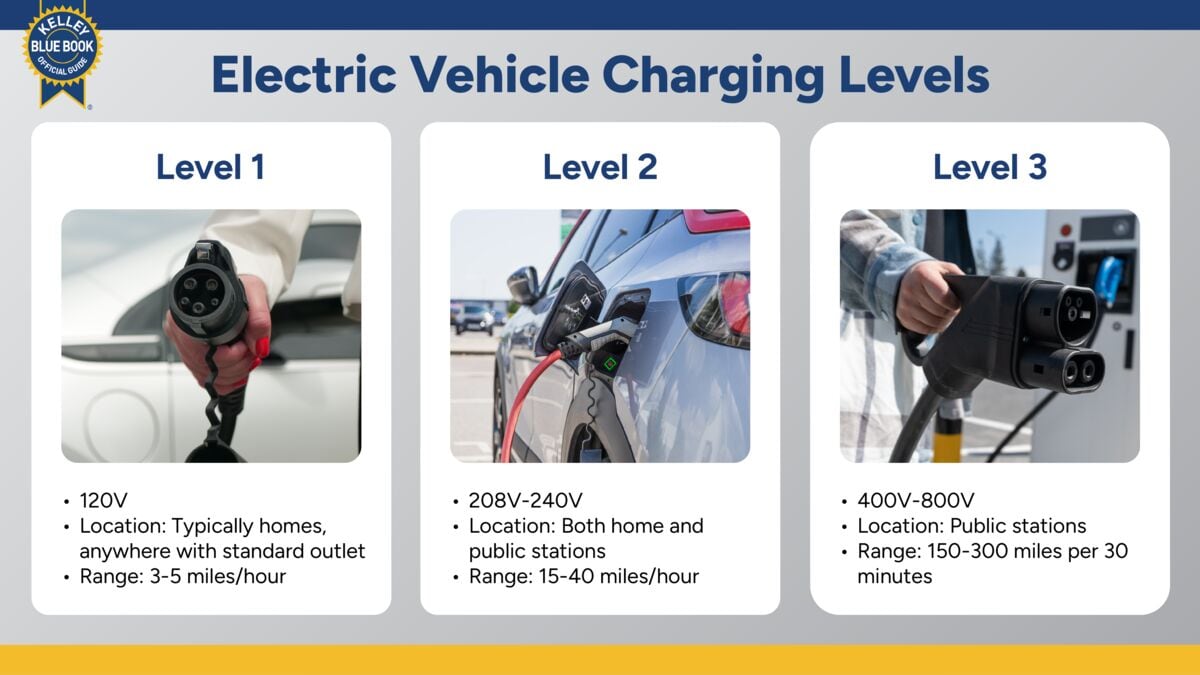
- Level 1: This level refers to household 3-prong outlets like those your computer or a desk lamp uses. Level 1 is the slowest charging method. It may be adequate for drivers with short daily commutes but can take more than a day to fully recharge a large EV battery.
- Level 2: Most people prefer Level 2 charging capability, whether at home or at a public charging station. These chargers provide 240 volts of power and can recharge an EV much faster than a standard household outlet. Level 2 is the most common choice for home EV charging.
- DC Fast Charging: Also called “Level 3” charging, DC fast charging is the quickest way to recharge an EV and is primarily available at public charging stations. Depending on the vehicle and charger, some EVs can replenish much of their battery in less than 30 minutes.
Charging speed varies by vehicle, charger output, battery temperature, and the battery’s state of charge. EVs also don’t charge at a constant rate; DC fast charging generally slows as the battery approaches full capacity.
Another major change in public charging is the industry’s shift toward the North American Charging System, or NACS, also standardized as SAE J3400. Many automakers now offer NACS ports or adapters that allow compatible vehicles to access portions of Tesla’s Supercharger network. Connector compatibility varies by vehicle and charging station, so check before a trip.
RELATED: An EV Charger Buying Guide: See All Your Options
How Much Does Charging Cost?
A common question from potential electric car buyers is: How much does it cost to charge an EV? For charging at home, the answer requires some math and depends on several factors, primarily how much you drive and the price you pay for residential electricity.
For example, let’s say you put 1,000 miles on your vehicle each month and pay the national average of about 18 cents for each kilowatt-hour of electricity. Your at-home EV charging bill will be about $46 to $61 per month, based on 3 to 4 miles of driving per kWh.
Now, look at the cost of filling a tank with gasoline. Let’s say you’re driving an economical car that has a combined average of 30 mpg during a mix of city and highway driving. Using a 12-gallon tank as a reference point, you’ll have 360 miles of driving range for each fill up.
If you’re driving the same 1,000 miles monthly, you’ll need about 33 gallons of gasoline. With the average price of gas about $4.10 per gallon in late August 2026, according to AAA, your monthly fuel expense will be about $135.
These examples are estimates. Electricity rates, gasoline prices, vehicle efficiency, charging losses, and public-charging fees can significantly change the comparison.
MORE: How Long Does It Take to Charge an Electric Car
What is the Cost to Own an EV?
The purchase price of an EV can be higher than that of a comparable gasoline-powered model, although prices vary widely by vehicle. Automaker discounts and state, local, or utility incentives may reduce the cost of some EVs.
EVs can cost less to fuel when charged at home and generally require less routine powertrain maintenance than gasoline-powered vehicles. However, insurance, tire replacement, public fast charging, and depreciation also affect the total cost of ownership.
Depreciation Costs of an Electric Car
Many EVs have experienced faster depreciation than their gas-powered counterparts in recent years. While this can be disappointing to a buyer who drives off the lot in a new EV, it’s good news if you’re buying a used electric car.
EV Maintenance: What’s Different?
Fully electric vehicles eliminate many maintenance items found on gasoline-powered cars. They don’t need engine oil changes, spark plugs, or exhaust-system repairs, and regenerative braking can help extend the life of brake pads.
However, an EV isn’t maintenance-free. Owners still need to monitor tires, brakes, brake fluid, cabin air filters, wiper blades, suspension components, and the vehicle’s 12-volt battery. Some EVs also have coolant or other thermal-management fluids with manufacturer-specified service intervals. Tires may wear more quickly on some EVs because of vehicle weight and the immediate torque electric motors can produce. Follow the maintenance schedule in the owner’s manual.
Tips for Buying a Used EV
- Check the battery health. Like the battery in a mobile phone or laptop, an electric car’s battery gradually loses some capacity with age and use. Check the vehicle’s available battery-health information and make sure its remaining range will meet your needs.
- Find out if the battery got replaced. Battery failure may be rare, but it does happen. If this has happened — and the seller can provide documentation confirming the work — find out when and why the battery was replaced and what warranty coverage remains.
- Investigate how much battery warranty is left. Automakers provide lengthy warranty coverage for battery packs. Many used electric cars will still be under warranty. Most battery coverage runs for at least eight years or 100,000 miles after the initial purchase, whichever comes first. Check the manufacturer’s warranty terms for the specific vehicle.
- Check the value of the vehicle. Use Kelley Blue Book’s valuation tool to determine the vehicle’s fair purchase price.
- Check for recalls. Use our recall tool to see whether recalls affect the used EV you’re considering and determine whether required repairs have been completed.
Should You Buy an EV, Hybrid, or Plug-in Hybrid?
The right powertrain depends largely on where you drive and whether you can charge at home or work. Take a look at our lists of Best Electric Cars and Best Hybrids to help narrow your choices.
Electric Vehicles: A fully electric vehicle can be a good fit if you have convenient home or workplace charging and your typical driving falls comfortably within the vehicle’s range. EVs use no gasoline and generally have lower routine powertrain maintenance, but long trips require planning around charging stops.
Hybrids: A conventional hybrid can be a good choice if you want better fuel economy without plugging in. It refuels at a gas station just like a conventional vehicle and uses its electric motor and battery to reduce fuel consumption.
Plug-in Hybrids: A PHEV can make sense if you can charge regularly and want to handle much of your everyday driving on electricity while keeping a gasoline engine for longer road trips. If you rarely plug it in, however, you won’t get the full benefit of its larger battery and electric range.
RELATED: Which Is Better to Buy: Fully Electric Car or Hybrid?
Are Electric Cars Safe?
Electric cars must meet federal motor vehicle safety standards, just as gasoline-powered vehicles do. EV battery packs and high-voltage electrical systems also incorporate protections designed to reduce risks in a collision.
An EV may offer advanced safety and driver-assistance technology such as automatic emergency braking, blind-spot monitoring, adaptive cruise control, and lane-keeping assistance, but availability varies by model and trim rather than powertrain type.
Electric Car FAQs
EV batteries are designed to last for many years, and new EVs include lengthy battery warranties. Most mainstream EV battery warranties cover at least eight years or 100,000 miles, although terms vary by manufacturer. Battery capacity gradually declines with age and use rather than suddenly reaching the end of its life.
Yes. EVs work in cold weather, but low temperatures can temporarily reduce driving range and slow charging. Heating the cabin also consumes battery energy. Preconditioning the vehicle while it’s plugged in can help preserve range before you leave.
Technically, yes, but almost all production EVs use a single-speed drivetrain and don’t need a traditional manual transmission. Electric motors provide useful torque across a much wider speed range than gasoline engines.
Battery-electric vehicles run on electricity stored in a rechargeable battery pack. The battery supplies electrical energy to one or more motors that propel the vehicle. Unlike gasoline-powered cars, BEVs don’t have an internal combustion engine or produce tailpipe emissions.
Editor’s Note: We have updated this article since its initial publication.