

Long before touchscreens, streaming apps, and voice assistants, the car was becoming a place to listen, choose, and escape. In-car entertainment started with radio, moved through tapes and CDs, expanded to rear-seat screens, and ultimately transformed the dashboard into a connected digital hub. Kelley Blue Book celebrates its 100th anniversary this year, and we’re looking back at a century of technology that has evolved from simple broadcast audio to personalized, software-driven experiences. Yet the goal has remained the same: making time on the road more enjoyable. As Kelley Blue Book celebrates its 100th anniversary, we look back at how in-car entertainment has evolved from 1926 to today.

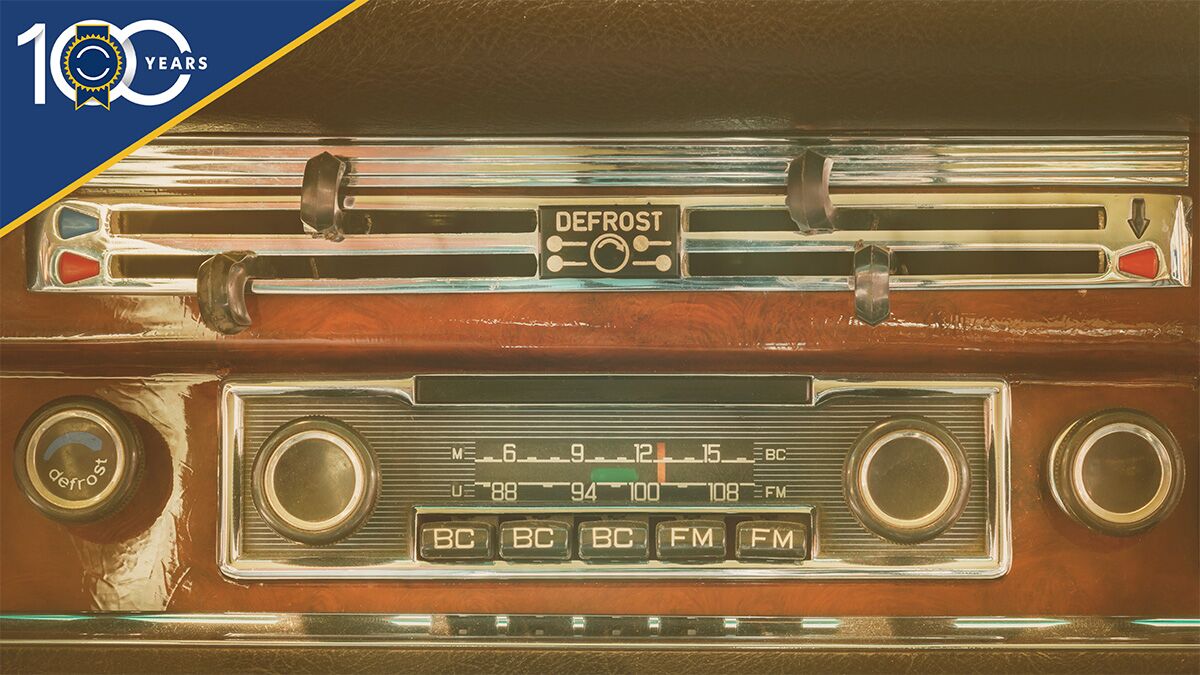
AM radio made the car feel connected to the wider world. News, baseball, serials, and music gave drivers a soundtrack long before playlists existed.
The Car Found Its Voice
Entertainment officially moved into the cabin in 1930, when Motorola introduced the first factory-authorized car radios in the Ford Model A. Earlier iterations had been experimental radios, burdened with supplemental batteries and big speakers. Motorola’s sleek (for the time) in-dash unit fit with the Model A’s design and function. Competing automakers soon began offering radios as optional equipment through factory or dealer-installed systems. The early systems were AM only and relied on an external antenna and analog tuning. Drivers had to manually adjust the dial to reduce static, especially on long-distance stretches.
Around the same time, drive-in theaters demonstrated that cars could serve as private listening spaces as well as transportation. Though drive-ins first appeared in the 1910s, Richard M. Hollingshead Jr. patented the modern drive-in on June 6, 1933, and opened his first one in Pennsauken, New Jersey. At first, Hollingshead’s Park-In Theater projected sound from three speakers near the screen. When the patent office overturned Hollingshead’s rights to the concept in 1949, drive-in culture exploded across the country, expanding to more than 5,000 screens in the 1950s. Individual speakers at each parking space improved sound quality for the audience. Eventually, most drive-ins adopted low-power FM transmission, enabling drivers to use their in-dash radios to listen to the soundtrack. Drive-in theaters have ebbed and flowed in popularity since their peak in the 1950s and 1960s. Most experts agree that fewer than 500 screens operate in the U.S. today.
In 1952, Blaupunkt offered an early FM car radio, but FM did not become broadly popular with listeners until the 1960s and 1970s. FM delivered better sound quality, reduced interference, and made music more immersive with stereo broadcasts.
Drivers Taking Control: Tape Takes Over
By the 1960s, drivers wanted a bit more control over what they listened to. In 1965, Ford Motor Company and Motorola helped popularize the 8-track player, offering it as an option on Ford’s 1966 models. By the next model year, General Motors and Chrysler offered an 8-track option. Bill Lear, founder of Lear Jet Corporation, led a consortium in developing the technology, which was originally intended for home use. An 8-track player used a continuous loop of analog magnetic tape, which meant no rewinding, just the ability to switch tracks. It was convenient, but prone to failure due to mechanical complexity.
The rise of the cassette tape, which Philips pioneered in the early 1960s, eventually eclipsed the 8-track. Cassette decks offered control that 8-tracks did not, including rewind and fast forward, the ability to record your own music, and the chance to build personalized mixtapes. By the 1980s, cassette players had become common across many new vehicles and aftermarket systems, turning the car into a deeply personal listening environment.
The CD Era
The next major innovation came in the mid-1980s. Audio suppliers developed compact-disc technology for cars, and manufacturers quickly adopted it. Mercedes offered the first factory-installed in-dash Becker CD unit in 1985, and Lincoln followed with a factory CD option in the 1987 Town Car. CDs used optical laser technology, delivering clean sound, no tape distortion, and instant track skipping.
By the 1990s, CD players gained ground, often paired with trunk-mounted multi-disc changers, though cassette decks remained common for years. For the 2026 model year, only the Subaru WRX offers a factory-installed CD player.
Portable Media Takes Over the Dashboard
In the early 2000s, the car caught up with the digital world. Automakers began adding aux inputs, USB connections, and MP3 compatibility, allowing drivers to connect external devices.
The launch of the Apple iPod in 2001 accelerated that shift. Suddenly, drivers could carry thousands of songs in their pockets and plug directly into their audio systems.
This era introduced on-demand music selection, digital media libraries, and personalized in-car entertainment.
Entertainment for Everyone: Rear Seat Screens
For decades, car entertainment focused on the driver, but this changed in the late 1990s and early 2000s. Vehicles such as the Honda Odyssey and Chrysler Town & Country began offering rear-seat DVD systems, giving passengers their own screens.
These systems used DVDs, which stored video as well as audio, creating independent entertainment, family-friendly road trips, and a more controlled and quiet cabin experience.
For the first time, the car considered everyone, not just the driver.
The Connected Car Era
The systems of today barely resemble those of the past. Modern vehicles rely on software-driven entertainment platforms that combine audio, navigation, communication, and apps into a single interface. In-cabin Wi-Fi allows each passenger to connect a device (or two or three) creating a personal entertainment bubble during travel.
Systems like Apple CarPlay and Android Auto made smartphone projection essential in modern cars. Apple launched CarPlay in March 2014, and Google released Android Auto in 2015. They mirror your smartphone directly onto the dashboard. Paired with Bluetooth, Wi-Fi, and cellular connectivity, they allow for streaming music and podcasts instantly, voice-controlled navigation, and personalization based on your habits.
We haven’t even touched on some in-car entertainment options, like Chrysler’s brief experiment with a vinyl record player in the 1950s, singing along to the songs in your head, or <gasp> conversation with your passengers. Don’t forget magnetic chess, the license plate game, Punch Bug, I Spy, and other diversions. But we hope this trip down audio and technology memory lane was informative and entertaining.
What started as a single radio signal has evolved into a digital ecosystem. Now the car not only plays what you want — it can also anticipate what you may want next.