
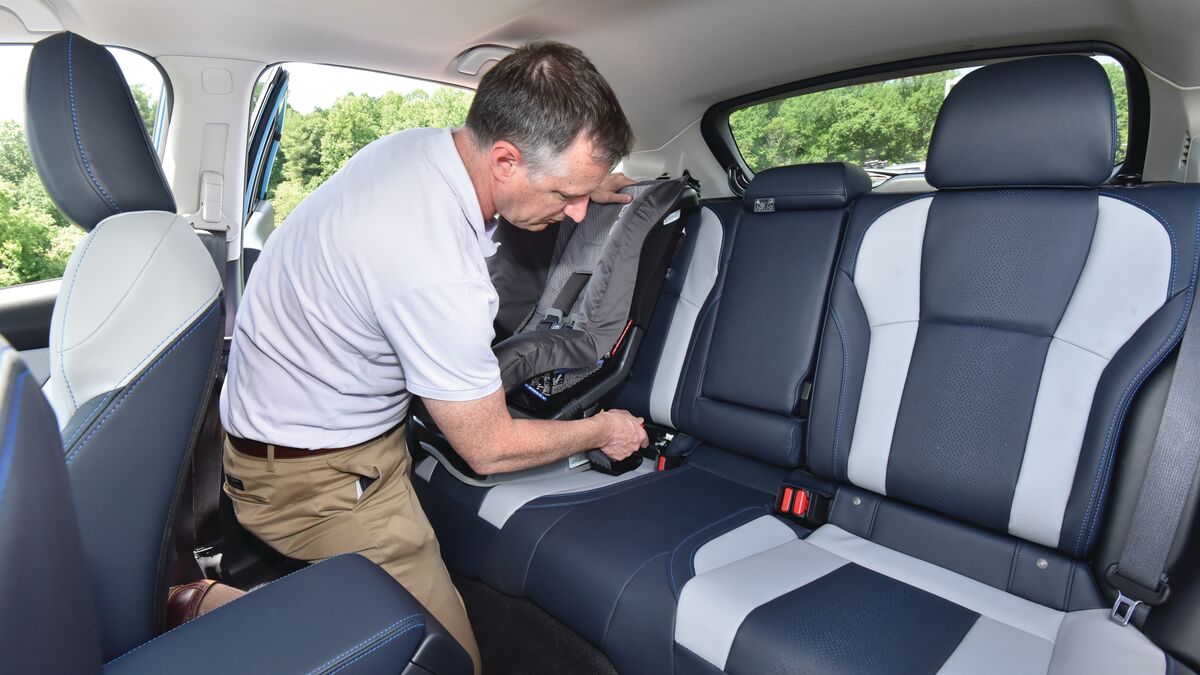
My daughters have both outgrown car seats, but I’d installed and uninstalled our seats in more than 300 vehicles before they graduated to boosters and, eventually, the front seat. Unless you’re an automotive journalist, you likely won’t have the unique pleasure of switching car seats to a new vehicle every week, but the experience taught me the importance of an easy-to-use LATCH anchor system.
Lower Anchors and Tethers for Children (LATCH) systems include two metal anchors in the rear seats. The two lower anchors are almost always located in the crease between the seat back and lower cushion, but some automakers have found creative ways to make them more noticeable and accessible. The Insurance Institute for Highway Safety (IIHS) includes LATCH ease-of-use scores in many vehicles’ overall safety rankings. Let’s look at how they can help you choose a car with easier car seat installation.
IIHS LATCH Scores
First, it’s important to break down what the car seat ratings actually mean. They aren’t a measure of a vehicle’s LATCH system safety. Instead, the IIHS rates vehicles’ car seat anchors for their ease of use, assessing factors such as how deeply they are located under the seat cushion and how easy they are to confuse with other seat hardware. For each seat with an anchor point, the IIHS assigns a rating of Poor, Marginal, Acceptable, or Good. Those scores are then tallied to create the vehicle’s overall rating.
When viewed in combination with other interior specifications, such as second-row legroom and hip room, these ratings can give you a good idea of the difficulty involved with installing car seats.
LATCH vs. Seat Belts
LATCH anchors became federally mandated in the United States in the early 2000s, though many automakers had already been installing them voluntarily. While there were other solutions available prior to then, including ISOFIX in Europe, seat belts were the primary method for securing car seats. While you can still use seat belts to anchor car seats today, LATCH anchors are generally considered easier to use. Here are some differences between LATCH and seat belts for anchoring car seats.
LATCH vs. Seat Belt
for Car Seats
Quick answer: install with one method at a time. For most families, that means lower anchors (LATCH) or the vehicle seat belt, not both together.
Can You Use Both Together?
Usually, no. Car seats are generally designed and crash-tested with one installation method at a time. Use lower anchors or a locked seat belt to secure the seat.
Is One Method Safer?
Not by default. When installed correctly, LATCH and seat belt installations are both secure. Choose the method that gives you the tightest, most correct fit in that seating position.
Child and Seat Weight
Lower anchors have limits. When your child plus car seat reaches the allowed threshold, switch to seat belt installation.
Ease in Your Vehicle
Whichever method lets you get a firm install in your specific vehicle wins, especially with tight back-seat layouts.
Anchor Availability
Not every seating position has lower anchors. Seat belts work in more positions and in older vehicles.
LATCH Weight Limit Snapshot
A common rule is a 65-lb combined cap for child plus car seat when using lower anchors. The exact limit depends on your seat and vehicle manuals.
Fast Safety Checklist
- Install with one method: LATCH or seat belt.
- Use the top tether for forward-facing seats when allowed.
- If using seat belt, lock it according to your vehicle instructions.
- At the belt path, the seat should move less than 1 inch side-to-side or front-to-back.
Read about how rear-seat dimensions affect car seat fit. Visit our Safety hub page for curated articles and insights to help you drive with confidence.