
We’ve broken down electric vehicle (EV) shopping advice to make the experience less intimidating and a lot more exciting. Before you buy an EV, here are the big things to think about.
Finances: Consider upfront costs, incentives, and long-term costs of fuel and maintenance.
Charging: Look for fast-charging capabilities and access to reliable public charging networks in your daily routes.
Range reality: Choose a vehicle with a real-world range that fits your lifestyle, factoring in weather, terrain, and your driving habits.
Ports & network connectivity: Make sure your EV supports standard charging ports and is compatible with major charging networks.
Know Your Budget
Start your electric car shopping with a clear budget range in mind. There are plenty of models, ranging from $30,000 to six-figure starting prices.
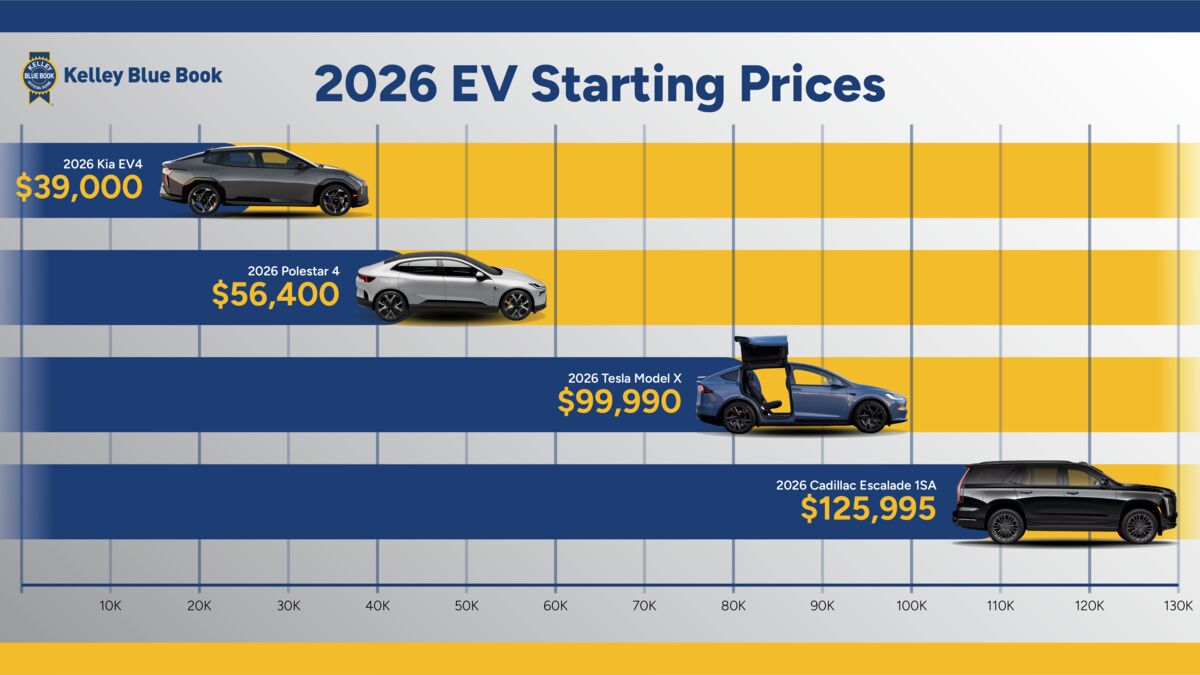
For example, the 2026 Kia EV4 begins in the high-$30,000 range, while the 2026 Polestar 4 starts at $56,400. At the upper end of the market, models like the Mercedes-Benz EQS 450+ and Lucid Air Sapphire cost more than $100,000.
If you’re not interested in a new vehicle, a used EV may save you thousands of dollars, especially as more models hit the second-hand market.
RELATED: How Much Are Electric Cars?
Check for EV Incentives
Some EVs qualify for state rebates and local incentives that help lower the purchase price and make recharging cheaper. Many manufacturers also include extras, such as free charging at preferred charging networks for a limited time or discounted home charging stations. Ask the dealership if the electric car you’re considering has similar perks, rebates, or other promotions.
Repair & Maintenance Costs
EVs don’t just save you money on gasoline. They typically cost less to maintain than traditional gas vehicles because they have fewer moving parts and no engine oil to change. Some estimates suggest that EV maintenance costs can be 40-50% lower over its lifetime compared with a similar car with an internal combustion engine.
Although EVs generally require fewer repairs, they still need regular care.
- Tires, brake pads, and suspension components, along with other wear items, will still need attention.
- Battery packs and electric motors are designed to last many years. Most owners won’t need a replacement for a decade or more, if ever.
- EVs come with a federally mandated 8-year/100,000-mile battery warranty (or longer on certain models), providing added peace of mind.
Research All Your Charging Options
Charging your EV is more than just plugging into the closest outlet. There are several charging types and speeds to understand.
Level 1 (120-volt household outlet, 1-2 kW)
- Uses a standard 110/120-volt outlet.
- It can take 24 hours or more to fully charge a depleted battery.
- Owners who make only short trips may find Level 1 charging adequate for replenishing the battery overnight at home.
Level 2 (240-volt, 7-19 kW)
- Many public stations feature Level 2 chargers, which can also be installed at home for convenient charging.
- Adds roughly 20-30 miles of range per hour, depending on the vehicle.
- It doesn’t provide “fast charging,” but it is significantly faster than Level 1.
DC Charging / Level 3 (50-350+ kW)
If you regularly take road trips or commute long distances, look for:
- EVs that can accept 150+ kW peak DC charging; not all EVs can accept a charger’s highest charge rate.
- Published charge times of 30 minutes or less to reach 80% capacity.
These high-powered public chargers make long-distance travel much easier, often replenishing about 200 miles of range in half an hour, depending on the vehicle and the charger speed.
Are There Charging Stations Where You Live?
Before buying an EV, get a sense of what charging is like in your daily life, especially if you aren’t able to charge overnight at home.
- Public charging apps like Electrify America, ChargePoint, and PlugShare let you filter by plug connection type, charging speed, and the cost to charge.
- We recommend downloading multiple apps, especially before driving in unfamiliar areas where you may need to rely on public charging stations.
- Check for charging incentives in your region or if your workplace offers chargers for employees.
Additionally, many carmakers and charging networks have started to adopt Tesla’s North American Charging System (NACS) ports, giving drivers access to the Supercharger network without a Tesla vehicle.
Even with a robust charging network accessible, you may still want to consider installing a home charger. At-home charging is convenient and can help you save money on charging costs.
MORE: Electric Car Charging Etiquette Guide
How Much Electric Car Range Do You Need?
Most new electric cars today have a minimum driving range of 200 miles per full charge. Some models with higher price tags can travel over 400 miles on a fully charged battery. To figure out what’s right for you, consider things like travel frequency, travel distance, and your daily commute.
| Persona | Commute & Lifestyle | Range Need | Potential Ideal EV |
| Urban Commuter | – Short work commute – Around 20 daily miles – Travels mainly for daily activities and work | 150–250 miles | Nissan Leaf |
| Suburban Family | – Moderate work commute – School and errand runs for family- Around 40 daily miles | 250–350 miles | Hyundai Ioniq 5 |
| Road Tripper | – Frequent road trips and long-distance travel | 350+ miles | Lucid Air |
Mainstream models like the Nissan Leaf offer an estimated range of 212-253 miles. That’s plenty for many drivers who don’t have long daily commutes. Pricier models, such as the Lucid Air Grand Touring, have a maximum range of 512 miles.
MORE: Back to the Future of Auto Shows
Additional Features
Now that you have a better understanding of personal EV fit and need, you may want to keep an eye out for these features.
Heat pump: A climate control system that utilizes ambient heat to warm the cabin, thereby preserving battery range in cold weather.
Preconditioning: Allows the vehicle to heat/cool the cabin before driving, improving comfort and battery performance.
Battery thermal management: Regulates battery temperature to maintain optimal performance, extend battery life, and ensure safe operation in extreme climates.
Bi-directional power: Allows the EV to send power back to your home or the grid, potentially lowering electricity costs.
- V2L (Vehicle-to-Load): Use your EV as a mobile power source for tools, appliances, or camping gear. This is perfect for outdoor adventures, tailgating, or emergency situations.
- V2H (Vehicle-to-Home): Your EV can power your home during outages, acting like a backup generator.
- V2G (Vehicle-to-Grid): Connect your EV to the grid during peak hours, supplying power and potentially earning credits or reducing your electricity bill.
Advanced driver assistance systems (ADAS): Features like adaptive cruise control, lane keeping assist, and automatic emergency braking to enhance safety and reduce driver fatigue.
Over-the-air (OTA) capabilities: Enable your EV to receive software updates remotely, adding new features, improving performance, and fixing bugs without requiring a visit to the dealership.
Editor’s Note: We have updated this article since its initial publication. Nick Kurczewski contributed to the report.