
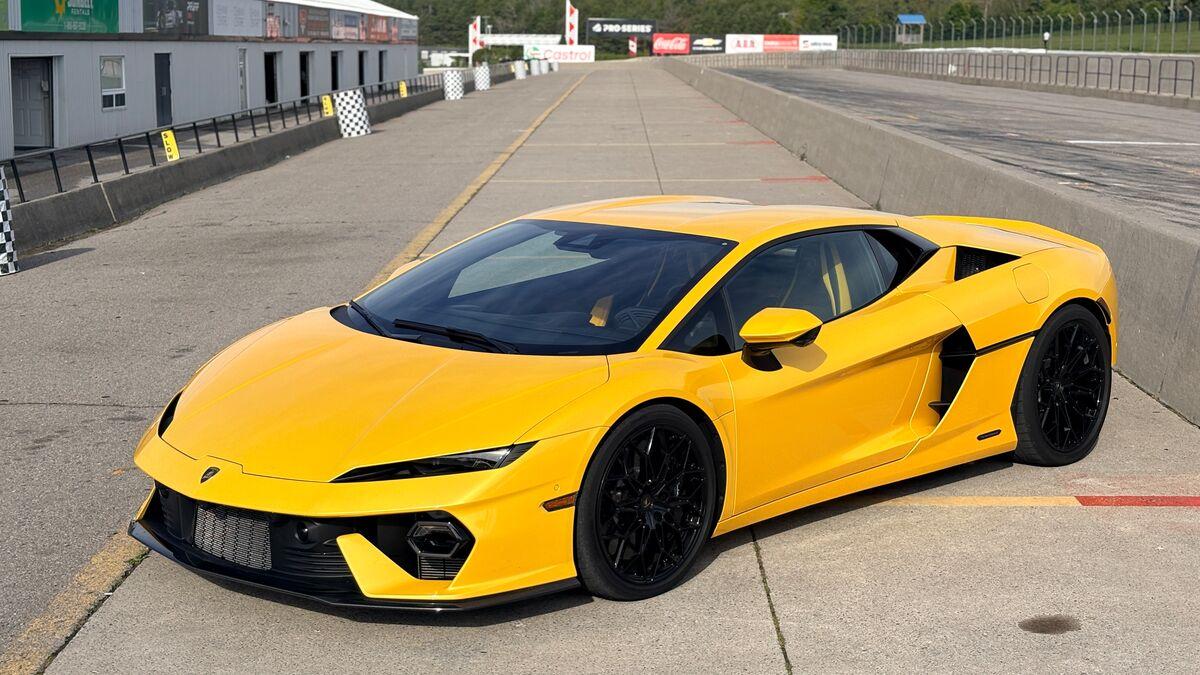
To go fast, you must know how to brake. This is the contradiction sweeping down into the bottleneck hairpin of Turn 5 at Canadian Tire Motorsports Park.
Hit it right, or be fortunate enough to hit it in a Lamborghini Temerario, and the double-right known as Moss Corner (after famed British racer Stirling Moss) will shoot you back uphill into the longest straight on the Grand Prix track. The revs cook to 10,000 rpm and the speedometer reads 172 mph.
I didn’t read it, too much going on. It was in the video on the passenger screen dash, a second after an expletive shot out of my mouth.
That’s nothing for the Temerario. The pro driver leading me could have topped it out at 213 mph. Maybe, a few more laps on a track that rises and falls with blind curves like Laguna Seca in California, maybe, I could have hit 173 mph.
If only I had listened earlier.
Three Motors, One Twin-Turbo V8, Sensational Power
“Take it to 10,000,” Davide Bizzarri told me at the briefing before the session. “Feel that power.”
When the head of vehicle motion and energy management — the chief engineer of the Temerario — urges you to take his supercar to its limits, you try to override your impulse to shift.
The power comes at 10,250 rpm with launch control, but we didn’t test that feature at Mosport. Either way, it’s unnatural. The mid-engine 4.0-liter twin-turbo V8 churns out 789 horsepower. Even though it’s behind the driver’s seat, it feels like it’s on your shoulder, screaming to flick the paddle shifters of the 8-speed dual-clutch transmission (DCT).
On the other shoulder, like a mischievous devil incarnate, Bizzarri, urging it into the red. Bizzarri has playful curls that dance above his twinkling eyes, all masked behind his studious glasses. It’s the way his Italian accent curls out of a half-smile that makes me trust and listen to his counterintuitive advice.
On that one lap of six, I gave in, my adrenaline surging like runaway greed through my core. Critics might cry for the Revuelto’s V12, but this soundtrack spikes my senses into a scream. I hit the redline, shift into fifth, surge into more power, crest the hill, then start to brake before the 90-degree right.
During a cooldown lap, I’m thinking of the screen saver on Bizzarri’s laptop: “If nothing has broken, you have not pushed hard enough!”
Nothing has broken except my sense of what is possible in a car.
Successor to the Huracan but the brand’s second plug-in hybrid behind the V12 Revuelto, the Temerario is an evolutionary mechanical marvel. It produces roughly half of the emissions of the Huracan and it’s nearly 200 pounds lighter than the Revuelto.
The high-revving flat-plane crankshaft of the V8 joins the rear propulsion motor and the transverse DCT in a compact package. The rear motor fills in off the line and elsewhere as the turbos spool, so torque is instantaneous. Yet it’s all very smooth and well-choreographed with the V8, and lacks the electric gut punch you get in some performance EVs.
A small 3.8-kWh battery pack sits below the floor and helps keep the center of gravity low. Weight is further balanced by two more motors, one at each front wheel, which might be where the real magic happens.

Temerario Handling
The 3-motor system and the engine conspire to make 907 hp and 1,106 lb-ft of torque. The zero-to-62-mph time is 2.7 seconds and it takes 7.1 seconds to 124 mph.
What was as compelling in our two sessions was how the axial-flux motors control how power gets to the ground on those Bridgestone Potenza Race Tires, 20 inches up front (255/35ZR 20) and 21 inches in the rear (325/30ZR 21).
The front motors are permanently connected, so it’s an all-wheel-drive supercar with some torque always going to one or both front wheels.
I kept it in Corsa, which dials back the stability control. There’s a Corsa no ESC mode, for the pros, or just to round out the drive modes to an uneven baker’s dozen.
Entering a turn, say the double-right hairpin of Moss Corner, torque shifts to the inside right wheel to counter all the weight going to the outside. It keeps it balanced and straight.
Then, coming out of the apex back on the throttle, the system shifts torque back to the outside wheel to prevent oversteer. There’s no squirreliness, and it’s all so balanced it encourages you to keep pushing it out of that second right uphill into the glorious long straight.
Temerario Inside
Lamborghini’s newest supercar gets more comfortable inside. It’s easier to get in and out of than the Huracan due to a narrower sill and lower rocker, and there’s 1.8 inches more headroom and 1.3 inches more legroom. At 5-foot-8, I had no issue getting in with my bulbous helmet. One of my 6-foot-5 peers on the track remarked how easy it was to sit in it and be situated.
The power seats have thigh extenders that tilt, and the bolsters can be inflated or deflated with a button push.
There are no stalks on the steering column. The turn indicators, drive assist systems, and headlight settings are all buttons on the left side of steering wheel. Drive mode dials sit like frankeknobs on the wheel’s center pad. Wiper controls are on the right side of the wheel, along with controls for the customizable instrument cluster.
On the back of the wheel are volume and tuning buttons.
There is a touchscreen that I never touched. It houses the climate controls and just about everything else not addressed on the steering wheel, including vent directions. There’s also a passenger screen I didn’t even notice until watching the in-cabin video after my drive.
The three screens are all on the smaller side, proportional with the Temerario, and it’s all there to configure in your garaj mahal before hitting the track.
Temerario Price
Temerario means reckless or daredevil in Lambo’s home of Sant’Agata Bolognese in Italy. “The system is to enable you to perform, to dare, but also to keep you safe,” Bizzarri explained afterward.
It’s so good, so balanced, it made me dare to believe I was a better driver.
It also made me dare to wonder what it would be like to buy a roughly $390,000 supercar. Add the Alleggerita package, which cuts 64 pounds due to carbon fiber lightweighting that also provides more downforce and aerodynamic efficiency, as well as those Potenza Race tires, and you’ll have to add anywhere from $50,000 to $80,000.
The second session of laps was in the Alleggerita, where I had my best lap and top speed. If you’re going to track it, you might as well dare.