

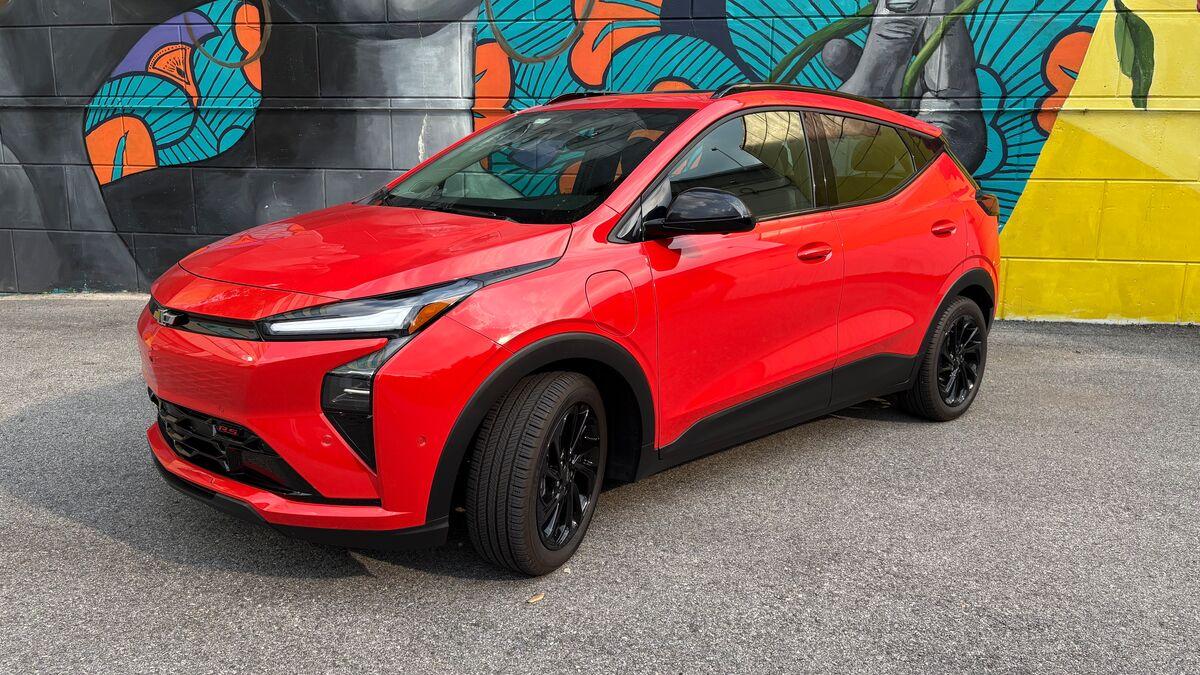
The 2027 Chevrolet Bolt is one of the strangest cars on the market this year, but it might be the right one for you.
It left the market, returned to the market, and will disappear almost as quickly as it reappeared. Chevrolet has changed its mind on how many copies of the little electric vehicle (EV) it will build several times. Currently, dealers have a healthy supply of Bolts in stock. But if you want one, be aware that they may not restock. Act while you can.
A little background to explain all of that:
You may remember the Bolt from its original form. From 2016 to 2023, it was a plucky little all-electric hatchback that proved a practical city car and second car for many Americans. It had high-profile struggles due to a series of recalls over battery fires, long since fixed. By the time it exited the market in 2023, it had briefly become the best-selling non-Tesla EV.
Chevrolet retired it because they had a new generation of EVs planned with an entirely different battery chemistry. That second-generation EV platform now powers everything from the Chevrolet Equinox EV (starting in the mid-$30,000-range) to the ultra-luxe Cadillac Celestiq (starting at over $400,000, with each built by hand to a custom order).
At first, the company didn’t plan to build a Bolt with it. But Chevrolet eventually realized there is still demand for an electric hatchback, and brought the Bolt back. They initially planned just a one-year production run, and have since cut the planned number.
That’s not a sign that the Bolt is a failure, however. The car is partly an experiment. The company is ending production, in part, because it learned what it set out to learn. Chevy used the Bolt to test out new manufacturing techniques.
Automakers usually build each car to a specification, so that one car rolling off the factory line can have different colors and features than the one in front of and behind it. Chevrolet, instead, built the Bolt in batches of 30 identical cars. That’s likely a test run for a future when most cars have most features and buyers pay to turn them on or off. It’s also likely a reason the current Bolt is often the least-expensive EV in America.
Despite its low price tag, it’s a fairly well-equipped car. I spent a week driving the Bolt around suburban Washington, D.C., even deliberately taking a road trip longer than its maximum range. I found a pleasant ownership experience in many ways.
Some of you might want to grab the new Bolt while you can.
Which Trim Level
The batch building process doesn’t mean you get no choices. Chevrolet builds the Bolt in two trim levels, though they’re mechanically identical. My tester was the more upscale RS, which gets heated and ventilated front seats and similar creature comforts. It had the optional Super Cruise hands-free highway driving system, which may be the best reason to consider it. The Bolt is the least expensive way to get Super Cruise this year.
Favorite Feature
The Bolt completes in a small class and has one standout feature none of its competitors offer. Chevrolet’s Super Cruise hands-free highway driving package is one of the best partial automation systems on the market.
It lets you take your hands off the wheel and your feet off the pedals on more than 600,000 miles of North American highway. It still requires you to keep your eyes on the road and be ready to take over if driving conditions get complicated. Automation isn’t ready for true self-driving yet.
But it takes a lot of the fatigue out of road trips. It changes lanes on its own to find the fastest route (more often than I tend to, I found), and handled bumper-to-bumper traffic safely in my testing. It requires a $6,660 package, but on a car priced as low as the Bolt, you can keep the sticker under $36,000, including delivery charges, even with it.
What It’s Like to Drive
No economy car quite pulls off the trick of feeling luxurious to the driver. But the Bolt has a few things going for it that make it more pleasant to drive than you might expect.
One is the nature of all-electric cars. They accelerate more quickly than gas-powered cars because electric motors make 100% of their power available at all times, with none of the spool-up effect of a gasoline engine. The single motor in the Bolt drives the front wheels and makes 210 horsepower – a surprisingly high rating for a subcompact car. The Nissan Leaf and Kia EV3 are its only logical competition in the EV space, and put out similar power.
The other is its small wheelbase, which makes every subcompact car feel nimble.
An unremarkable suspension insulates you from bumps as well as you’d expect at this price, and its nature as an EV keeps noise to a minimum.
One thing takes some getting used to: The regenerative braking is exceptionally strong. It makes one-pedal driving feel a little herky-jerky, but you can turn that off or dial back the braking settings through the touchscreen.
Interior Comfort and Technology
Chevrolet has done a good job keeping the cabin of the Bolt from looking like its price.
The driver faces an 11-inch digital display and an 11.3-inch center touchscreen, both sized right for the small cabin. They sit on a dashboard filled with storage cubbies that will likely require regular cleaning.
My RS tester wore GM’s Evotex faux leather, which is relatively convincing and easy to clean. The less-expensive LT model gets cloth.
The confines are normal for a subcompact car, so climate control is just one zone – no point in pretending there’s room for two. But the rear seats offer more legroom that you find in the Leaf or EV3. I wouldn’t recommend any subcompact EV if you regularly carry more than two adults. But this is the roomiest for them if you have to.
Rear-seat passengers do not, however, get vents in the Bolt but can in the Leaf and EV3.
Strangely, the Bolt does not come with Apple CarPlay or Android Auto integration, while all of its rivals do. Google Built-in tools do a reasonably good job of taking their place, and you may not miss them. But if you have favorite navigation apps or want the interface you’re used to from your music steaming service, those things aren’t available here.
Cargo room – 16.2 cubic feet with the seats in place and 56.3 with them folded – is fairly typical for the class. The Bolt had no problem swallowing everything a teenager would need for a week away at camp with room for three with the smaller panel of the 60/40 split rear seats folded.
Limitations
If I were looking for an affordable subcompact EV and rarely carried people in the rear seats, yet wanted Super Cruise, a low price, and the ease of finding repairs for a GM product, that all might make the Bolt my choice. If I needed one to carry more than two people regularly, the lack of rear vents would give me pause.
Key Considerations
The Bolt won’t be around long, with production already limited. That’s not a reason not to buy one – Chevy dealers will have an easy time supporting this vehicle for many years. It might be a reason to move quickly if you think this is your next car.