
Luxurious and rugged is a hard combination to pull off.
There are designer-brand hiking boots with four-figure price tags. I’ve never been in the tax bracket to climb Angel’s Landing in a set of $2,000 Brunello Cucinellis. I’ll always be left to wonder if it’s more comfortable than the shoes the rest of us use.
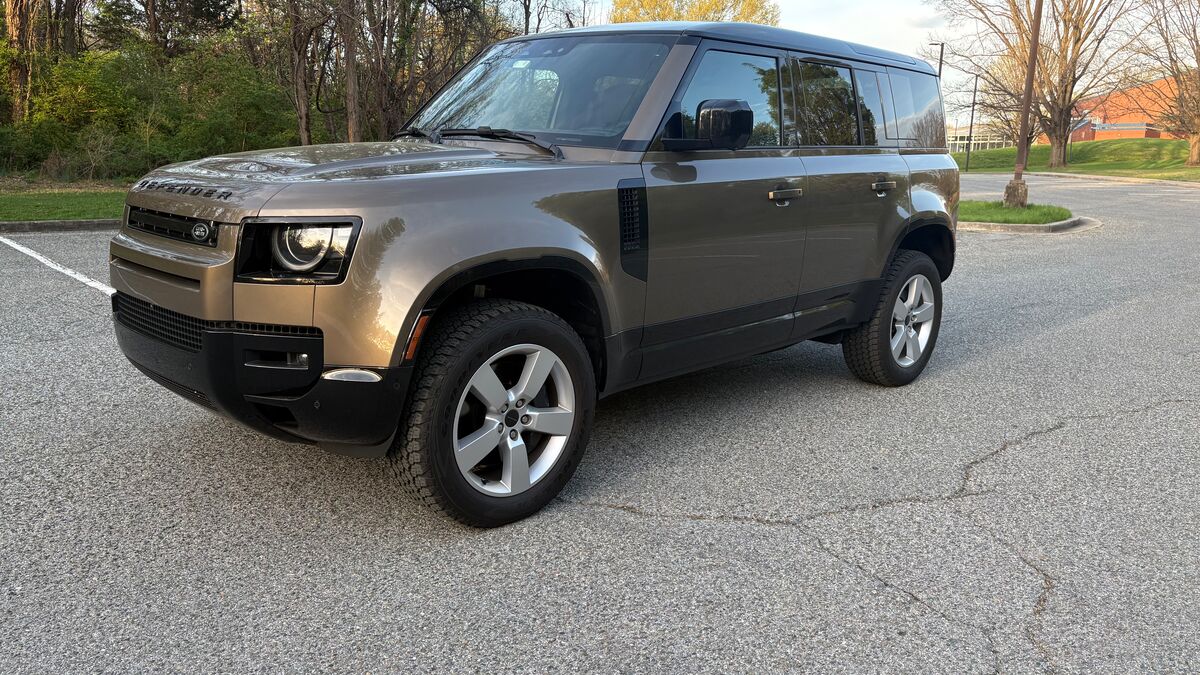
But I have driven the 2026 Defender 110 X-Dynamic SE, with its supercharged V8, Windsor leather upholstery, and 14-speaker Meridian Surround Sound system. It strives for that same unusual combination, rugged and luxurious. It mostly pulls it off.
And yes, you could get two pretty well-equipped Jeep Wranglers for its price. But the Defender balances high-end furnishings with billy goat agility like only a few products do.
I didn’t get the chance to take the Defender on a truly challenging trail. I mostly lived with it as you likely would day to day – commuting, driving kids and friends around, and hauling topsoil and plants home from the garden center. My travels did take it on a few unimproved logging roads, but it laughed at the notion that these were challenges.
Which Trim Level
JLR (formerly known as Jaguar Land Rover, but going by initials only these days) builds the Defender in a nearly endless variety of forms. You can get it with two rows of seating and two doors as the Defender 90, with two of each as the Defender 110, or with three rows and two doors as the Defender 130. The Defender 110 we’re testing here comes in four trim levels and with a choice of a 395-horsepower 6-cylinder or a 493-hp V8. Lower trims also have a 4-cylinder option. My tester was a V8-powered X-Dynamic SE, near the middle of that massive lineup.
New 2026 Land Rover Defender 110 Prices
|
Retail Price
|
Fair Purchase Price (66538)
|
|||
|---|---|---|---|---|
$65,350 |
$63,600 |
|||
$77,050 |
$75,500 |
|||
$89,250 |
$87,200 |
|||
$97,450 |
$95,300 |
|||
$115,350 |
$113,000 |
|||
$160,150 |
$157,000 |
|||
$170,550 |
$167,000 |
Favorite Feature
If you’re shopping for a Defender, you’re shopping for a vehicular multitool. You may drive your Defender in many circumstances and conditions, from a simple drive to work on dry, well-maintained asphalt to a complicated one in a snowstorm, on a muddy trail, or on sand.
JLR prepares you for every one of them. In this configuration, the Defender 110 has an astonishing 10 drive modes, one of which is completely customizable. It’s part of what JLR calls the Terrain Response 2 system.
While some rivals offer drive modes (think throttle response and steering sensitivity) and terrain modes (suspension and grip) separately, the Defender adjusts both simultaneously.
In its Auto setting, it analyzes grip from each wheel and adjusts its own mode to suit the terrain. If you don’t like its choices, you can opt for Comfort, Eco, terrain-specific modes like Grass/Gravel/Snow, and Rock Crawl. Or you can dial in your own preferred throttle response, steering sensitivity, and traction settings in Configurable.
Lower-priced versions get Terrain Response, without the Auto setting.
What It’s Like to Drive
So many drive modes mean you can select the personality you want from your Defender. Anything a reviewer tells you about how it drives can be changed with a single button press.
In Dynamic mode, it has more raw acceleration and tighter handling than you’d expect from something this tall. The big V8 makes it sound like a muscle car. An active rear differential and brake torque vectoring make it nimble.
No matter which engine you choose, you get the same 8-speed automatic transmission.
Test-driving many cars, I often find the suspension of an off-road-focused SUV too soft and prone to causing carsickness in kids. I’ve often found myself using the sport mode of a rock crawler on dry pavement just to firm up the springs a bit.
That’s not the case in the Defender. It lacks that sponginess common to trail trims even in Comfort mode. I only found myself seeking out more firmness in a construction zone with pockmarked roads, and that’s a personal preference you may not share.
I averaged about 16 mpg in mostly city driving. You can beat that with the 6-cylinder model. The EPA estimates 20 mpg combined with that one.
Interior Comfort and Technology
The luxury-hiking-boot nature of the Defender shows up most prominently in aesthetics. High-end, ultra-soft Windsor leather shares space with exposed hex bolts on the dash and doors. Grab handles and rubberized all-weather floor mats read like a ruggedized outdoor product. A Meridian sound system and a cabin air purifier read like a luxury sedan.
Put them together, and you have a Defender. No other automaker blends the two so well.
With its more asphalt-bound vehicles, JLR has nearly eliminated buttons and knobs. But the automaker seems to understand that the cabin of the Defender is not the place for that. There’s a large central touchscreen, but beneath it, real tactile climate controls and easy access to change drive modes and ride height.
The Meridian surround sound system is unusually crisp and clear out of the box. I spent little time searching for the right tune because it was so easy to find.
Both front and rear seats are comfortable and sit slightly higher than most, promoting good visibility. The dashboard is upright, lending a truck-like feel, and contains a wide, deep storage well on both sides of the screen. It adds to the utilitarian feel, but keeping it clean over years of ownership will take some elbow grease.
Headroom is exceptional in both rows of seating. Rear-seat passengers get an unusual small window in the roof near the pillars, allowing for extra light in the cabin. They also get separate climate controls for left and right seats.
The cargo area is spacious – the spare tire mounted outside on the swing gate allows for extra room inside. The under-floor storage area is deep and more usable than in rivals that store the spare there. But the second-row seats don’t fold completely flat.
I do appreciate a set of buttons in the cargo area that let you raise and lower the ride height. When you’re loading in heavy cargo, it’s a blessing to be able to lower the vehicle and, thus, the height you must lift.
Limitations
A colleague who frequently camps in SUVs on overlanding trips has complained that the Defender 110 seems like it should suit an air mattress, but doesn’t because the rear seats won’t fold flat.
Key Considerations
The Defender 110, particularly when equipped with the Terrain Response 2 system, is likely capable of far more than you’ll ever use it for. There are other luxury off-roaders – the Lexus GX comes to mind – that are nearly as capable and slightly more reasonably priced. Those two have similar starting prices, but the Defender’s window sticker climbs much higher than the GX’s as you option it out, and I’m not sure you gain capabilities you’ll really use.
Many buyers looking at a V8-powered Defender X-Dynamic SE might even find a lesser-trim Defender just as rewarding for less money.