
The 2027 Nissan Rogue Hybrid is different. It drives more like an electric vehicle than an SUV with a gas engine. Yet there’s no plug so you can drive it for long distances then fill up the tank like, well, a traditional engine.
Yet the engine never propels the SUV. Two motors do. Mechanically, the Rogue’s series-hybrid system differs from the popular Honda CR-V Hybrid, which, like the redesigned 2026 Toyota RAV4, is a series-parallel hybrid. All this means is that the Rogue Hybrid’s small 3-cylinder engine serves only as a generator. The two electric motors do all the work of driving, making it smoother, quieter, and more refined than rivals.
How the 2027 Nissan Rogue Hybrid Drives
To show how confident Nissan was in the new Rogue, they had a redesigned 2026 Toyota RAV4 on site in Santa Barbara, California, to compare with the Rogue Hybrid. While the RAV4 costs less and beats the Rogue’s city driving fuel efficiency (46 mpg vs. 41 mpg), the Toyota was louder, coarser, and generally busier.
The Rogue Hybrid’s new 1.5-liter turbo-3 has a larger turbocharger and greater thermal efficiency than in past generations of a hybrid system that had been offered in other markets for more than a decade. That’s why Nissan, for the first time, could bring it to the U.S., where we generally log more highway miles and travel greater distances.
Going uphill or accelerating hard at an on-ramp or merge, the engine generator kicks on enough to feel it thrum by the firewall. Otherwise, it’s hard to notice the presence of an engine as it blends into the normal tire and wind noise.
A 202-horsepower motor powers either axle, so the Rogue Hybrid has standard all-wheel drive (AWD). The larger front motor is the main propulsion unit, but the smaller 134-hp rear motor could handle all of the torque if the front wheels were stuck in mud or snow. Like most hybrid SUVs, the Rogue Hybrid doesn’t have a max torque spec because either motor can be operating at variable levels of capacity at any time.
Generally, the system defers all 225 hp to the front motor. The rear motor mostly handles grip. Either way, the power makes it reasonably quick off the line and for passing moves. Nissan claims its zero-to-60-mph time of 6.4 seconds is best in class.
The Rogue Hybrid has six drive modes that firm up or soften the throttle response and allegedly alter the steering feel, but I couldn’t sense that. What I sensed and appreciated was the Rogue Hybrid’s regenerative braking system. Since it’s motor-driven, it acts like an EV and can help recharge the 1.67-kWh battery pack located beneath the rear seat.

E-Pedal Regen Braking in the Rogue Hybrid
This is another difference-maker in the Rogue Hybrid. You can coast like a gas car, or flick the e-Pedal toggle on the console and have true one-pedal driving, as in an EV. Buh-bye, gas station.
It sends energy to the battery so the engine doesn’t have to, thereby saving you fuel. It also saves effort. On a dreaded 74.3-mile morning commute through Los Angeles, I hardly used the brake, instead letting off the throttle to come to a full stop. It takes a minute to get used to, but once you do, it seems almost silly to go back to the 2-pedal dance.
Over the course of that trip, averaging 47 mph with e-Pedal active, the trip meter read 49.7 mpg. On a separate trip covering 94.3 miles, with e-Pedal off and testing a mix of drive modes, the Rogue Hybrid averaged a steadier 44 mph and 37.4 mpg.
As ever, your mileage may vary.
How the 2027 Nissan Rogue Hybrid Looks
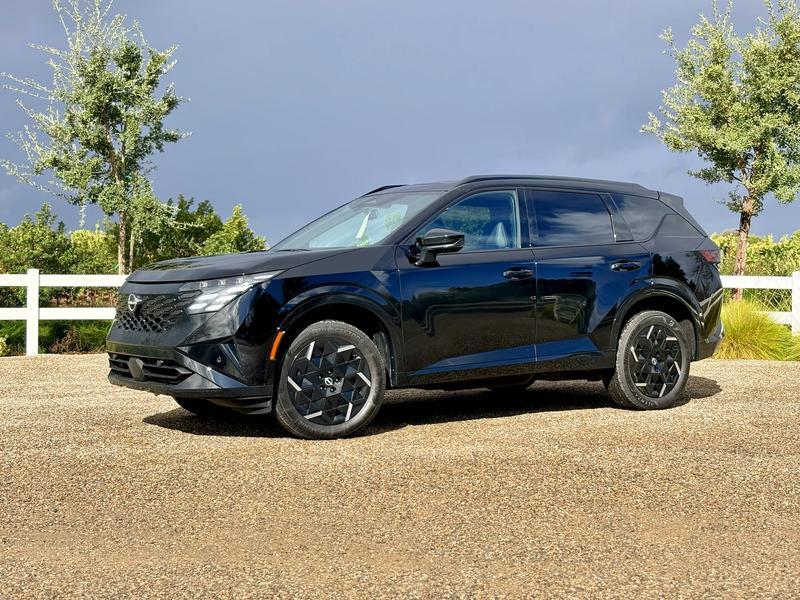
The Rogue Hybrid steers away from some outdated Nissan design language. Forget V-Motion; the tall, broad grille is dappled with hexagonal shapes that help lend the Rogue more SUV presence. The hexagons carry over into the five running lights that sweep up on either side into narrow headlights. This sense of captured motion is matched at the bottom by a body line that kicks up over the rear wheels, forming an outline at the roof pillar meant to resemble Mt Fuji. A light bar spans the liftgate, same as many EVs.
The more chiseled SUV look belies the fact that the 2027 Rogue Hybrid has pretty much the same underpinnings as its predecessor: same size, same chassis, and mostly the same dimensions. It also has the same rear doors that swing open 90 degrees to make getting in and out and helping kids into child safety seats easier.
Front headroom and rear legroom are excellent, and a 6-footer should have no problem sitting behind a 6-footer. Cargo room remains the same, and a tiered cargo floor lets you lower it for taller items or keep it standard for a flat floor with the 60:40-split rear seats folded flat. Buckets on each side of the floor can stow a gallon of milk or a watermelon (so it doesn’t roll out of the power liftgate and splat on the driveway).
How the 2027 Nissan Rogue Hybrid Compares
Another difference appears on dealer lots. The 2027 Rogue Hybrid marks the fourth generation of Nissan’s bestseller, but it will be sold alongside the carryover Rogue non-hybrid for the model year. The 2028 Rogue will mark the next iteration of the non-hybrid Rogue. It’s confusing. It feels as if Nissan wants to test how the Rogue Hybrid will be received.
There was a Rogue Hybrid before, and not the short-lived 2026 Rogue Hybrid plug-in hybrid that was a market experiment. From 2017 to 2019, Nissan offered a Rogue Hybrid in the U.S., but it wasn’t much more efficient than the non-hybrid.
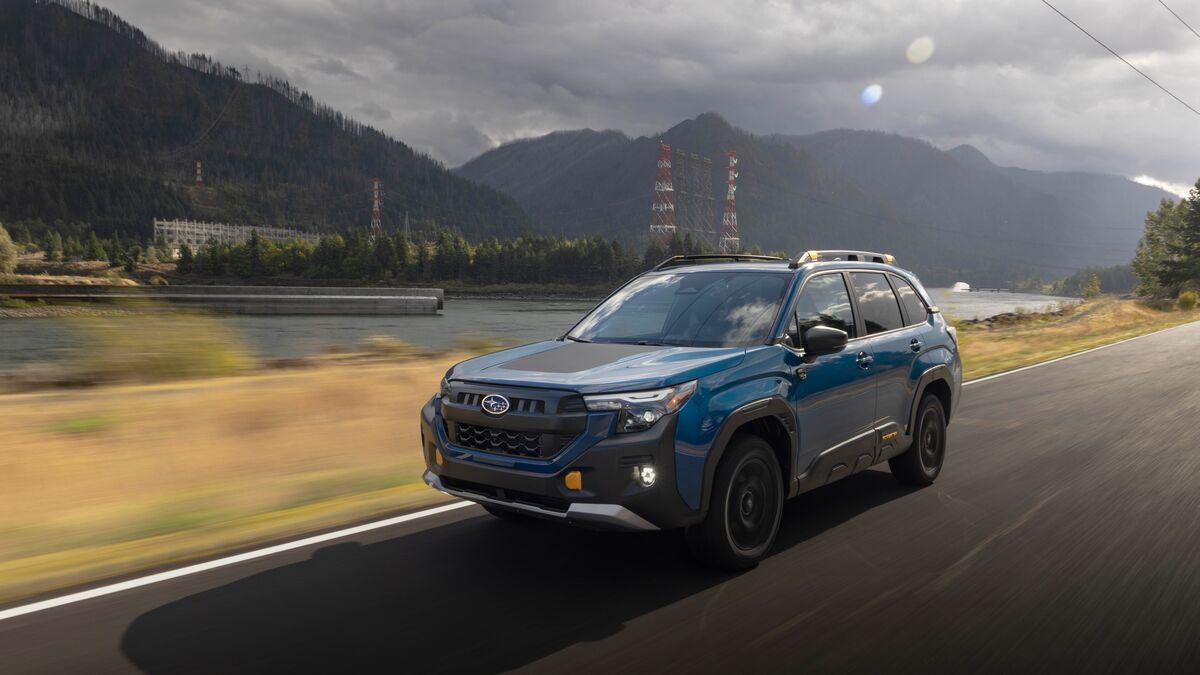
The 2027 Rogue Hybrid AWD nets up to 38 mpg combined; the 2026 Rogue AWD gas-only model is rated at 31 mpg combined. Here’s a look at how it compares with rivals in the crowded compact hybrid SUV class.
| Model | Base Trim: Price (with destination) | City/Highway/Combined MPG |
| 2027 Kia Sportage Hybrid AWD | S: $34,385 | 35/36/35 mpg |
| 2026 Hyundai Tucson Hybrid AWD | Blue SE: $34,450 | 38/38/38 mpg |
| 2026 Toyota RAV4 AWD | LE: $34,895 | 46/39/42 mpg |
| 2026 Subaru Forester Hybrid AWD | Premium: $36,180 | 35/34/35 mpg |
| 2026 Mazda CX-50 Hybrid AWD | Preferred: $36,345 | 39/37/38 mpg |
| 2027 Nissan Rogue Hybrid AWD | SV: $37,065 | 41/36/38 mpg |
| 2027 Jeep Cherokee AWD | Base: $37,125 | 39/35/37 mpg |
| 2027 Honda CR-V Hybrid AWD | Sport: $39,080 | 40/34/37 mpg |
The 2027 Nissan Rogue Hybrid comes well-equipped with a 12.3-inch digital instrument cluster, a 12.3-inch touchscreen with wireless Apple CarPlay and Android Auto integration, a wireless device charger, and four USB-C ports.
Standard creature comforts include remote start, keyless entry, heated front seats, a power driver’s seat, and a power liftgate.
Standard driver-assist features are adaptive cruise control, blind-spot warnings, lane-departure warnings, and automatic high beams.
The Rogue Hybrid, goes on sale in November with the mid-grade SR trim at $39,065, including destination charges. The base SV ($37,065) and top Platinum ($45,065) go on sale early next year. It will be sold alongside the carryover gas-only 2027 Rogue. A new gas-only Rogue will be introduced for the 2028 model year.