

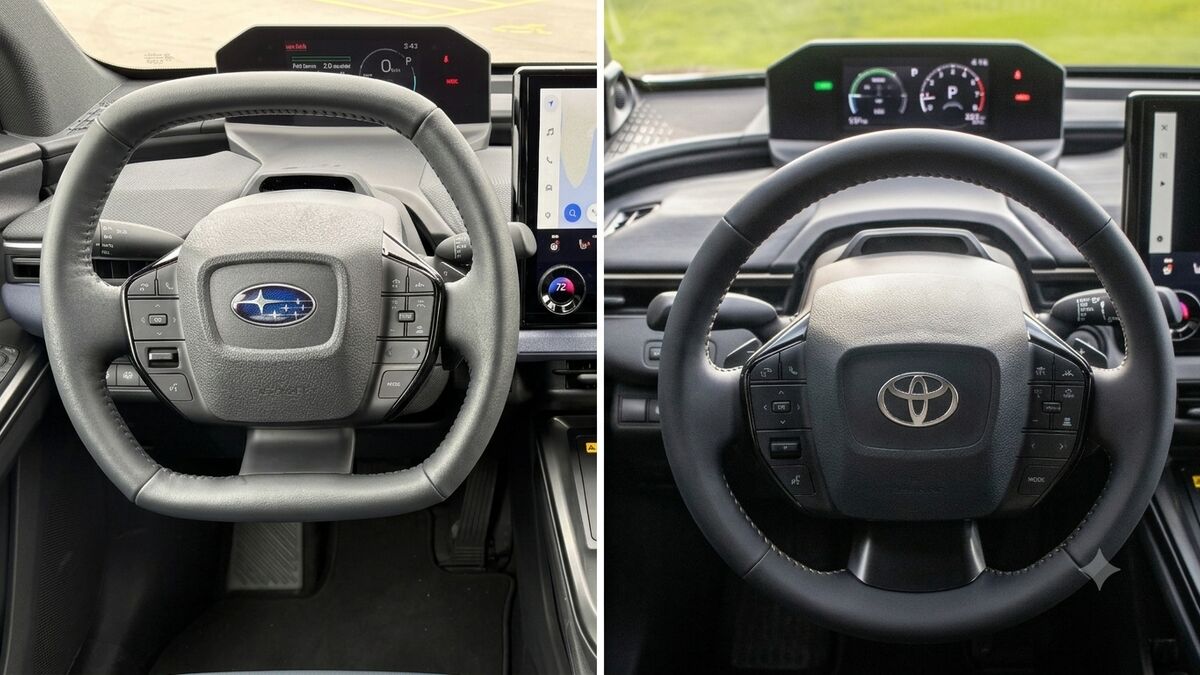
- More new cars are adopting steering wheels with flat tops and bottoms, and rounded sides.
- The squircle steering wheel bridges the gap between the conventional wheel and the steering yoke.
- The squircle trend arises from new digital gauge cluster designs.
It started with a flat bottom. Then came the flat top. Then, a name: The squircle.
Part square, part circle, and not quite oval, the squircle heralds a new design trend for a classic piece of automotive hardware: the steering wheel. Even more so than pedals, the steering wheel is the driver’s main interaction with the car. The squircle trend is less about reinvention for reinvention’s sake than about keeping pace with technology.
With digital instrument clusters and large touchscreens proliferating in new-car cabins, new designs for how that information is displayed and accessed have changed the ergonomics and safety of the human-machine interface (HMI).
Automakers ranging from Lucid to Lincoln, as well as more mainstream brands such as Toyota and Subaru, have recessed the instrument clusters away from the steering wheel and closer to the base of the front windshield. The idea with these recessed displays is to keep that information in the same line of sight as the roadway, rather than drawing your eyes down to the steering wheel controls or into the touchscreen menus.
This conflict between information and safety has played out on the battlefield of the steering wheel.
“With the gauges now above the steering wheel rim, it’s helpful to reshape the steering wheel or make it smaller to make sure the rim doesn’t block the gauges,” Ed Kim, president and chief analyst of AutoPacific, explained to Kelley Blue Book.

MORE: 100 Years of Automotive Steering Wheels
A Squircle is No Yoke
Inspired as much by F1 racing steering wheels as airplane yokes, the squircle acts as an evolutionary bridge between what we as automobile drivers are familiar with and what is most optimally needed to steer ourselves forward.
The squircle has a flat top and bottom, as well as rounded sides like a conventional wheel, but it’s more ergonomic because it conforms to the driver’s hands, like a yoke.
Initial offerings of the yoke didn’t go over well. Tesla introduced it in the Model S and Model X Plaid performance versions in 2021, but quickly reintroduced a round wheel as standard. By 2023, the yoke became a $1,000 option.
Derived from F1 racing, which requires far less lock-to-lock steering, the yoke was somewhat impractical at low speeds because it required several turns of the wheel. With an open top and flat bottom, drivers’ hands could miss part of the wheel entirely when parking or backing up.
When the Lexus RZ electric vehicle launched in Europe and other markets in 2023, it was initially offered with a yoke and a steer-by-wire system that has no mechanical connection between the steering wheel and the driven wheels. Instead, a motor on the steering rack receives inputs from sensors based on steering angle. This could simultaneously limit harsh vibrations from the road to the steering wheel, but also result in a disconnect between the driver and the road.
The yoke arose from an inflection point.
“As technology removes some barriers and changes the hard point requirements, designers and engineers have more flexibility,” said Stephnie Brinley, associate director of AutoIntelligence at S&P Global. “At the same time, engineers and designers are continuously looking for how to evolve and improve interaction with the vehicle.”
In most cases, especially in North America, the industry steered away from the yoke.
Steering Comes Full Squircle
“I was nervous at the time because we were developing Gravity as the [Tesla] yoke came out,” Zeb Coughenour, senior manager of interior design for Lucid, explained in an interview with Kelley Blue Book. “People were comparing ours to theirs, and they were like, ‘Not another yoke,’ and I said, ‘No, it’s a full wheel!’”
A full wheel, even if squished into a squircle, ensures that drivers can hold their hands at 9 and 3 or 10 and 2, and execute hand-over-hand steering at low speeds.
The squircle features a flat bottom, another development ported over from more cramped sports cars. A flat bottom makes getting in and out of any car easier, which is why nearly every Nissan vehicle has a flat-bottomed wheel that makes the rocking world go round.
The flat top is a concession to both familiarity and improved sightlines to screens.
Lucid didn’t look at the yoke for inspiration, or dis-inspiration, for the Gravity SUV. Instead, the challenge was to incorporate a new design element: a touchscreen that serves as the instrument cluster.
“When we first proposed it, it seemed pretty radical,” Coughenour said of the touchscreen above the steering wheel.
The driver can use steering wheel controls, hard buttons on the console, or the touchscreen to access key driving information. To enable the radical placement of the touchscreen, Lucid shrunk the somewhat hexagonal wheel of the Air. In the Gravity, the top bar is shorter than the bottom bar, but a wrist or hand can still rest on the top while pressing a button on the touchscreen. The yoke-like sides are heavily contoured to fit the driver’s hands.
Even though Lucid eschews a steer-by-wire system, unlike many other EVs, the feeling overall is one of both performance and luxury. Yet sportiness was never the intent, even if the 828-horsepower Gravity rockets to 60 mph in 3.2 seconds.
“The intent from the beginning was to open up the viewability to all the controls,” Coughenour said.
This is what drove Lincoln and Ford to adopt the squircle, first in the Lincoln Nautilus and then expanding to the Navigator and Ford Expedition. The innovative Panoramic Display consists of a 48-inch screen curving from door to door along the base of the windshield. The Expedition’s display takes up half of Lincoln’s real estate.
“It was a balancing act between where we place the screens so that you have great visibility outside the vehicle,” said Ryan Niemic, Lincoln interior design chief. “We kind of worked back from that.”
A Vicious Squircle or a Safer Wheel?
With more instrument clusters moving from the steering column toward the base of the windshield, where the sightline is closer the road, the squircle wheel design adds an element of safety. It’s almost like a more thorough yet less distracting head-up display.
“[The display] gives that flexibility when not overwhelming the interior space with every button possible,” Niemic explained. “I’m not looking down at my switches. I’m looking forward. It keeps the eyes up and reinforces that mindset of eyes up and out.”
A conventional round wheel would block views of such displays. The squircle also keeps the steering wheel controls relatively uncluttered.
“With the potential for driver distraction greater than ever given all of the apps and gadgets in new vehicles today, automakers are looking for ways to reduce distraction and keep drivers’ eyes on the road,” Kim echoed. “Displays mounted at the base of the windshield can certainly help reduce distraction as they reduce the need to glance away from the road, and squircle-shaped steering wheels help enable that.”
The Squircle of Trust
But how does the squircle feel to drive?
“It is different and people will need to get used to it,” Brinley said, adding that some automakers will do it better than others.
It takes a minute to get used to the Panoramic Display in the Lincoln Nautilus, more so than the wheel. It feels as if you’re riding higher, since the dash sits much lower than in other cars due to the 4-inch screen wall between the dash and the base of the windshield.
Same for Lucid’s narrower wheel in the Gravity. It took about a minute for each of our four test drivers to get used to it and comment positively. Even though Toyota and Subaru jointly developed their six-pack of EVs, the brands diverged on the steering wheel. Toyota uses a traditional round wheel while Subaru employs a smaller diameter squircle that’s easy to adjust to.
“This has nothing to do with EVs,” Lucid’s Coughenour said.
Lincoln would agree.
Both analysts interviewed agreed that, once acclimated, this reinventing of the steering wheel was an evolutionary improvement, notwithstanding the goofy name.
“There’s not a lot of downside, once you’ve been in one for a minute, to better visibility,” Brinley said.