

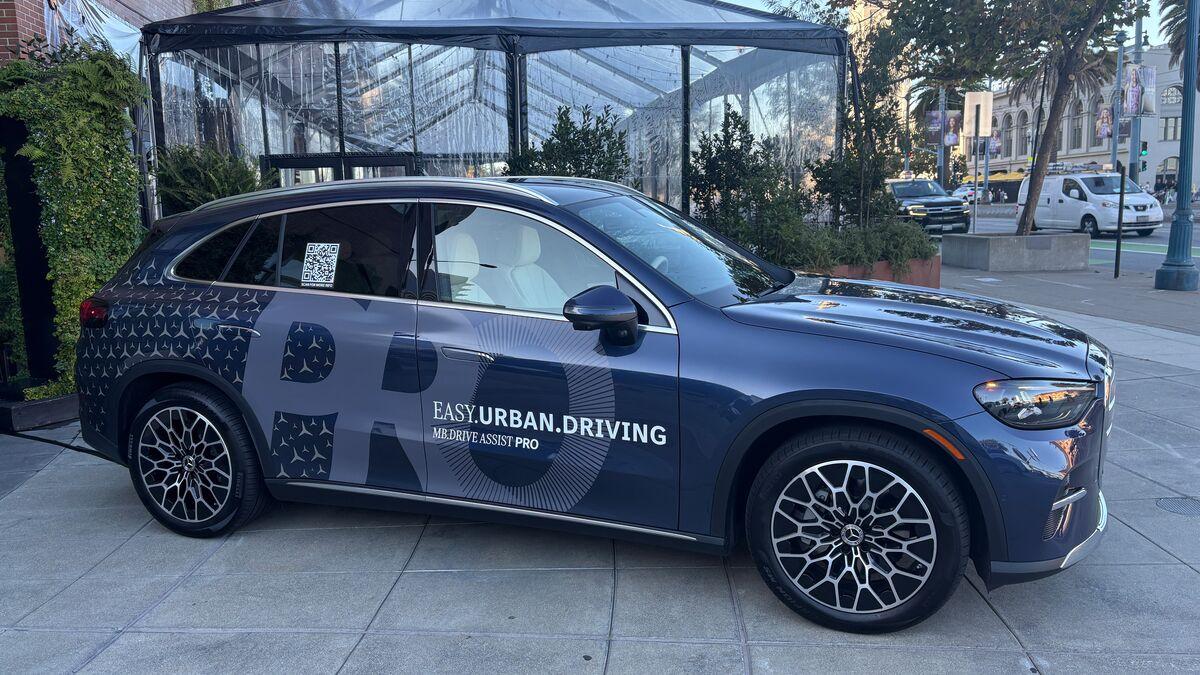
Hills. Fog. Traffic. Errant Waymos. Navigating the roads of San Francisco, California, isn’t for the faint of heart (or for the timid behind the wheel). But if you’re looking to put new point-to-point navigation technology through its paces, the city is the perfect testing ground. Mercedes-Benz did just that last week, demonstrating its upcoming MB.DRIVE ASSIST PRO.
Coming in 2027, MB.DRIVE ASSIST PRO will join Mercedes’ suite of driver assistance offerings, and it includes some of the manufacturer’s most compelling technology to date.
While not a Level 3 autonomous driving system, MB.DRIVE ASSIST PRO will work with Mercedes’ existing MB.DRIVE ASSIST system, including its Hands-Free Highway Assist technology arriving in spring 2027, and other standard MB.DRIVE features, to create a relatively hands-free Level 2 assisted driving experience from departure to destination (except for the safety requirement to touch the wheel at least every 45 seconds or so, of course).
Mercedes Takes Point-to-Point Technology for a Spin
Advanced driver assistance systems (ADAS) are electronic systems that help keep drivers safe on the road. Continuous technical innovation augments these safety features, including adaptive cruise control, lane-keeping assist, and traffic sign recognition, all of which fall under the ADAS umbrella.
Since 2020, Mercedes has had a strategic partnership with NVIDIA to develop its MB.OS technology for the manufacturer’s ADAS systems. Level 2 point-to-point driving is the latest development in this collaboration. A point-to-point ADAS system differs from highway-only systems by extending support to the entire drive route, including in complex urban traffic.
MB.DRIVE ASSIST PRO will use 27 sensing components, including 10 cameras, five radar sensors, and 12 ultrasonic sensors, to assist drivers on city streets, from highway exits to their destinations.
“It is a collaborative system,” Mercedes-Benz North America’s CEO Jason Hoff said during a media roundtable. “It’s not completely hands-off, eyes-off-the-road, but we also believe it fits very well to Mercedes’ heritage and tradition of bringing out systems that people should trust.”
Availability and Pricing
Pricing for MB.DRIVE ASSIST PRO is not yet available, but we do know that drivers will have flexible purchase options depending on the vehicle’s model year. For vehicles with the required hardware, an over-the-air (OTA) update can deliver the feature. The technology begins its commercial rollout for select models in 2027, with a U.S. Early Access Program (EAP) providing select eligible customers in California with access starting in December 2026.
For customers who may feel hesitant about the technology, or who may not want to dive straight into a lengthy subscription, Hoff suggested that drivers simply try it out. “We will be offering subscription models…one month, a year, three years would be the time frames,” he said. “That’s going to allow people to try things without getting into a long-term commitment…you’re not going to have to go out and spend thousands of dollars on something and not be sure or say ‘Oh, I don’t really know if I’m going to like this or not.’ ”
Driving Scenarios That Put Point-to-Point Tech to the Test
During an approximately 45-minute drive in a GLC 400 through San Francisco, I experienced a range of urban driving scenarios under the supervision of a Mercedes engineer. The loop took us along the Embarcadero for a view of the Golden Gate Bridge, then through the city itself.
Once you program your route, you can engage point-to-point assistance with a steering wheel button. If you happen to have trust issues that extend into your driving life (speaking only for myself, of course), ceding control to software isn’t easy. This drive was no exception, but the Mercedes team repeatedly emphasized the company’s 140-year legacy of safety throughout the experience. That legacy may be the ultimate selling point for this technology.
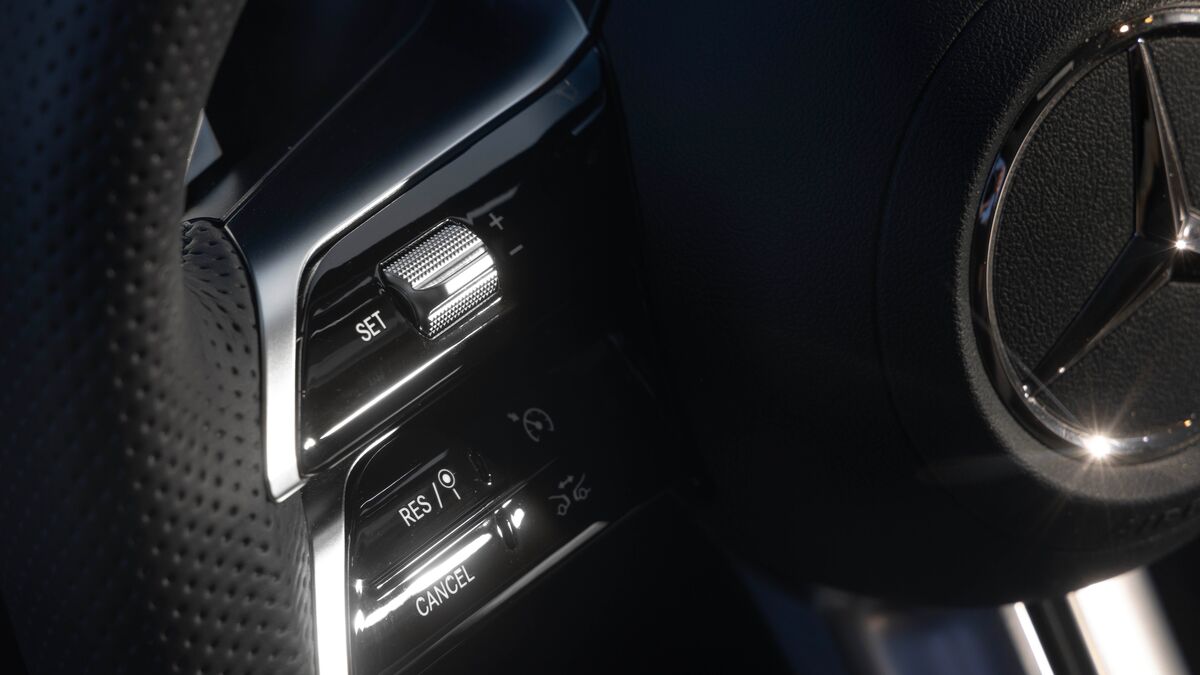
MB.DRIVE ASSIST PRO is not fully autonomous driving technology, but rather assisted technology. The system requires your hands to make regular contact with the wheel. Approximately 45 seconds without contact triggers a visual alert in the instrument panel and head-up display. While driving, you can relax a little bit, but you must still be ready to take over driving at any time. Mercedes calculates that complacency with your awareness never has time to develop.
If you do not make contact with the steering wheel, you will first receive a visual alert and an auditory warning tone. If the wheel does not receive feedback, alerts will continue to escalate. If the driver does not react to these alerts for an extended period, the car’s hazard lights will begin to flash, and an emergency stop will be activated. Mercedes also uses eye-tracking technology via an interior camera to help assess driver alertness. If the line of sight from the camera to the driver’s head and eyes is blocked for any reason, alerts will follow the same sequence.
The car handled the drive without my intervention from start to finish except for parking, which remained my responsibility. (Mercedes’ Parking Assist technology is available on most models.) My control issues eased somewhat over the course of the drive as I adjusted to the car’s handling in these scenarios, but in a dense urban environment like San Francisco, constant vigilance remains essential.
Steering adjustments or acceleration do not deactivate the system, so when you need to be a bit more aggressive, you can complete the maneuver and then let the car resume its activity.
Three situations stood out.
The 4-Way Intersection
On a busy afternoon in the city, a 4-way intersection with stop signs presents an especially complex challenge for this technology. Not only do multiple cars wait in all four directions, but there is scooter and cycling traffic, as well as heavy pedestrian traffic in both directions at every crosswalk.
The Mercedes engineer emphasized that the technology can trend toward more conservative decision-making, almost like a new driver who’s in their first year on the road. That caution, he said, is essential from a safety standpoint. We remained at the intersection longer than we might have with a human driver in control. In a busy urban scenario like this, while the car may obey regular traffic and right-of-way rules, the constant and unpredictable pedestrian traffic can make it very difficult to maintain that flow. Even when the car had the right of way, unpredictable pedestrians and cyclists made it difficult for the system to proceed.
Sitting at the 4-way stop, I felt very tempted to intervene with the point-to-point to be a bit more aggressive. City driving sometimes calls for assertiveness, and the system leaned toward hesitation.
The Garbage Truck Workaround
In another instance, a large garbage truck blocked most of the lane ahead past a traffic signal. Given the car’s hesitation at the previous 4-way intersection, I was curious to see how it would handle this. I came away impressed.
Without unpredictable foot traffic to bother us, the car capably assessed the situation, including the timing of the stoplight and the flow of oncoming traffic. The Mercedes successfully got us around the truck at the intersection after the light changed, without getting stuck or disrupting oncoming traffic.
This did rely on the benevolence of an oncoming driver in the other direction to let us pass; however, had that driver been stubborn, or had there been a solid wall of traffic, our car might have maintained the same measured hesitation as in the first intersection scenario.
Left-Turn Hesitation
The most distinct scenario for me was hesitation at a protected left turn due to detecting oncoming bicycle traffic to the right. Green arrows assured us we were good to go for this turn, but we were alerted to oncoming cyclists. Though we all could have safely made the turn, the car opted not to, and instead stopped. The bikers made it past, but the light turned red in the interim.
This situation highlighted the need for the driver to be ready to intervene with point-to-point. The decision to stop for safety was reasonable, but this is San Francisco driving, after all, and if we had had vehicles behind us, we would certainly have had an incoming chorus of frustrated horns. Driver intuition and knowledge of San Francisco traffic flow come into heavy play.
Point-to-Point Is Not for Highway Driving, but Hands-Free Highway Assist Helps Close the Loop
This iteration of point-to-point technology arriving with MB.DRIVE ASSIST PRO is not for highway driving – it is intended for all that comes after a vehicle exits.
That doesn’t leave Mercedes drivers without help on the highway. Hands-Free Highway Assist will be available to MB.OS vehicles with MB.DRIVE ASSIST PRO beginning in Spring 2027.
We also drove two routes using Hands-Free Highway Assist, which offers supervised, hands-free driving. Combined with adaptive cruise control, this feature keeps the car centered in the lane, assists with lane changes, maintains pace with the flow of traffic, and anticipates road hazards and slowdowns.
“Hands-Free” is a bit of a misnomer – you can’t work on your latest crochet project while driving; your hands are still required to make regular contact with the wheel, and there are some scenarios that will require you to take over again, like sharp curves in the road or roadwork.
With the introduction of point-to-point technology, Mercedes sees these technologies working in tandem to bring a car to its destination with minimal driver assistance, whether the journey leads you deep into the city, across highways, or both.
Who Is Self-Driving For?
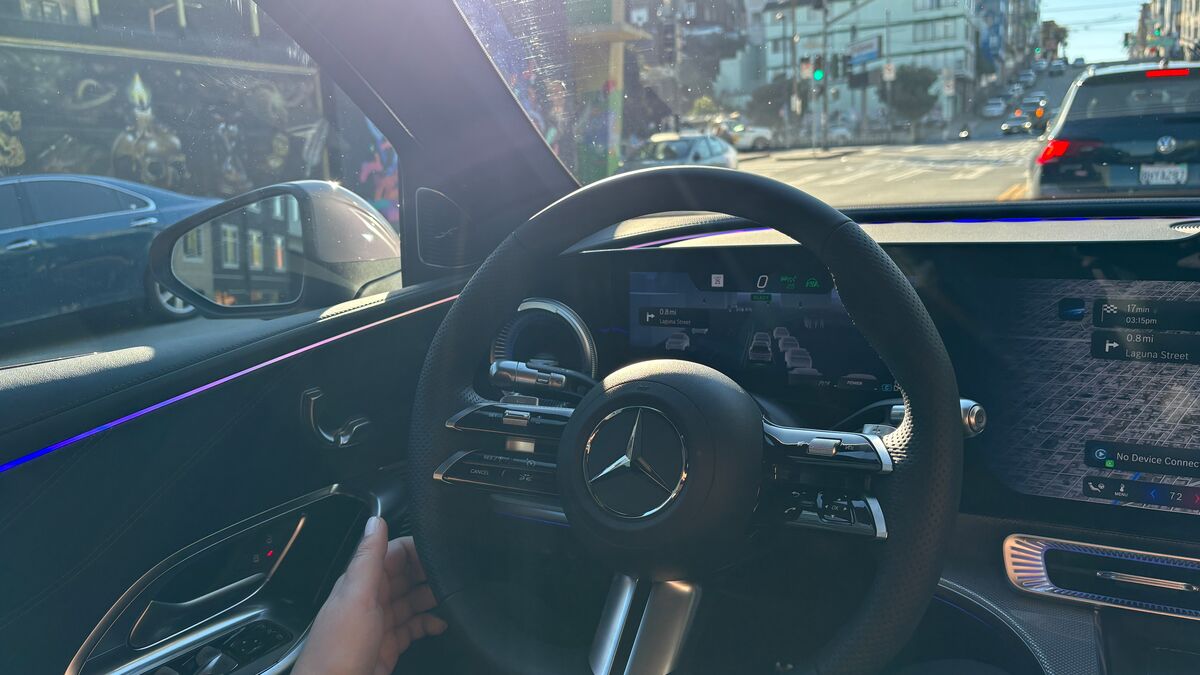
Mercedes’ systems could appeal to a range of drivers, from those already within the Mercedes ecosystem to those looking to dip their toes into the technology for the first time.
Point-to-point may be especially appealing for drivers who are less confident, or who get stressed out by city driving. A location like San Francisco can be overwhelming even for seasoned drivers, and a little extra help and safety assurance is never unwelcome.
The technology may be a bit less enticing if most of your driving is done in calm suburban or rural environments, but it will still provide an extra layer of protection, or a bit more rest on longer drives.
The Bottom Line
While MB.DRIVE ASSIST PRO will offer the opportunity to use all of the MB.OS safety features together, it does not yet provide a full park-to-park experience like Tesla’s Full Self-Driving (Supervised) does. Tesla’s FSD is currently available for $99 per month. Mercedes does have its Park Assist feature, which very capably navigates parking scenarios, but you must engage it via the infotainment screen, unlike Tesla’s technology, which integrates all these features without requiring additional driver input.
It’s a small distinction, but one which will matter to buyers. However, price and other design factors will also weigh heavily in car-shopping decisions. FSD is very compelling technology, but the Tesla design aesthetic is not for every buyer. Mercedes’ technology will also be applicable across gas, hybrid, and electric vehicles, widening the scope of availability and range of models for consumers to select from. Will shoppers be willing to compromise on an entirely seamless end-to-end assisted-driving experience for the world-class safety features and luxury and design reputation that Mercedes offers?
When considering city-dwellers in particular, there is also the question of alternatives to a personal car altogether. Commercial robotaxis like Waymo and Tesla’s Cybercab offer Level 4 autonomous driving options to riders in many cities, and the services are growing in popularity. Level 2 driving systems like MB.DRIVE ASSIST PRO or FSD require constant driver attention, whereas a robotaxi requires no human input, and a rider really could work on their latest crochet project until arriving at their destination.
In the long term, the question lingers: Will the everyday buyer lean toward overall convenience, or an emphasis on safety? Time will tell.