
- The insurance industry’s car safety watchdog has a new crash test designed to measure whiplash risk.
- The group regularly makes its tests harder, and has pushed car safety forward by doing that.
The Insurance Institute for Highway Safety (IIHS) is launching a new seat and head restraint evaluation focusing on neck injuries from rear-end crashes.
IIHS President David Harkey explains that neck sprains and strains are the most frequently reported injuries in U.S. auto insurance claims. “This new test challenges automakers to further improve their seats and head restraints to provide better protection in the rear impacts that typically cause these injuries,” he said.
The Test
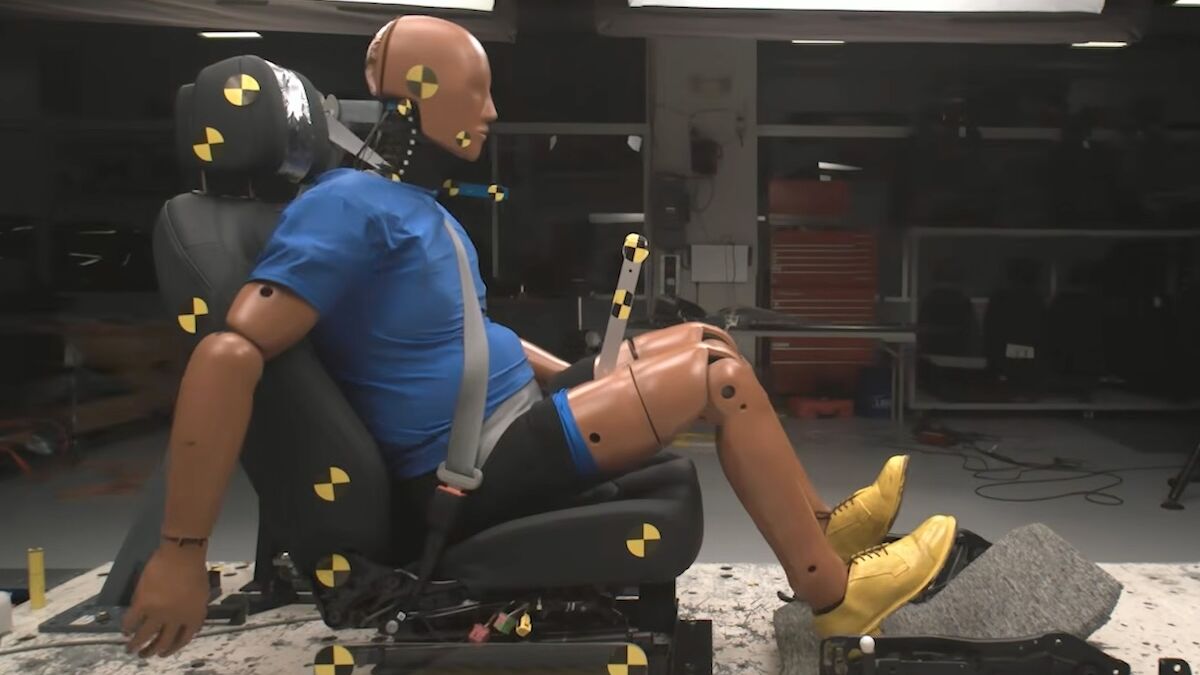
In this test, the driver’s seat is removed from the vehicle and secured to a sled. A midsize male dummy designed for rear impact testing is positioned in the driver’s seat. The sled delivers a sudden pulse of acceleration to simulate the effect of a stationary vehicle being struck from behind.
The original test involved a single pulse equivalent to being struck by a vehicle traveling at 20 mph of the same weight. That evaluation was discontinued in 2022 because automakers had improved their vehicles so much that almost all earned good ratings. However, occupants of vehicles with good ratings still suffered whiplash injuries, indicating that a new test was needed. The IIHS is known for making tests more difficult to promote greater safety.
The Metrics
Analysis showed that several key metrics recorded at impact speeds of 20 mph and 30 mph provided useful information, so the new test uses separate acceleration pulses to simulate crashes at both speeds. Additional research was conducted to zero in on the metrics that appear to most directly influence injury risk.
The new test combines measures to gauge three aspects of injury prevention: head and spine support, the interaction of the head with the head restraint, and how well the seat manages the energy transferred to the occupant’s body.
The Results
Vehicles that receive a poor rating fall short in all three areas at both impact speeds and perform very badly in at least one. Poorly rated vehicles show the dummy’s head moving significantly relative to the spine. In contrast, vehicles with a good rating show that the seat and head restraints keep the dummy’s head and spine in alignment. Furthermore, vehicles that receive a good rating provide excellent protection across all metrics at both speeds. Acceptable ratings indicate that vehicles may falter slightly across multiple areas, while marginal ratings indicate serious flaws.
So far, only four of the first 18 small SUVs tested earned a good rating: the Audi Q3, Hyundai Ioniq 5, Subaru Forester, and Toyota RAV4.