
In the 2026 model year, there are traditional cars and Silicon Valley cars.
Silicon Valley cars have their own vibe. They’re electric, yes. But beyond that, they run nearly every feature through a touchscreen and have cutesy high-tech names for common features. They feel like devices as much as transportation.
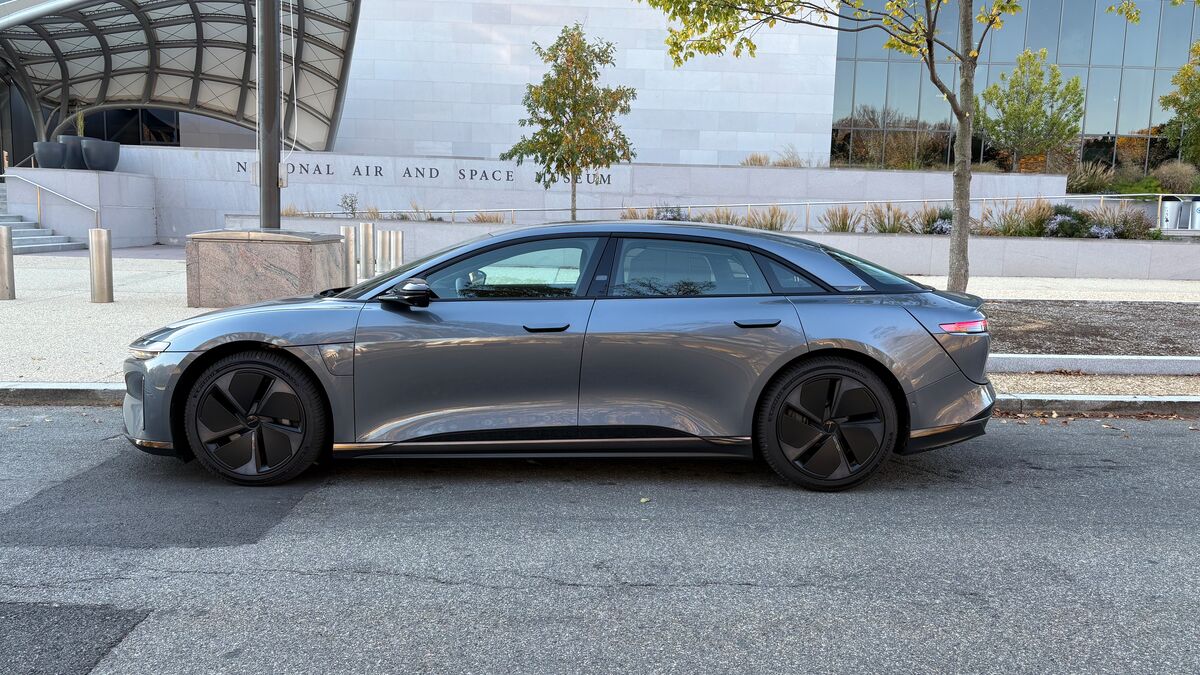
The 2026 Lucid Air is decidedly a Silicon Valley car. It feels like it’s competing for the same audience as the Tesla Model S or Polestar 4. You should know whether you want one of those before you can decide whether you want an Air.
I don’t mean to criticize or praise with the distinction. A Silicon Valley car could be the right choice for you. But every time I drive one, I’m left with the unshakeable feeling that the car has something more in common with my phone than with the other cars in traffic. That either appeals to you or turns you off, but it’s worth knowing up front.
Among Silicon Valley cars, the Air sets itself apart with remarkably fast charging, an interior design aesthetic a little more varied than Tesla or Polestar has to offer, and head-snapping acceleration.
Yes, every high-end electric vehicle (EV) is quick. Still, a zero-to-60 time barely over three seconds in a five-seat sedan is something you can’t understand until you experience it.
I spent a week driving the Air around Washington, D.C. and its suburbs, and was impressed … but still walked away thinking this is not a car for the masses. It’s a car for a very particular subset of people.
Lucid has built a better Tesla than Tesla does.
Which Trim Level
Lucid builds the Air in base Pure, midlevel Touring, and high-end Grand Touring models. There’s also a blistering-fast, ultra-luxe Air Sapphire, but that has as much in common with other Air models as cheetahs do with my lazy cat.
Lucid loaned me the Touring model with some pricey options, including an upgraded 21-speaker audio system and excellent massaging seats (the massage is firm enough — a rarity in a car). See the window sticker in the gallery below for precise details.
New 2026 Lucid Air Prices
|
Retail Price
|
Fair Purchase Price (39367)
|
|||
|---|---|---|---|---|
$72,400 |
$71,000 |
|||
$81,400 |
$79,800 |
|||
$116,400 |
$113,000 |
|||
$250,500 |
$248,000 |
Favorite Feature
The Lucid Air is one of the fastest-charging electric cars on the market.
Range anxiety is really time anxiety. I’ve driven many EVs, including several multi-day roadtrips, and I can tell you from experience that the speed at which a car charges matters more than its range. Stopping every 250 miles for a 20-minute recharge is a drastically better experience than driving 50 miles farther but needing twice as long to charge.
Lucid’s Wunderbox Onboard Boost Charger (did I mention everything has a cutesy name in a Silicon Valley car?) manages the charging process efficiently and can even boost some older, low-powered chargers to work faster.
I once watched the Air gain nearly 100 miles overnight when plugged into an ordinary wall outlet like it was a phone.
An estimated 406-mile range is impressive. Charging to 80% of that range in 23 minutes on a DC fast charger is more impressive. This thing would save you time over most of its competition.
What It’s Like to Drive
The Air Touring boasts 620 horsepower from two electric motors, one per axle, giving it all-wheel drive (AWD) grip. It leaps from zero to 60, Lucid claims, in 3.4 seconds.
Those are numbers. Mashing the accelerator to the floor scrambles your understanding of numbers.
Look, there are a lot of quick EVs. There are even EVs quicker than this one (the Sapphire model is one of the first sedans in history to get to 60 mph in under two seconds). But nothing you have experienced prepares you for the warp drive feeling of putting the Air in Sprint mode and stepping on the accelerator.
That Star Wars effect where the stars become straight lines when Han Solo engages the hyperdrive? It’s that, on a highway on-ramp. I’ve driven performance cars on tracks and never felt the rush of the Air’s neck-snapping whooooosh to 60 … okay, 68 by accident. I wonder if it’s safe to give some drivers that much torque.
Apart from that, the Air is quite pleasant in daily driving. One-pedal driving mode brakes more aggressively than similar modes in other EVs. But you can either get used to it or turn it off.
Handling is smooth but unexceptional.
My tester had the optional Dream Drive Pro hands-free driving mode. It was a cautious driver in traffic and earned my trust quickly, but it works only on stretches of pre-mapped highway.
Interior Comfort and Technology
EV interiors in tech-forward cars can feel clinical. Lucid mostly avoids that with some artistic material choices.
My tester wore the Mojave color scheme, which is mostly a selection of grays and metallic trim. Large stretches of a coarse, canvas-like material on the doors and dash contrasted nicely with soft faux leather. I’m a sucker for texture in design, and Lucid has put artistry into its texture choices.
Lucid’s PureLuxe vegan leather is a convincing mock-up of the real thing.
Nowhere do the car’s Silicon Valley roots show as clearly, however, as in its touchscreen. The Air has few buttons. Nearly every function runs through that screen — even adjusting the steering wheel and side mirrors. You can’t open the glove box without finding the right touchscreen menu.
There’s been some pushback to that idea — European law will soon require buttons for some functions as a safety measure, and the Air may need to be modified to meet them. However, some drivers appreciate the high-tech feel of a screen-powered car, and the Air provides that.
You can also put the screen away — brush your finger up from the bottom of the screen and it tucks neatly into the dash, revealing a cubby behind.
Limitations
There are risks in buying from a startup automaker.
Several have fallen into bankruptcy in recent years, leaving users with expensive cars that may never have an adequate supply of repair parts or even technicians who’ve worked on them before. Lucid has some deep-pocketed investors, including the Public Investment Fund of Saudi Arabia. It may be more failure-proof than most. But know that there is risk in buying from a startup automaker that may not survive, and don’t buy an Air if you can’t afford that risk.
Additionally, some taller editors have complained that the Air’s optional glass canopy roof is distracting. My tester did not have it, and I am not tall.
Key Considerations
If you want a high-luxury electric sedan with more conventional controls, the Porsche Taycan is about as quick and sumptuous as this. If you want the Silicon Valley sheen of a Tesla Model S without the political controversy, this may be your car.