
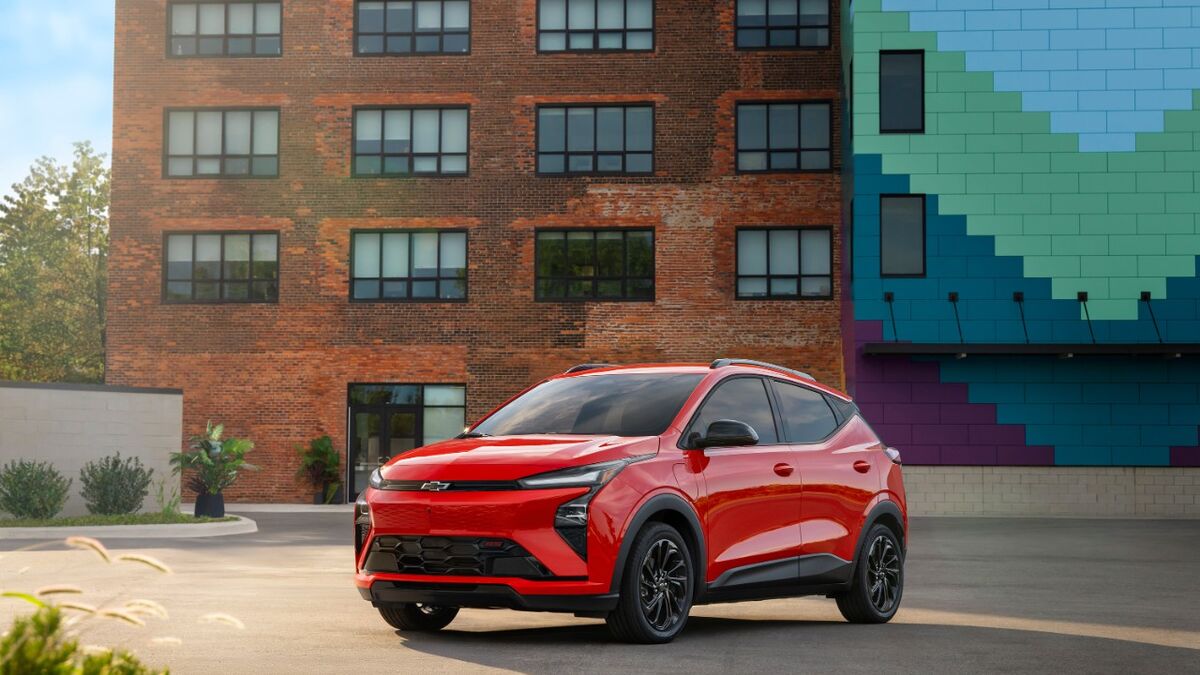
- The 2027 Chevrolet Bolt will start at $28,995, undercutting the Nissan Leaf to become America’s least expensive electric car.
- The Bolt returns for 2027 with familiar looks but a new battery.
The 2027 Chevrolet Bolt will reach dealerships in the first quarter of 2026 and will be the least expensive electric vehicle (EV) in America.
When it first appears, the base model Bolt LT will start at $29,990, including a $1,395 destination fee. Later in the model year, the price will drop to $28,995, and a better-equipped RS model will appear at an as-yet-unannounced price.
That makes it less expensive than the current title holder, the 2026 Nissan Leaf, which has a $31,485 minimum. Note that we’re comparing prices between the 2026 Leaf and the 2027 Bolt because Chevrolet is releasing their EV so early that the two will be on sales lots at the same time for most of 2026.
Chevrolet estimates that the Bolt will offer 262 miles of range, though the EPA hasn’t weighed in on that. The Leaf has it beat in that category, with over 300 miles. But Chevrolet notes that the Bolt will “offer the most range in an EV under $30,000.”
That’s an easy claim to make, as it’s the only EV under $30,000.
Returns With a Mix of New and Old
- Chevy ended Bolt sales in late 2023, though it was the best-selling non-Tesla EV at the time.
The Bolt has been off the market since late 2023, but returns for the 2027 model year. The Bolt had been the best-selling non-Tesla EV in America, but used a different battery chemistry than GM’s other EVs and faced a series of recalls over battery fires.
Its appearance has changed little, but under the skin, it’s quite different this time. It now uses the same battery chemistry as every other GM EV, from the $34,995 compact Chevrolet Equinox EV to the immense $129,795 Cadillac Escalade IQ. That should solve the fire issue.
Chevrolet says the new Bolt charges more than twice as fast as the old one, going from 10% charged to 80% in just 26 minutes at a DC fast charger (the rarest type).
It will be capable of powering a home with bidirectional charging and use the Tesla-style North American Charging System (NACS) port.
Interior features include an 11.3-inch infotainment screen with Google built-in, but not Apple CarPlay or Android Auto (GM plans its own phone projection system in their place). GM’s Super Cruise hands-free driver assistance system will be an option.