

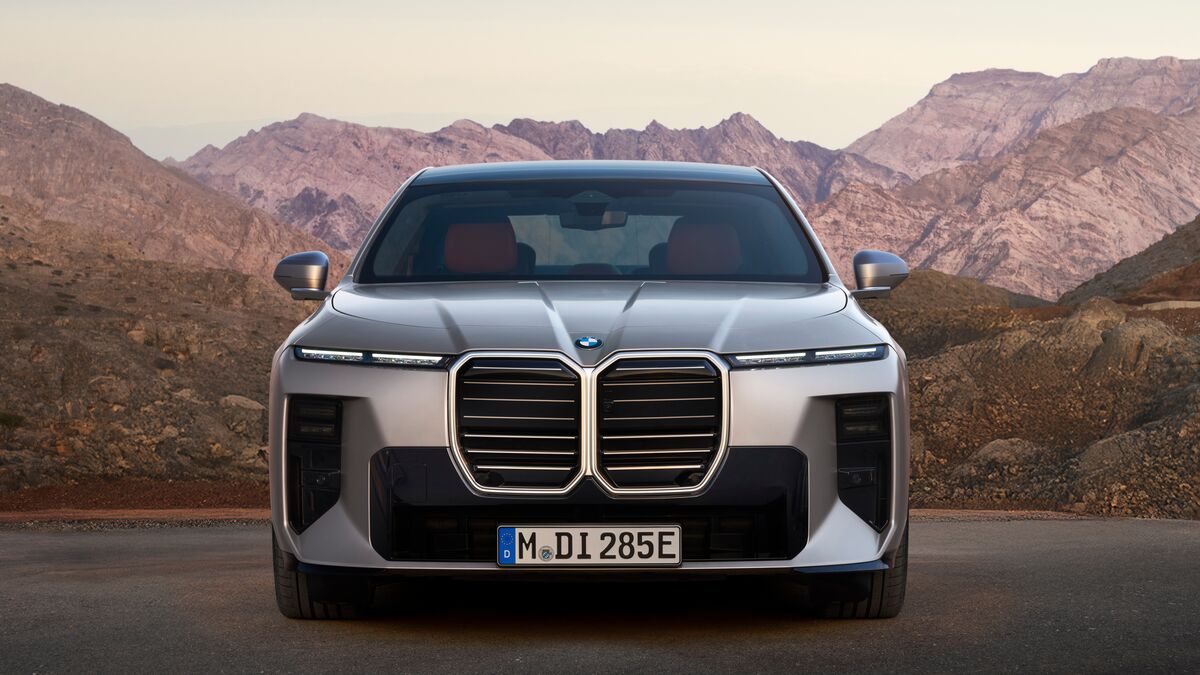
- The heavily refreshed flagship sedan wears bold and blocky design cues from BMW’s latest EVs.
- BMW i7 electric variants have a range of up to 350 miles and a starting price of $107,750.
- BMW 740 and 740 xDrive variants use a more powerful 6-cylinder engine; prices start at $101,350.
- A BMW 750e xDrive plug-in hybrid (PHEV) arrives later this year, followed by a V8 M Performance model.
The BMW 7 Series glows up for the 2027 model year. For its mid-cycle refresh, the flagship sedan wears bold and blocky ends borrowed from the brand’s latest electric vehicles. The 6-cylinder BMW 740 returns with a bit more power, but the i7 electric variant gets new battery cells and more battery capacity to boost both power and range, BMW announced. Inside, a new display curves from door to door around the base of the windshield, and new touchscreens debut.
In short, there’s a lot going on in the new 7 Series, so much so that BMW calls it the most extensive model update not just in the 50 years since the 7 Series debuted in 1977, but ever in the brand’s history.

Bold New Look for the 2027 BMW 7 Series
BMW leans into its garish front end design even more so for the refreshed 7 Series. Like the iX3 SUV and i3 compact sedan that debuted the brand’s Neue Klasse (“new class”) design language, the 7 Series’ classic kidney grille morphs into something like an iron butterfly, illuminated. A dual-ridged hood flows back from each of the kidneys, or butterfly wings, depending on your hot take, and thin daytime running lights try to spread the vertical face to the edges. Its face is unequivocally upright and blocky, with tall side intakes and LED headlight housings, as well as a pronounced lower grille.
Call it an evolution from its stately predecessors, including even the sixth-gen 7 Series that ran from 2016-2022 and its somewhat polarizing mid-cycle update that paved the way for the grille we see now. The profile rises up into the signature Hofmeister kink that bends in chrome around the rear window. Wide, thin taillights wrap the muscular rear. We can’t help but notice some Rolls-Royce influences on the new 7 Series, especially when equipped with an available two-tone paint scheme with hand-drawn lines and custom body work that BMW calls Individual Dual-Finish.
Bold Screens Bedazzle the 2027 7 Series Interior
Elements of the Neue Klasse migrate inside the new 7 Series as well, most notably with an instrument cluster that recesses from the steering wheel to the base of the front windshield. Dubbed Panoramic iDrive Display, the thin screen stretches from door to door and curves along where the dash meets the windshield. It houses most vehicle info and acts as a replacement for the traditional instrument cluster, but with the info safely nestled in your range of vision with the road.
Closer to the cushy front seats are a trapezoidal 17.9-inch touchscreen for navigation, climate, and multimedia functions, as well as a 14.6-inch front passenger screen. The screens have a switch to automatically open the doors, similar to Rolls-Royce models. Wireless Apple CarPlay and Android Auto are standard, as are over-the-air updates.
Available features include massaging front seats, a 31.3-inch Theater Screen suspended from the ceiling for rear-seat fortunates, and a 36-speaker, seat-shaking Bowers & Wilkins sound system, among many, many other options.
One of the biggest changes to the 7 Series comes from something drivers or passengers may never see. The software-defined vehicle uses high-performance computers that result in 20 times greater processing power than current BMW models, enabling interactive AI and over-the-air updates. Additionally, the new computer systems helped BMW cut 2,000 feet of wiring and trim harness weight, as well as increase overall efficiency.
BMW i7 Electric Variants Get More Power, More Range
- 2027 BMW i7 60 xDrive makes 536 horsepower and 549 lb-ft of torque, with a 0-to-60-mph time of 4.6 seconds. It costs $126,250 (with destination).
- 2027 BMW i7 50 xDrive makes 449 hp and 487 lb-ft of torque, with a 0-to-60-mph time of 5.3 seconds. It costs $107,750.
- The i7 60 has an estimated range of 350 miles, up from 314 miles in the outgoing i7; BMW did not reveal range estimates for the i7 50.
The updated i7 gets the biggest changes thanks in part to the new electric architecture mentioned above as well as a new high-voltage battery pack. It features cylindrical cells estimated to be 20% more energy-dense than the prismatic cells of the outgoing battery pack, according to BMW. The usable battery capacity increases from 101.7 kWh to 112.5 kWh, and increased drive system efficiency boosts both power and range. Range in the i7 60 increases from 314 miles to 350 miles, BMW estimates.
The i7 still has a 400-volt electrical architecture but it now has a native North American Charging Standard (NACS) port that can tap into Tesla Superchargers. Adapters are included to access CCS stations. The charging rate increases from 195 to 250 kW, enabling a 10% to 80% state of charge in an estimated 28 minutes at a DC-fast charger.
BMW 740 Has More Power
- The revised turbocharged 3.0-liter in-line 6-cylinder makes 394 hp (up from 375 hp) but the same 398 lb-ft.
- BMW estimates the 740 xDrive all-wheel-drive (AWD) version will hit 60 mph in less than five seconds.
- Prices increase by $500, with the 740 starting at $101,350, and the 740 xDrive at $104,350.
BMW’s classic inline-6 gets a new turbocharger that increases the output from 375 hp in the 2026 BMW 7 Series to 394 hp. BMW estimates that the 740 xDrive with AWD gets to 60 mph in less than five seconds, and a top speed of 155 mph.
Global production of the 2027 BMW 7 Series begins in July. A revised BMW 750e xDrive plug-in hybrid (PHEV) will arrive later this year, followed by a V8 M performance model.