

Quick Facts About New Car Prices
- October’s new-vehicle average transaction price (ATP) reached a record $51,109.
- Despite record prices, automakers and dealers remain restrained in their incentive spending.
- Prices continue to rise moderately year over year, but have stayed fairly flat throughout 2026. Waiting for a significant price drop may not pay off. If you need a new car, shop around and consider a wider range of vehicles to fit your budget.
At $51,109, October’s average transaction price (ATP) for a new vehicle set another record. However, the year-over-year increase was just 2.1%, below October’s long-term average increase of 3.6%. Higher prices for midsize SUVs and full-size pickup trucks helped drive the increase. The other three of the five highest-volume segments — subcompact SUVs, compact SUVs, and compact cars — sold well below the industry average.
More buyers are choosing the most affordable models, which keeps the overall industry average transaction price relatively stable despite rising prices. However, demand for lower-priced vehicles is keeping supply for these lower-priced options relatively tight. If you find a vehicle that fits your needs and budget, waiting for a better deal may not pay off. Manufacturer incentive spending in October averaged 6.8% of ATP, up only 0.1 percentage point from September and up 0.2 percentage point year over year. Still, careful shoppers can still find good deals. Model year 2027 vehicles now account for 32% of available inventory, and dealers will continue to clear out older inventory to make room for new vehicles.
Read on for expert insights into what’s driving these trends and what you need to know if you’re planning to start your search or buy a car now.
- Where New Car Prices Stand
- The State of Electric
- New Car Inventory Update
- The Implications for Car Shoppers
- What Drives New Car Prices
- Shop Around for the Best Offer on Your Trade-in
October Sees a New Record ATP
The new-vehicle ATP in October was up 1.3% from September, and up 2.1% year over year. At $51,109, October’s ATP dethroned the previous record of $50,614 set in December 2025. Strong sales of higher-priced midsize and full-size SUVs and full-size pickup trucks helped drive the increase.
Because ATP is only an average, looking at individual segments can give shoppers a better sense of what to expect:
- Midsize SUV: ATP of $50,570, up 1.9% year over year.
- Compact SUV: ATP of $37,895, up 4.3% year over year.
- Full-size pickup truck: ATP of $67,912, up 1.4% year over year.
- Subcompact SUV: ATP of $31,333, up 1.9% year over year.
- Compact car: ATP of $28,030, up 3.4% year over year.
These five segments accounted for 64.4% of all new vehicle sales in October. Midsize SUV sales outpaced compact SUVs with volume growth near 10% year over year.
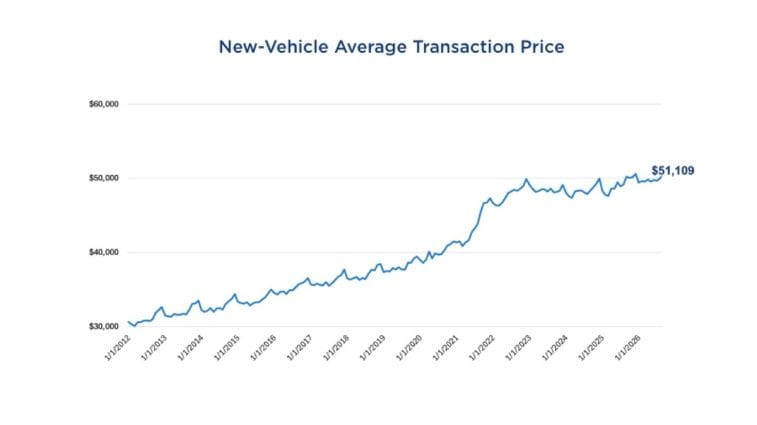
“The average is telling us as much about product mix as it is about affordability,” said Cox Automotive Executive Analyst Erin Keating. “Three of the five highest-volume segments transacted significantly below the industry’s $51,109 average, while vehicles priced from roughly $28,000 to $38,000 collectively gained 9.6% in volume year over year. Consumers are still buying plenty of vehicles well below the headline average transaction price, even as strong demand for full-size pickups and other larger, well-equipped vehicles keeps pushing the average to new highs.”
October’s sales pace was relatively flat compared with September and October last year. Inventory grew for the second consecutive month, but steady sales suggest the increase in days’ supply reflects more available vehicles rather than weakening demand.
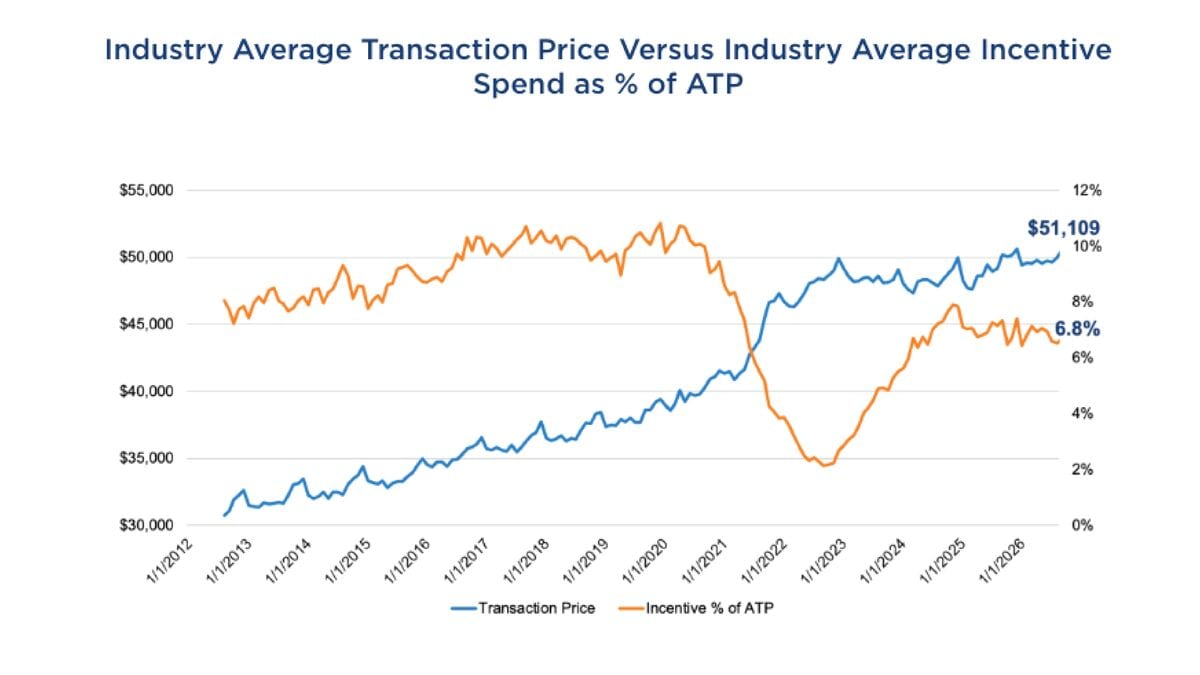
Despite volatile fuel prices and economic uncertainty, new-vehicle demand remains resilient. However, inventory varies widely by brand and model.
If you need a car now, explore Kelley Blue Book’s Car Affordability Information Center for advice on finding a vehicle that fits your budget.
MORE: Can I Afford a Car in 2026?
New EV Sales Saw First Gains in 2026
New electric vehicle (EV) sales posted their first year-over-year gain of 2026 in October, rising 3%, but fell 3.9% from September. Sales totaled an estimated 83,262 vehicles, accounting for 6.2% of new vehicle sales, down from September’s 6.5%. Tesla led the market with 47,850 sales, down 1.1% from September. Rivian, Cadillac, and Chevrolet electric models followed in sales.
The average ATP for a new EV reached $56,221 in October, up 1% from September but down 2.9% year over year. Incentives averaged $6,375, or 11.3% of ATP. Sales of Tesla’s Model Y, the EV market’s best-selling vehicle, helped drive the increase in ATP, with average transaction price rising 0.8% to $53,492.
New EV inventory increased in October. Days’ supply rose to 85 days, up 21% from September, but down 40.4% year over year. The gap between EV supply and ICE+ supply narrowed to about four days from September’s 12-day gap. At 38 days, Honda had the leanest supply, while Volkswagen had inventory more than twice the industry average.
“The electric vehicle market continues to adjust to the expiration of the federal tax credit, and October offered an early read on demand in a post-incentive market,” said Cox Automotive Director of Industry Insights Stephanie Valdez Streaty. “New EV sales rose year over year for the first time in 2026, but EV share remained relatively steady, and inventory rose, reinforcing the importance of affordability and incentives. Heading into year-end, broader economic conditions, including inflation, fuel prices, and consumer confidence, will shape how much shoppers are willing to spend.”
New Car Inventory Update
Dealerships track inventory with a metric called “days’ supply,” which estimates how long it would take to sell all available vehicles at the current sales pace. According to Cox Automotive’s vAuto Live Market View, new car inventory data for October showed an 87-day supply, up from 83 days in September. That marked the second consecutive monthly increase, although supply remained below the 90-day level recorded a year earlier.
Total available inventory rose 4.2% to 2.92 million vehicles in October. The average listing price was $50,498, up 1.7% from September and 2.7% year over year.
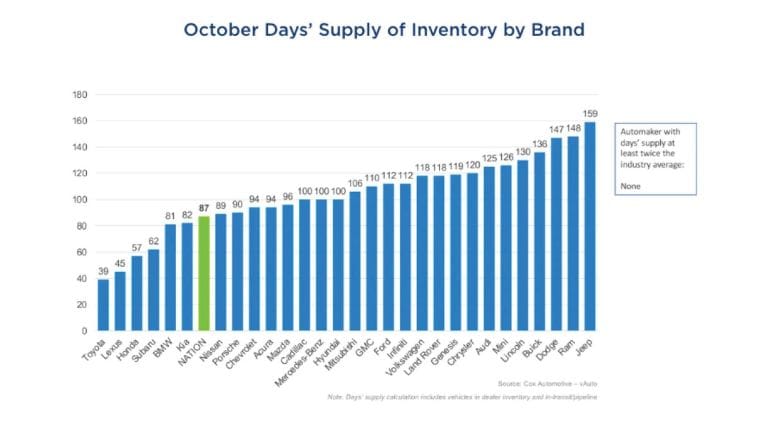
Inventory varied considerably by brand. Toyota had the tightest inventory in October at 39 days’ supply, followed by Lexus at 45 days, Honda at 57 days, and Subaru at 62 days. The Toyota Grand Highlander had just 22 days’ supply, while the RAV4 had 24. At the other end of the spectrum, Stellantis brands carried some of the industry’s largest inventories. Jeep had 159 days’ supply, followed by Ram at 148 and Dodge at 147 days’ supply.
What Does This Mean for Car Shoppers?
The 2026 market has demonstrated relative stability, and the industry does have more supply as Q4 gets underway. However, while inventory levels look balanced overall, the distribution is certainly not even across all brands. Brands like Toyota, Lexus, and Honda are operating with very lean, competitive inventory, and supply of the most affordable vehicles remains constrained. Supply at more expensive price points was generally higher in October, with about 27% of new retail inventory priced above $60,000.
This creates more pressure for consumers, and automakers and dealers continue to show restraint in incentive spending. That said, as 2027 vehicles continue to hit lots through the end of the year, dealers will look to make room for them. If you’re willing to shop around and consider a wider range of makes and models from prior model years, you may find a deal. And, while popular models from Toyota and Honda have a scarcer supply, this isn’t uniformly true across all models with average listing prices below $40,000. Models like the Ford Bronco Sport, Jeep Compass, and Volkswagen Taos all have a much larger supply available.
What Drives New Car Prices
New car prices are not established by any single factor. They reflect a complex interplay among the following:
- Inventory availability
- Manufacturer incentives
- Dealer discounts
- Trade-in vehicle values
- Economic conditions and global events
Shop Around for the Best Offer on Your Trade-in
Trade-in value is another factor driving car prices. A lack of used-vehicle stock has kept prices higher, giving credence to the idea that buying a new vehicle can sometimes be cheaper than purchasing a used model that’s only a few years old. As a result, it’s still potentially a good time to trade in your car.
Used-car prices remain relatively high, which could work in your favor when trading in your current vehicle.
Dealers value your trade-in partly based on what they need in stock, so if you have a popular model, you may be in luck. On the other hand, they may offer less for a model already plentiful on their lots. In other words, a buyer trading in a 2018 Honda Civic for something else may be much happier with the trade-in appraisal than a shopper trading in a 2021 Jeep Grand Cherokee.
Car buyers should prepare to shop around for the best trade-in offer. It requires another step, but selling your old vehicle to one dealership and buying your new car from another may make sense if the final numbers work in your favor. Use the Kelley Blue Book Instant Cash Offer tool to shop your trade-in vehicle at nearby dealerships. Comparing multiple bids makes it easier to choose the best offer. Remember, you can always negotiate the offer, and using one offer to counter another is not unheard of when shopping for a vehicle.
RELATED: Bad Credit Car Loans: Everything You Need to Know
What to Do if You Need a Car Now
Incentives are a buyer’s best friend in the current market. If you can adjust your expectations about the type of car or brand you are willing to buy, you may find good deals. Beyond that, prices remain on a steady, modest upward trend. Before buying:
- Research your options and expand your search if needed.
- Look for deals and incentives, especially on vehicles that dealers may be trying to sell to make room for newer models.
- Shop ahead for a car loan if you’re not paying cash.
Editor’s Note: We have updated this article since its initial publication.