


Use our checklist to help you get the most from your car test drive — an important hands-on part of the car-buying experience. It’s an exciting – and brief – time for you to be confident the new car will fit the needs of your daily life. We want to help ensure you consider the vehicle’s essential features, its condition, and how it feels when you’re behind the wheel.
Before you go, think about your normal driving routine. If the dealership allows it, try to include parking-lot maneuvers, stop-and-go traffic, rough pavement, and a short stretch of highway. The goal is to find out how the car fits your real life, not just how it feels on a quick loop around the block.
Download our printable test-drive checklist.
What to Bring to a Test Drive
Along with your test-drive checklist, bring these with you:
- Driver’s license — You will need a valid driver’s license.
- Smartphone and cord — Bring your smartphone to test the vehicle’s connectivity.
- Notepad — Record your observations on paper or your smartphone while your impressions are fresh.
- Game face — Stay focused and remain in control. Let the salesperson know you have a limited window and other vehicles to compare, so you can keep the test drive on track.
- Friend — Having a trusted sidekick with you can help you spot things you might miss, engage the salesperson (so you can concentrate), and take different seating positions during the test drive.
What to Look for When Test-Driving a Car
The test drive is about more than driving. Take your time before, during, and after the drive. Do not let excitement or sales pressure rush the process.
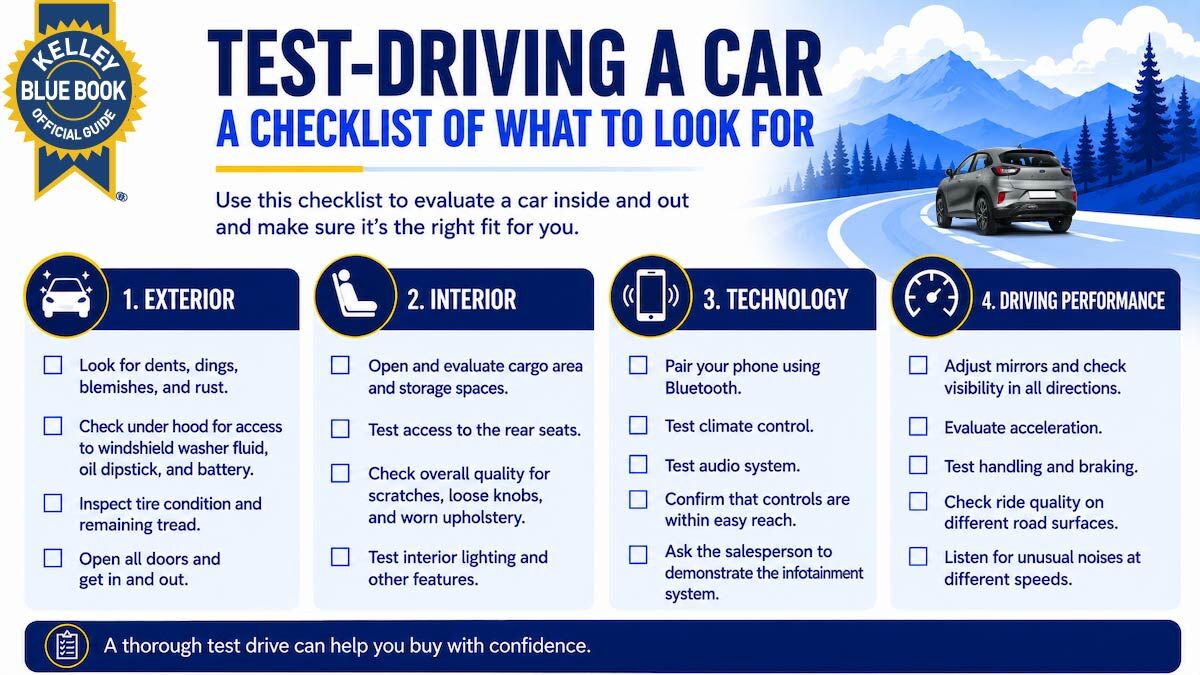
Walk Around the Exterior
The walk-around is a chance to kick the tires, peek under the hood, and do the other things you can’t do once the vehicle is moving. Here are a few things to look for and do.
- General appearance — Look for wheel rash, nicks in the tire sidewalls, remaining tread and condition, scratches, chips, or dings in the paint finish. On a used car, also look for uneven panel gaps, mismatched paint, water stains, or other signs of previous damage or poor repairs.
- Entering — Open all the doors and slide into both the front and rear seats. Climb into the rear seat and the third-row seat in an SUV and rate the exercise for difficulty. Reevaluate the experience when exiting.
- Under the hood — Locate the window washer fluid, oil dipstick, and battery. These are the items drivers are most likely to access. Are they easy to get to?
- Inside the cargo area — How high is the lift over when loading and unloading cargo? Is the space usable? If the rear seat folds down, does it fold flat? Where are the jack and spare tire, and are they easy to access? If the vehicle does not include a spare tire, find out whether it has a tire repair kit, run-flat tires, or roadside assistance coverage.
Inspect the Interior
Resist the temptation to begin driving immediately. Take a few minutes to appraise the space and get a feel for the cabin. Here are some steps to assess the interior.
- Front seats — You spend a lot of seat time in a car. Are the seats comfortable? Recline and adjust the seat to your needs. Adjust the seat belts to accommodate your height. Make sure you can find a comfortable driving position with a clear view of the road and gauges.
- Rear seats — If the second row is a bench seat, does it split and fold? Is it comfortable? How about the legroom? If you regularly carry passengers, have someone sit behind the driver after the front seat is adjusted.
- Storage — Are there enough cup holders and storage cubbies? How about keys, change, and other oddities? Is the glove box large enough to hold more than the owner’s manual?
- Connectivity — Are there enough USB ports? Where are they located? How about power ports and their location? Here’s where you can try out Bluetooth and smartphone integration for Apple CarPlay and Android Auto. If you use wireless charging, confirm that your phone fits securely and charges while driving.
- Infotainment — To save time, invite the salesperson to demonstrate the infotainment system. Evaluate its user-friendliness. Appraise the audio system by turning on the radio or connecting to a smartphone. Try the features you use most, such as navigation, voice commands, phone calls, and audio controls.
- Climate control — Test the heating and cooling controls while you familiarize yourself with the functions. If the vehicle has rear climate controls or heated and ventilated seats, test those, too.
- Interior lighting — Make sure you like the lighting and can adjust it to your taste.
- Other features — Determine if the windows raise and lower easily and quietly. Are all the buttons and knobs within easy reach? Can you operate them? Review other elements to your liking.
- EV and hybrid checks — For electric vehicles and plug-in hybrids, check the displayed range, charging-port location, charging cable storage, regenerative braking feel, one-pedal driving settings, and how easy it is to find charging information in the infotainment system.
MORE: Is Now the Time to Buy, Sell, or Trade-in a Car?

What to Look for on a Test Drive
Here are the basic things to check out during the actual drive. If you’re unable to get behind the wheel of the exact car you picked from the website inventory, drive a version as close to it as possible — the same trim level, engine, and features you want. Small differences in engines, tires, seats, suspension, or options can change how a vehicle feels.
- Visibility — How well can you see out of the vehicle from the driver’s seat? Sitting in the seat, look forward, to each side, and in the rearview mirror. Take note of blind spots created by large door pillars or seat headrests. Try parking and backing up to see how well the mirrors, cameras, and sensors help.
- Noise — Turn the audio system off and listen to the noise levels in the cabin. How much wind, tire, and engine noise do you hear? Electric vehicles are often quieter at low speeds because they lack a gas engine, but they can experience greater road noise as a result.
- Powertrain — Evaluate the vehicle’s performance, including acceleration, engine sounds, transmission shifts, and fuel economy. Pay attention to how smoothly the engine and transmission work together and test the acceleration. Highway on-ramps are a great place to get a feel for how well a model can get up to speed. Watch for hesitation, rough shifts, unusual vibration, or warning lights.
- Braking — You can find braking distance figures online, but brake feel is an important factor to consider. How does the pedal feel under light and hard braking conditions? The vehicle should stop smoothly without pulling to one side, grinding, pulsing, or making unusual noises.
- Handling — Testing the vehicle on a curvy road can help you understand how its suspension system behaves. Pay attention to the body movements and steering to get a feel for the ease of turning and stability at higher speeds. In a parking lot, also check the turning radius and how easy the vehicle is to maneuver at low speeds.
- Ride — Even sports cars should offer a reasonable ride quality. Take the vehicle on uneven or rough roads to determine how comfortable you and your passengers will be on your daily drive.
Test-Drive Red Flags
A test drive should leave you feeling more confident, not more uncertain. Be cautious if you notice warning lights, unusual smells, uneven braking, pulling to one side, clunking sounds, rough shifting, hesitation during acceleration, or electronics that do not work properly. Not every concern is a deal-breaker, but anything that raises questions should be inspected by a trusted mechanic before you buy.
What Is the Age Requirement to Test-Drive a Car?
In many cases, a licensed driver who is at least 16 can test-drive a car, but dealership policies vary. Some dealers or automakers may require drivers to be 18, 21, or older, especially for performance vehicles, luxury models, or certain EVs. You may also need proof of insurance. Call ahead if a younger driver plans to participate in the test drive.
Bottom Line on Test-Driving a Car
A comprehensive test drive is an essential part of shopping for a new or used car. By thoroughly evaluating the exterior and interior, assessing comfort and convenience features, experiencing its performance across various driving conditions, and confirming it fits your body, you can ensure that the car aligns with your needs and preferences. This diligent approach will help you make an informed decision, leading to greater satisfaction with your investment.
Visit our Car Features Information Center to learn about the different bells and whistles available in vehicles today.
Editor’s Note: We have updated this article since its initial publication. Russ Heaps contributed to the report.