
Buying a used electric vehicle (EV) may seem intimidating at first, especially if you’ve never owned one. Electric cars require a different approach than traditional vehicles. The used EV market continues to grow as current owners trade in for newer models, giving shoppers more choices at a range of prices.
If you’re looking to reduce fuel and maintenance costs, you may find yourself exploring an EV. Read on to understand the pros and cons of buying a used electric car and what to consider when determining whether EV ownership is the right option for you.
Benefits of Buying a Used Electric Car
- Operating savings: Electric vehicles typically have lower operating costs than their gas-powered counterparts. You can save money on fuel and routine maintenance expenses.
- Upfront savings: EVs can depreciate faster than gas-powered cars. That depreciation can allow cost-conscious consumers to buy slightly used electric cars at a notable discount.
- Energy efficiency: Electric motors are more energy-efficient than internal combustion engines because they convert a greater share of their energy into power that moves the vehicle.
- Quiet performance: Electric vehicles offer a smooth and quiet driving experience. There’s no combustion engine noise, and instant torque delivery means quick, quiet acceleration.
- Modern features: Because EVs are relatively new to the market, many used models include contemporary driver-assistance, infotainment, and connectivity features.
Drawbacks of Buying a Used Electric Car
- Driving range: Used EV range varies widely depending on the model, age, and battery condition. Consider how much range you need and how often you’ll need to recharge.
- Charging access: Public charging is easier to find in populated areas, but at-home charging may be the most convenient option for many owners. Installing charging equipment at home can add to your upfront costs.
- Charging time: Refueling at a gas station usually takes only a few minutes, but recharging an electric vehicle can take much longer. Level 2 charging often takes several hours, while DC fast charging can replenish much of a battery considerably faster. Charging times vary widely by vehicle and charger.
- Battery degradation: EV batteries gradually lose capacity with age and use. The rate varies depending on factors including vehicle design, climate, charging patterns, and battery chemistry. Significant degradation can reduce driving range, and replacing a battery outside warranty coverage can be expensive.
Buying a Used Electric Vehicle: A Step-by-Step Guide
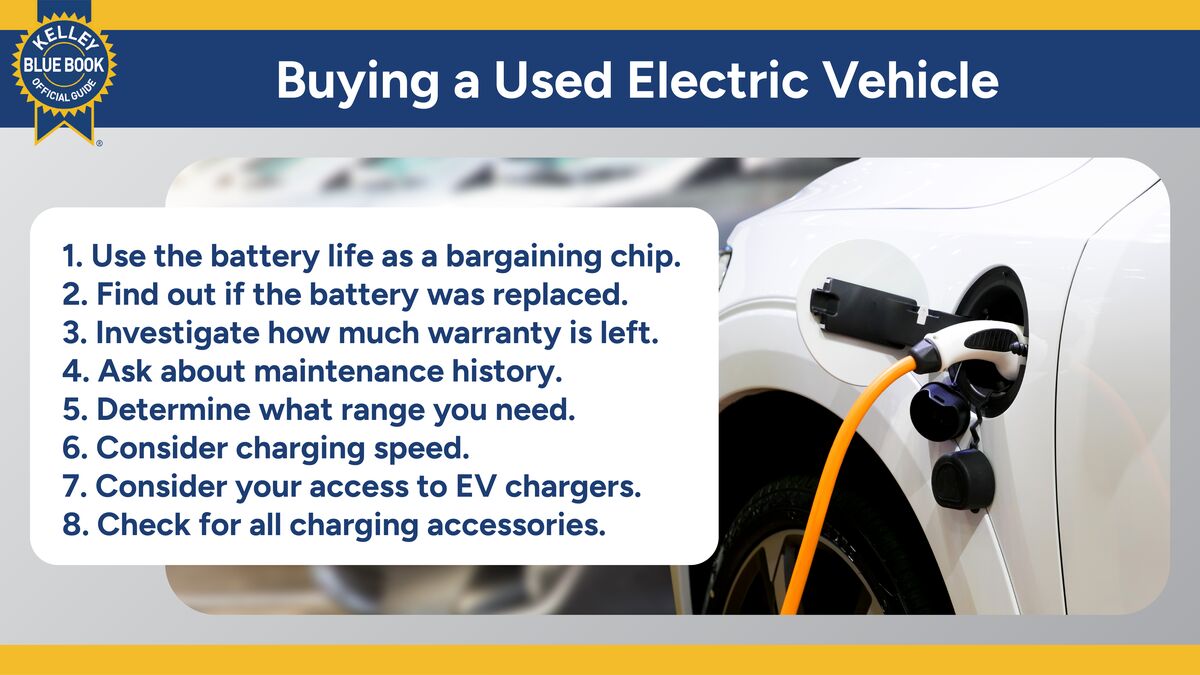
1. Use the Battery Life as a Bargaining Chip
Just like the battery in a mobile phone or laptop, an electric car’s battery gradually loses capacity over time. Heat, charging patterns, battery chemistry, and other factors can affect how quickly degradation occurs.
Ask the seller for a battery health report if one is available. Some models provide battery health information through the vehicle itself, while a dealer or qualified technician may be able to run a diagnostic test.
You can also charge the used electric car fully and look at its estimated range, but don’t treat that number as a direct measurement of battery capacity. Temperature, recent driving habits, climate-control use, and other conditions can affect the vehicle’s displayed range.
A used EV isn’t expected to retain exactly the same battery capacity or range it had when new. What matters is whether the remaining capacity meets your driving needs. Significant degradation may also give you room to negotiate the price.
MORE: Electric Cars 101: Everything You Need to Know
2. Find Out If the Battery Was Replaced
Complete battery pack replacements are relatively uncommon, but they can occur because of defects, damage, or degradation.
If the battery was replaced and the seller has documentation, the replacement could be a significant benefit. Even if the dealer or seller doesn’t know whether the battery was replaced, a Carfax or AutoCheck vehicle history report may have documented the service. Asking for one is always good practice.
Look at any documentation closely to ensure it applies to the car you want to buy. Also, determine when the replacement occurred, whether the entire pack or only individual components were replaced, and what warranty coverage applies to the repair.
3. Investigate How Much Battery Warranty Is Left
Yes, we’re still talking about batteries, but there may be some good news this time. Manufacturers typically provide lengthy warranty coverage for EV battery packs. Many offer at least eight years or 100,000 miles of coverage, and some offer longer terms.
However, battery warranty terms vary by automaker, model, and model year. Coverage may also include specific requirements for how much battery capacity must be lost before a repair or replacement qualifies.
Check the warranty booklet for the specific vehicle you’re considering. You can also contact the automaker’s customer service department with the 17-digit vehicle identification number (VIN) to confirm what coverage remains and whether it transfers to a subsequent owner.
4. Ask About Maintenance History
We always suggest asking the seller or dealer for the vehicle’s maintenance history and any available service records.
EVs generally require less routine maintenance than gasoline-powered vehicles because they don’t need oil changes or many engine-related services. However, they still require maintenance and inspections for items such as tires, brakes, cabin air filters, fluids, suspension components, and windshield wipers.
Brake components can also last longer on EVs because regenerative braking helps slow the vehicle while returning energy to the battery, reducing use of the friction brakes. However, brakes should still be inspected according to the manufacturer’s recommendations.
You should also check for open recalls before buying a used EV.
RELATED: Everything You Need to Know About Recalls
5. Determine What Range You Need From the Used Electric Car
Electric car technology has advanced considerably during the past decade. Some earlier EVs offered around 100 miles or less on a full charge, while newer used models can travel several times farther.
For example, the 2024 Hyundai Ioniq 6 SE with rear-wheel drive (RWD) carried an EPA-estimated range of 361 miles when new. That’s far more than many drivers need for everyday use.
Figure out how much range you actually need rather than simply shopping for the biggest number. Longer-range EVs can cost more, and battery degradation means a used vehicle may no longer deliver its original EPA-estimated range. If you plan to use your EV mainly for commuting and local errands, a lower-range model may be perfectly adequate.
You’ll also want to explore charging options around you, especially if you can’t recharge while parked overnight at home.
RELATED: Electric Car Range: Everything You Need to Know
6. Consider Charging Speed
Electric cars don’t necessarily charge at the same rate. Battery size, vehicle charging capability, charger output, battery temperature, and state of charge can all affect how long charging takes.
This is particularly important when comparing used EVs from different model years. Some older electric vehicles have relatively slow DC fast-charging capability, while newer models can add substantial range during a short charging stop.
If you expect to rely regularly on public charging, look closely at a vehicle’s DC fast-charging capability. If you can charge overnight at home or all day at work, charging speed may matter less, potentially allowing you to save money with a less expensive used EV.
MORE: Electric Car Buying Guide: How to Buy the Right EV
7. Consider Your Access to EV Chargers
When buying a used electric car, find out where EV chargers are available along your typical and occasional driving routes. The U.S. Department of Energy’s Alternative Fueling Station Locator can help you locate public charging stations near you or along a planned trip.
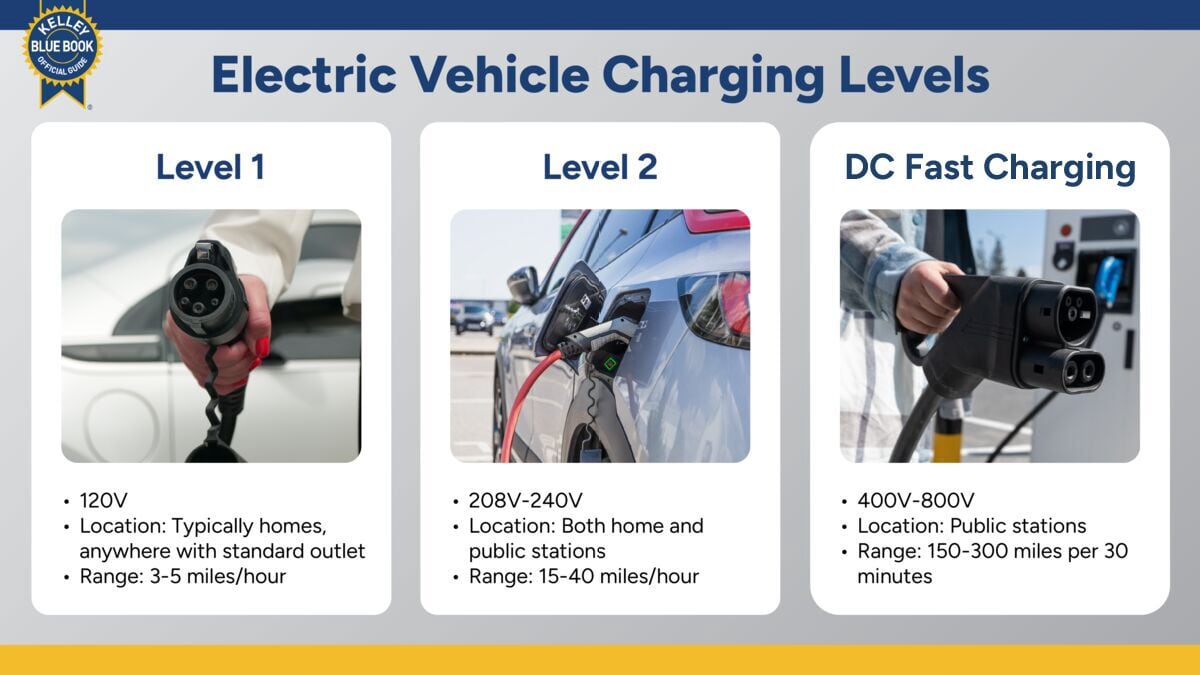
Here’s what you need to know about EV charging:
- Level 1: Level 1 charging uses a standard household 120-volt outlet. It’s the slowest way to charge an EV but may be sufficient for drivers who travel relatively few miles each day.
- Level 2: Level 2 charging typically uses a 240-volt power source and is common for home charging. As one example, Hyundai says a 2024 Ioniq 5 with the 77.4-kWh battery can charge from 10% to 100% in about 7 hours and 10 minutes using a 10.9-kW Level 2 charger.
- DC Fast Charging: Commonly found at public charging stations, DC fast charging can replenish a battery much more quickly. Hyundai says the same 2024 Ioniq 5 can charge from 10% to 80% in about 18 minutes when connected to a 350-kW DC fast charger. Actual charging times vary depending on factors including battery temperature, state of charge, and charger output.
RELATED: An EV Charger Buying Guide: See All Your Options
8. Check for All Charging Accessories
Once you’ve picked out the electric car you want to bring home, find out which charging equipment comes with it. Some EVs originally included portable charging cords, while others offered them as optional accessories. Replacing missing charging equipment can cost several hundred dollars, depending on the equipment you need. Make sure any included cable is compatible with the vehicle and inspect it for obvious damage before relying on it.
Should You Buy a Used EV?
Buying a used electric car can offer notable advantages, including a lower purchase price than a new EV, lower operating costs, and high energy efficiency. However, carefully consider battery health, charging access, remaining warranty coverage, and your driving needs. Before making a purchase, research the vehicle’s battery condition, vehicle history, warranty coverage, charging speed, and charging compatibility. A used EV can be a practical, affordable choice when its range, battery condition, and charging needs fit your lifestyle.
Editor’s Note: We have updated this article since its initial publication.