

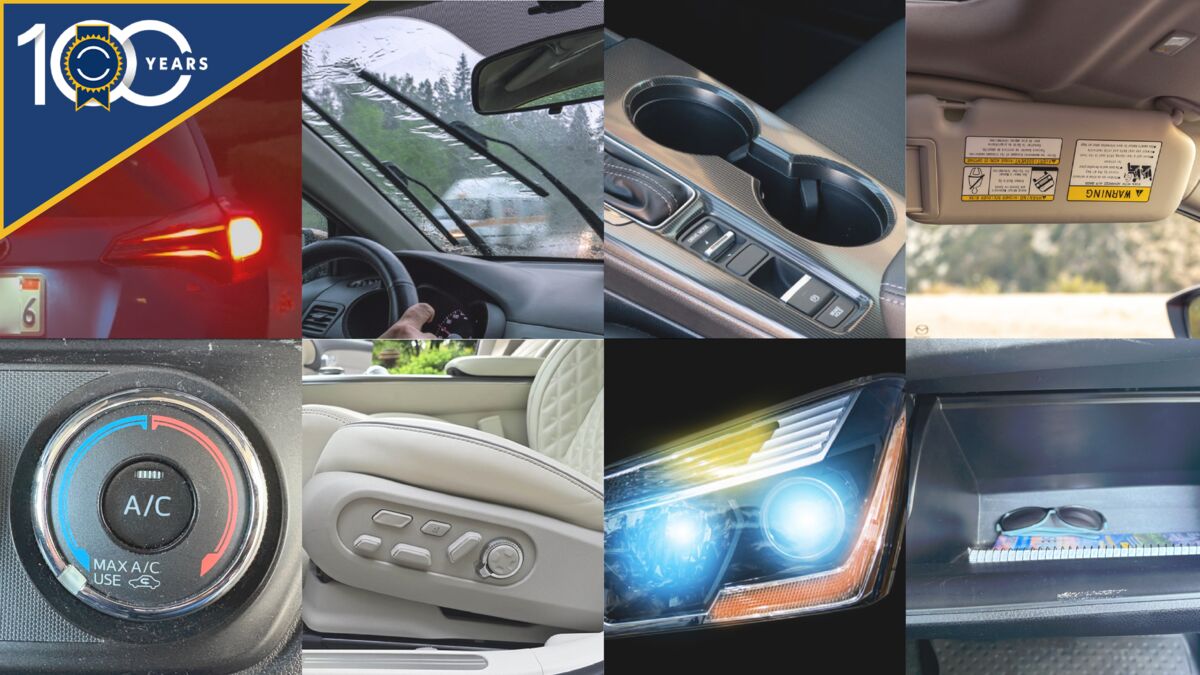
Kelley Blue Book turns 100 in 2026, and now that we’ve explored a century of auto innovations, the history of car paint colors, car brands that have come and gone, and the history of auto shows in celebration, it’s time to turn the spotlight on the underdogs. These are the quiet workhorses, the stalwart elements, the car features that don’t always get the glitz and glam, but that are always there for you in exactly the way you need them, when you need them.
We’re talking, of course, about cupholders, wiper blades, headlights, and all the other pieces of your car that we tend to take for granted. They may not get top billing on your wish list when you’re buying a vehicle (or even make it at all, given how fundamental they now seem to our driving lives), but you will ruefully long for any one of them if you find yourself without a working version.
Here’s a look at the brief histories of these heavy hitters. This one’s for you, unsung heroes of automotive!
Hark, Headlights!
Imagine: you forget an ingredient for dinner and need to head out to the market. It’s dark out, but before you can go, you need to rustle up your matches and light your acetylene or oil headlamps before heading out into the night. Even then, their brightness is questionable. This was the scenario for the earliest vehicles. Visibility in the dark has been essential since the days of pre-automobile carriages, and lamps of various types have long been used. Headlamps have been available for cars since the 1880s, becoming standard equipment on the Ford Model T in 1909, which used headlamps of lit acetylene gas produced by a carbide generator.
The first electric headlight debuted on the 1912 Cadillac Model 30, and low-beam headlights appeared in 1915. In the early days, drivers had to get out of the car to manually adjust and turn on the headlights. This situation evolved over the decades into the sealed-beam headlight in 1939, which remained standard through the 1970s.
The 1980s and 1990s saw composite and xenon/high-intensity discharge (HID) lights, leading the way for today’s light-emitting diode (LED) and laser technology. These advances also led the way for conversations around the blinding brightness of some of today’s headlights. Whatever the material, headlights are a safety essential that is an anchor on this list, and rightfully so.
Behold, Brake Lights!
Much like their headlight counterparts at the front of the car, brake lights are an essential standard that we don’t tend to think about much until they need replacing. They’re just a bit younger than headlights, not appearing on very early models. Hand signals were the original brake light, but at night or in poor visibility, they were ineffective.
The earliest brake light was actually not a light at all, but a rear-bumper-mounted sign that read “STOP” and would automatically pop up when the brake pedal was depressed. This was the brainchild of silent film actress Florence Lawrence in the first decade of the 1900s. Unfortunately, it was never patented or widely adopted.
The technology developed throughout the 1910s and 1920s, and a series of different legislation, both federal and state-wide, in the 1930s finally led to firmer mandates around stop lights or brake lights in vehicles. Later in the 20th century, the Federal Motor Vehicle Safety Standard 108 mandated center high-mounted stop lamps (CHMSL) as standard equipment on all new passenger cars sold in the U.S. from model year 1986 and all new light trucks from model year 1994. Like headlights, materials and aesthetics around brake lights continue to evolve, but the basics remain the same: you brake, your lights alert anyone behind you, and accidents are (hopefully) prevented.
No Shade to Sun Visors
Driving off into the sunset may look glamorous in movie finales, but the reality is that it’s both miserable and hazardous to have the sun blaring into your eyes. The sun visor was an early arrival in cars, first appearing in the 1920s as exterior-mounted “glare shields” on models like the Model T. In 1930, George Gagnier and Bion Cole Place filed a patent for the interior sun shield, which became the foundation for all future iterations.
This trusty and essential safety device hasn’t changed all that much from its original iteration, but a few notable developments include:
- The standardization of interior flip-down visors during the 1930s for both driver and passenger.
- In 1937, the visor mirror was patented by Ryerson & Haynes, Inc., but these “vanity mirrors” wouldn’t hit their popularity stride until the 60s. Now, they’re a no-brainer for checking your teeth for errant food before you head to your appointments.
- Sun visor materials have evolved over time. Early external glare shields were made of metal and other rigid materials. Over time, materials such as cardboard, foam, and high-density polyethylene (HDPE) were introduced, often covered with leather or fabric.
In the modern automotive era, companies are looking at further developing sun visor technology. Companies like Bosch, for example, have toyed with technology that combines AI and liquid-crystal display (LCD) screens linked to cameras to more effectively reduce glare without limiting the driver’s view. Will there be a new wave of futuristic sun-blocking technologies down the road? Maybe, but for the time being, your trusty old flip-down visor will continue to show up for duty.
Cupholders Bring Spill-less Beverage Bliss
Maybe it holds your morning coffee, your post-gym protein shake, or your can of bubbly water. Whatever the beverage, your reliable cupholder keeps your drink close at hand and snug through the twists and turns of your day. This wasn’t always the case, however – cupholders were actually a relatively late addition to the auto world.
Early cars tended to be a much rougher ride, and eating or drinking while moving didn’t hold a lot of appeal. It wasn’t until the 1950s and 1960s that the idea began to gain legs. In 1953, Burnard Byford patented the “Automobile Seat Article Holder” which was essentially a metal plate that wedged between two seats. This was ideal for an era of drive-in restaurants and movies, where eating in the car became more popular, but it still wasn’t entirely secure. Later in the 1950s and into the 1960s, glove compartments began to feature cupholders in the backs of their doors.
It wasn’t until 1983 that Chrysler introduced the minivan and the built-in cupholder, featured in the Dodge Caravan and the Plymouth Voyager. The trend continued to catch on and cupholders became a standard feature. That it took so long is a little hard to imagine today, when cars like the 2025 Subaru Ascent boast up to 19 cupholders. Hydration, meet your match.
Winning Windshield Wipers
It’s all fun and games until you get caught in an unexpected storm and you realize that you haven’t replaced your crusty, dusty windshield wiper blades in far too long and can’t see a thing. Our trusty windshield wipers, like the other items on this list, aren’t things we tend to think about much until we need them, but they’re always there for us, like an old friend.
Mary Anderson, an Alabama woman visiting New York in 1902, was stuck on a streetcar in a snowstorm. Observing the streetcar driver manually clearing the window inspired Ms. Anderson to create what would become our modern windshield wipers. Her “Window Cleaning Device” was patented in 1903 and featured a rubber blade and a lever-operated spring-loaded arm to wipe the windshield.
Gradually, windshield wipers gained steam on new vehicles, but the manual mechanisms could be distracting and clunky. In 1926, Bosch introduced the first electric windshield wiper. From there, the technology evolved into what it is today.
Modern wiper blades include innovations such as frameless wipers, sensors, intermittent speeds, aerodynamic designs, and heating technologies to help combat ice. Next time you’re caught in the rain or a bug hits your windshield, take a moment to appreciate not having to get out of your car to address the issue manually.
Glove Boxes, or Trinket Treasure Chests?
Registration. Proof of insurance. Owner’s manual. Tire gauge. Mad money. Snacks. Spare car forks. In modern times, gloves don’t often make the list of things we store in our gloveboxes, but in early automobiles, good driving gloves were essential. Goggles and scarves were also commonly-stored items.
Though the contents have changed over time, the glovebox itself has been an auto staple since the mid-1910s. As engines shifted from under the carriage floor to the front of the car, early dashboards gained more space for storage and gauges. The first true glovebox appeared with the 1915 Pierce-Arrow, and it caught on. By the 1930s, the glovebox had become an auto standard.
Like every item on this list, the glovebox has undergone shifts and experimentation throughout automotive history, but it has persisted as a standard expectation in vehicles. It’s a simple and elegant storage solution, one that keeps things in place and prevents the need to find (and pay for) other less-secure options.
Every Body Is Unique, and Seat Adjustability Knows It
When it comes to seats, car buyers often clamor for luxury materials and fancier features like seat warmers. What we don’t often stop to appreciate is the ability to adjust our seating position to suit our individual bodies. Sure, it’s nice to have massaging seats, but there’s only so much they can do if you’re cramped into an uncomfortable position for a long day of travel (ever been in an economy airplane seat for a long haul flight?).
Until the early 1910s, car seats were mostly fixed and rigid. Over the next few decades, seats slowly became more adjustable to accommodate different angles and legroom. In 1946, Buick offered the first optional two-way power seat. Ford debuted 4-way power seats with the 1955 Thunderbird. Headrests found their footing in the 1960s.
With all this technology well in place, modern cars have focused on increasing comfort and introducing new luxury features in car seats. Next time you hop in your car, before settling on the massage pattern you want in your seat, take a moment to appreciate the leg room that’s just right for you and the seat angle that won’t cause a backache for the rest of the day.
Don’t Sweat It: Temperature Adjustment Is There for You
These days, newer cars have sophisticated climate control that allows drivers to adjust cabin temperature to an exact degree of comfort. But – you guessed it – this wasn’t always the case.
Early driving could be a chilly affair. Early motorists would often heat bricks or soapstones at home and place them in dedicated heatboxes in the car. Manifold heaters became popular with Model A owners, but they were unreliable. GM introduced coolant-based heaters in the early 1930s. Later in the decade, Nash Motors introduced the first integrated heating and ventilation system.
For sweatier days, drivers were mostly out of luck until the 1940s and had to rely on the trusty breeze or unreliable fans while driving. Packard broke through with the first factory-installed AC in 1940, followed closely by Cadillac in 1941. These systems, however, left a lot to be desired. Drivers had to get out of the car and manually turn the air conditioner on or off by installing or removing the drive belt from the compressor. The systems could only recirculate air and drip water and were generally not a focus of further innovation until after World War II.
AC and heating systems both improved dramatically in the decades that followed. Automatic climate control and digitization have brought us to today, where we lavish in multi-zone, automatic AC and heating systems that can be adjusted down to the degree. We can drive in extreme climates and still be wildly comfortable with a simple dial adjustment or a tap on the screen.
Raise Your Glass
We don’t begrudge anyone the flashy features that can make driving luxurious and fun, but we do feel like it’s important not to forget the ones that are absolutely foundational to the car and the driving experience. Without these, driving would be in upheaval. Cups would be flying, car registrations would be within range of the dog’s teeth, we’d be shivering in the cold or sweating in the heat, and we’d be unable to see in the rain or dark. We’re not being dramatic, just sentimental about the lesser-lauded wonders of our vehicles that unflaggingly put in the work day in and day out.
Three cheers to you, fundamental features, and to all the innovators who have helped to refine you throughout automotive history.