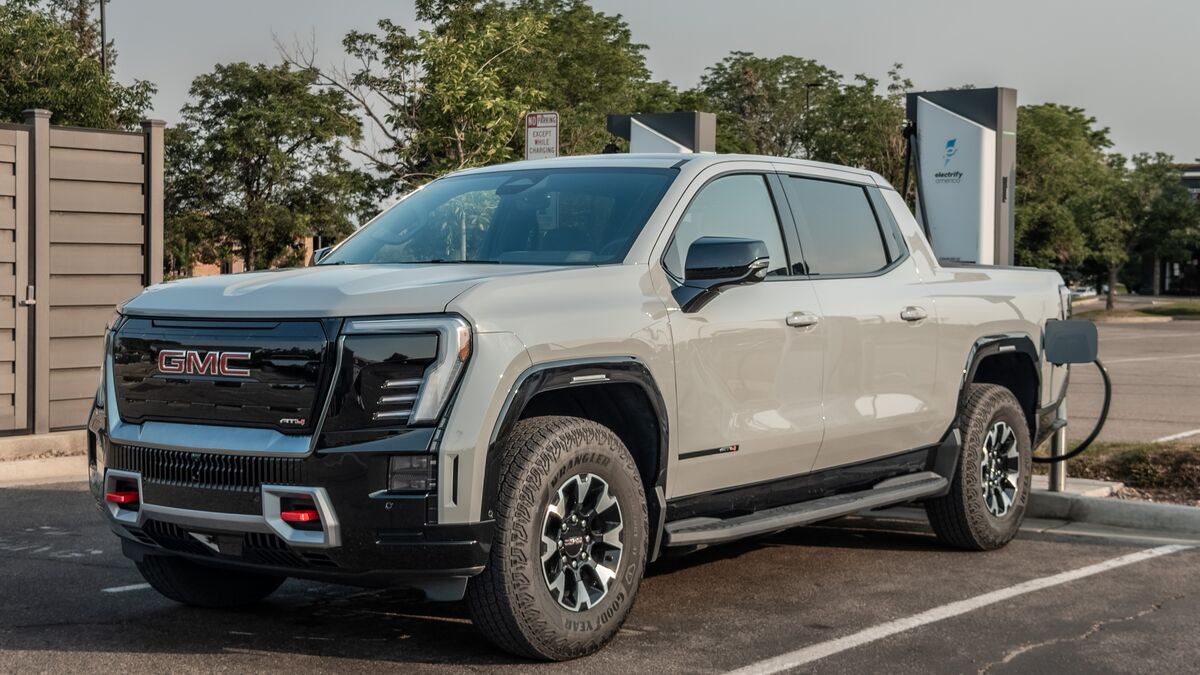

The Sierra EV AT4 makes a strong first impression through sheer scale. The tires are immense. The screen overwhelms the dashboard. The battery is gargantuan. And the range is more than enough.
Fortunately, that range challenges one of the most common criticisms of electric trucks. Even when you start towing, hauling, or simply treating it like a truck, the range remains useful instead of stressful.
That’s where the Sierra EV AT4 finds its identity. It’s a better truck than most people need, even after accounting for the compromises that come with being nearly 9,000 pounds.
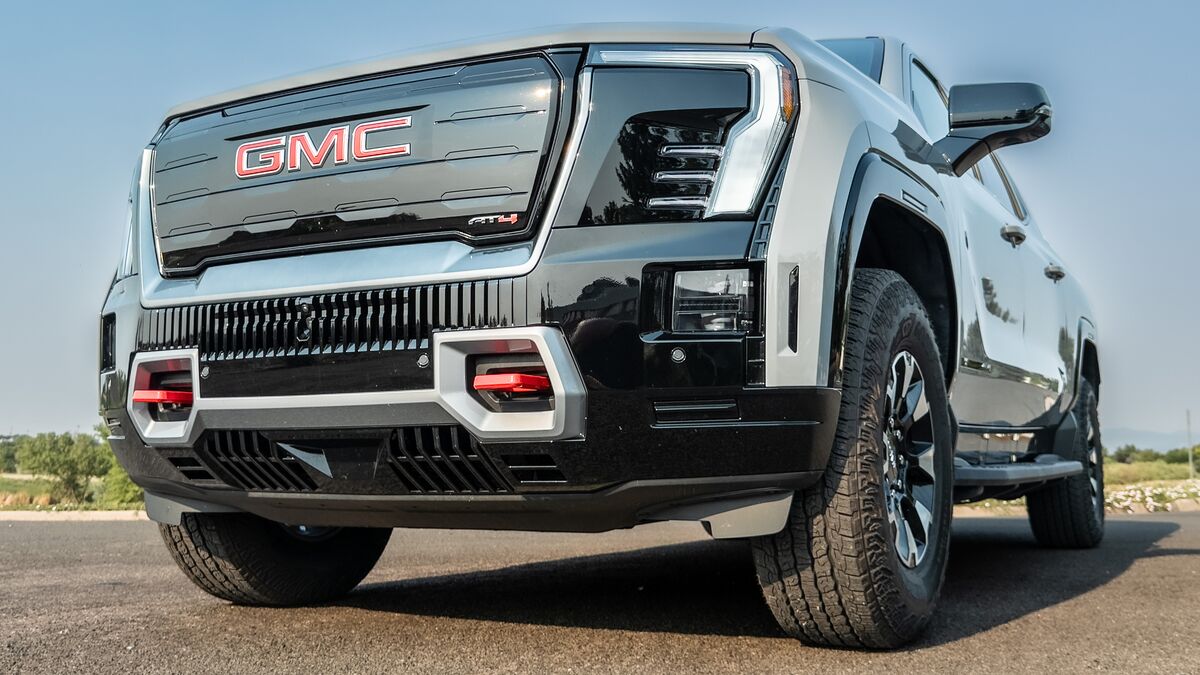
Bigger Than Expected
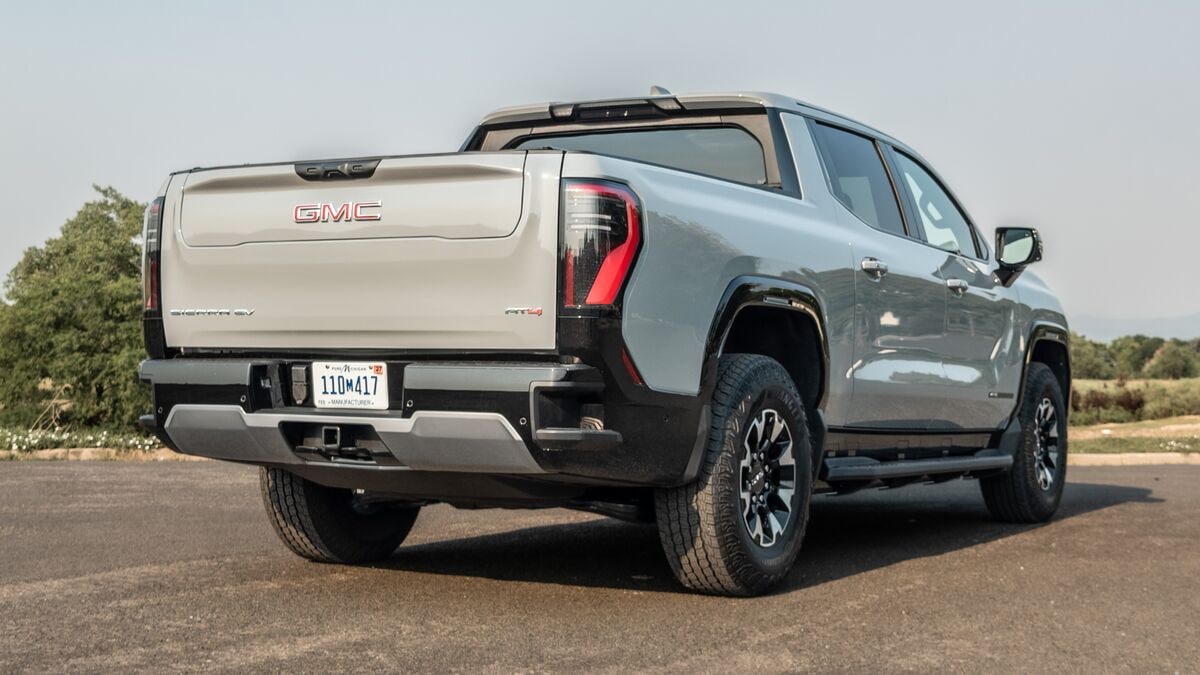
My tester wore the new-for-2026 AT4 treatment, complete with a factory 2-inch lift, 35-inch all-terrain tires, 4-wheel steering, and the Max Range battery pack. Thunderstorm Gray paint and a hard-folding tonneau cover brought the as-tested price to $94,715.
Class-leading range has always been a headline for the GM electric trucks. GMC estimates up to 478 miles, and my real-world experience came close despite the AT4’s off-road-focused hardware. For normal ownership, range anxiety will quickly disappear with each practical experience.
Material quality is noticeably higher than that of its mechanical twin, the Silverado EV, though the cabin still falls short of what I’d call truly luxurious. Perhaps that’s a deliberate choice to preserve some separation from the Denali.
The Forest Storm interior also left me slightly confused. It was pleasant enough, but I never got much “forest” from it. No one who looked at it or stepped inside made a single comment about the entirely black colorway.
New 2026 GMC Sierra EV Prices
|
Retail Price
|
Fair Purchase Price (92620)
|
|||
|---|---|---|---|---|
$64,995 |
$63,300 |
|||
$72,295 |
$70,400 |
|||
$73,195 |
$71,300 |
|||
$80,495 |
$78,400 |
|||
$81,895 |
$79,800 |
|||
$92,195 |
$89,800 |
|||
$101,195 |
$98,600 |
Plush Party Trick
The AT4 doesn’t get air suspension or GM’s Magnetic Ride Control (because it’s too heavy), yet its ride quality remains impressive.
A large part of the credit goes to the combination of 18-inch wheels and massive 35-inch all-terrain tires. All that sidewall helps absorb the impact of rough pavement in a way many modern trucks simply cannot. There’s also the sheer length of the thing — a long wheelbase is part of what makes big trucks such comfy highway cruisers.
The result lands somewhere between traditional truck toughness and luxury SUV smoothness. It feels surprisingly isolated for an AT4 riding on aggressive all-terrain tires. The tradeoff appears when you ask all 725 horsepower and 775 lb-ft of torque to hit the pavement at once.
At maximum acceleration, the combination of squirmy all-terrains and instantly terrific torque can cause torque steer. With modern traction control, it’s not exactly dangerous, but it is alarming. This much power in a lifted truck on off-road rubber feels like an amusing engineering decision. But numbers on paper sell trucks more than I like to admit.
Built for Truck Stuff
The giant battery feels like a strategic reserve, providing more than enough range. Average commuters could charge once a week, even less than some gas-powered trucks.
With over 10,000 pounds of towing capability, the Sierra EV handles truck duties with far less compromise than many shoppers probably expect from an EV. Even the drastic range cut from towing allows its use around town, around a farm, or hauling equipment across a work site. Towing road trips, on the other hand, will still be a nuisance at times. Even with its decently impressive charging performance.
Speaking of DC fast charging, under optimal conditions and with a powerful enough charger, it can add up to 100 miles of range in 10 minutes, tapering as the battery fills.
Ironically, the battery’s size creates one unusual downside. Public Level 2 charging feels less impactful because you’re trying to refill something more than twice the size of many modern EV battery packs. This translates to home charging as well, unless you have the capacity for 48A or even 80A charging. A full charge on a regular household outlet would take several days.
Screens, Space, and the Bright Sun
The giant Google-based infotainment display is one of GM’s better software implementations. Multi-app views work well, maps are expansive, and the screen makes excellent use of its real estate. A few menu items remain buried deeper than they should be, but overall usability is strong.
Rear-seat passengers were impressed with its spaciousness, openness, and excellent visibility provided by the glass roof. Child-seat access is also an easy task thanks to wide doors and generous rear-seat space.
Rear climate control is less impressive. Only two small vents serve rear passengers, controls are buried within the front-screen menus, and the system doesn’t consistently recognize rear occupants. During the summer heat, especially with the glass roof overhead, it became more detrimental than expected.
The other issue is sun-lit glare. Several metallic trim pieces on the dashboard and steering wheel can produce intense reflections depending on the angle of the sun. It happened far more often than I expected throughout my daily driving.
Handling the Road
For something so large, the Sierra EV shrinks around you surprisingly well.
Four-wheel steering gives the truck a tight turning radius for its size and enables GMC’s CrabWalk mode. It’s not as dramatic as the Hummer EV’s implementation that uses a full 10-degree of rear steer, but it’s still entertaining. I’m not sure if useful is the right term.
Super Cruise can now link highways together, which is helpful in that unique scenario. Yet it never felt completely confidence-inspiring. The truck occasionally ping-ponged within its lane, became unsettled around tighter curves, and behaved similarly when using standard hands-on lane centering assistance.
Automatic lane changes were equally inconsistent. Sometimes they worked. Sometimes they seemed intimidated by barriers that weren’t even in the target lane. In heavy traffic, it’s far too timid to make the aggressive lane changes needed to stay competitive with the predicted ETA.
One final nitpick: the turn-signal cadence still sounds slightly off. I spent an entire week being bothered by it far more than any rational person should.
The AT4 Takeaway
The Sierra EV AT4 is fascinating because many of its limitations stem from excess rather than compromise. But the few annoyances feel like side effects of building a truck capable of doing almost everything. The software needs minor refinement. Rear climate deserves more attention. Some interior trim could use less reflective materials, and the price tag may suggest it should feel more premium.
But after a week behind the wheel, I kept coming back to the same conclusion: the Sierra EV just works. It tows, hauls, road-trips, and handles both pavement and dirt with very little drama. And it does all of those things while delivering ride comfort and range that would have seemed impossible for an electric truck just a few years ago.
The Sierra EV AT4 may be more truck than most people need. That’s exactly what makes it impressive.