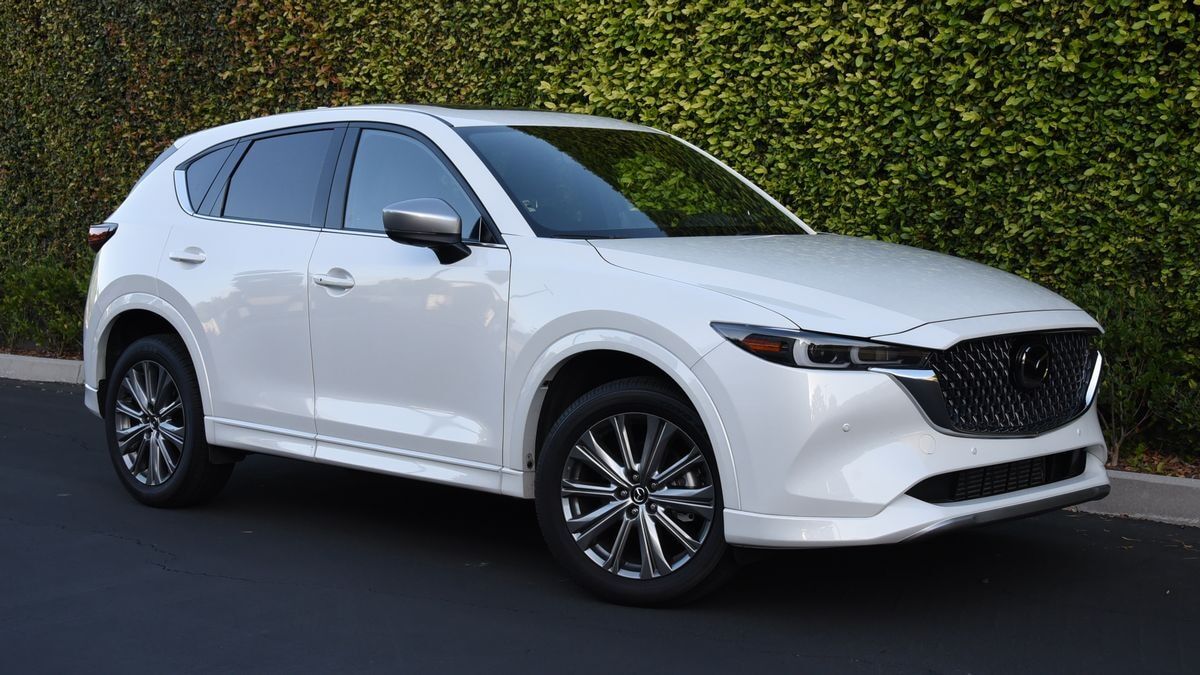
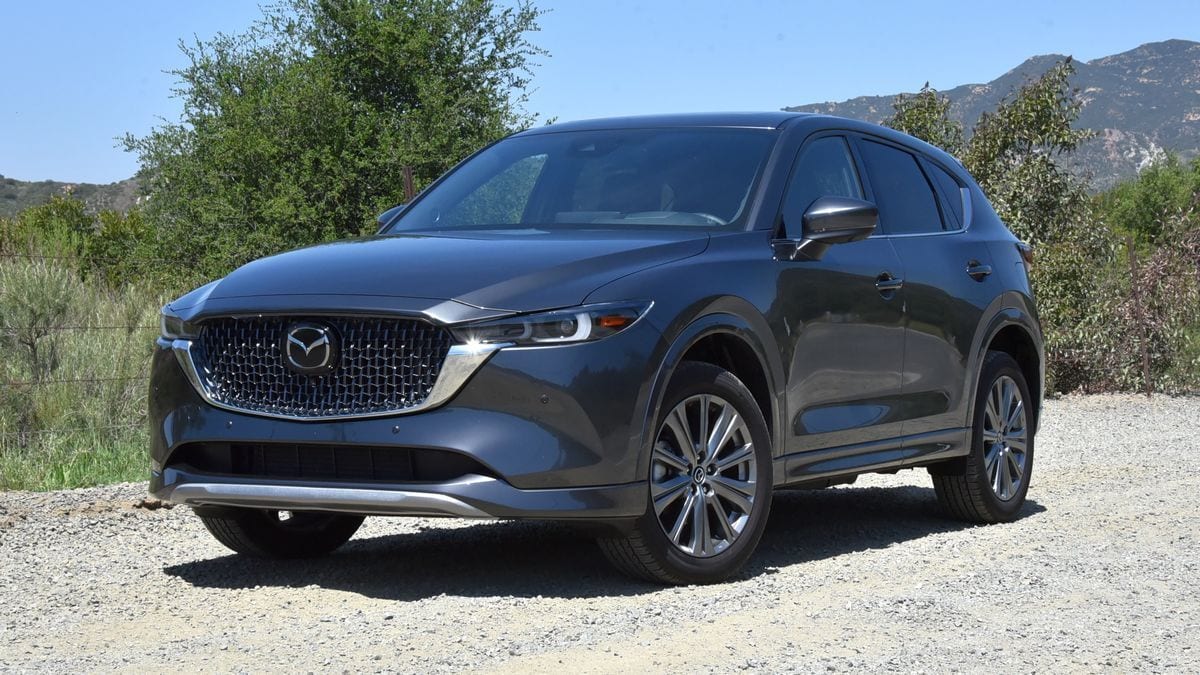
The CX-5 sells well for Mazda. So well that they keep it in their lineup alongside the similarly sized CX-50. We might love it as much as they do. Every one we’ve driven has put smiles on our faces.
We especially like them for their sporty driving dynamics. And we often say it drives more like a car than an SUV. However, we also appreciate that Mazda gives buyers a choice between two powertrains. Most competitors in the segment no longer do this.
Mazda’s 2.5-liter four-cylinder engine puts out 187 horsepower. This supplies power to several trim levels, from the entry-level base model to Premium Plus. Then Mazda ups the ante with its 2.5-liter turbocharged option. This engine offers drivers a generous 256 horsepower on the Carbon Turbo, Turbo Premium, and Turbo Signature trims.
So, let’s look at which option might be right for you.
What’s the Price Difference?
For the 2025 Mazda CX-5, $30,265 will get you into a 2.5 S. That comes with the 187-horsepower variant. The higher you climb the trim ladder, the more you’ll pay, but you also get more in-cabin amenities. The highest trim with the naturally aspirated powertrain is the 2.5 S Premium Plus. It starts at $36,895.
Starting price on the least expensive turbocharged model, the 2.5 Carbon Turbo, is $38,695. For the top of the turbo line, you’re looking at a $42,295 price tag.
Which Is More Efficient?
Looking at fuel economy numbers, the 2025 Mazda CX-5 shouldn’t make you feel too skittish to take some road trips. The 2.5-liter base engine gets 23 city/29 highway, and 25 mpg combined. It’s not a hybrid, but those numbers aren’t bad.
However, if you upgrade to the Preferred, Carbon Edition, or Premium Plus trims, you’ll get Mazda’s i-Stop cylinder deactivation technology, which improves those numbers. Now you’re looking at 26 city/30 highway and 28 mpg combined.
If you buy a turbocharged model, then those numbers drop to 22 city/27 highway/24 combined mpg.
Buying the turbocharged option will only cost you $300 more a year in fuel than the most efficient alternative, the naturally aspirated engine with cylinder deactivation. You’re looking at $100 difference annually between the two naturally aspirated engine options.
Which Is Faster?
All one needs to do is look at the horsepower number to know how to answer this question. Clearly, the turbocharged Mazda CX-5 engine is quicker off the line than its naturally aspirated cousin.
Comparing torque numbers is another good indicator of quickness. Torque is a measurement of twist or force and is what, as Steppenwolf would have said, gets the motor running.
The 2.5-liter makes 186 pound-feet of torque, and the 2.5 turbo makes just shy of double that at 310 lb-ft. If you opt for premium fuel in the turbo models, that number can rise to 320 lb-ft. These are substantial torque figures for this segment.
Both engines mate to a well-tuned six-speed automatic transmission, which distributes that power smoothly. All CX-5s come standard with AWD. This gives you thrust at all four corners of the car, helping put all that power where you want it most: on the ground.
Which Mazda CX-5 Engine Is Best?
The answer to this question depends on your personal preferences. As Mazda tends to make cars and crossovers with sporty driving dynamics and punchy powertrains, some buyers might be more interested in the CX-5 for those attributes. Here, an excellent argument can be made for the 2.5-liter turbocharged option.
However, because Mazda imbues even their lower-powered cars with excellent suspension tuning, sharp steering feel, and handling fit for a sportier car, that might be enough to scratch the occasional spirited driving itch, without the need for extra power.
If that’s the case, then the Preferred or the Carbon Edition with the non-turbo 2.5-liter might be the sweet spot here. You’ll get that cylinder deactivation software that affords you better gas mileage, and you’ll get a lower sticker price. Seems like a win-win.