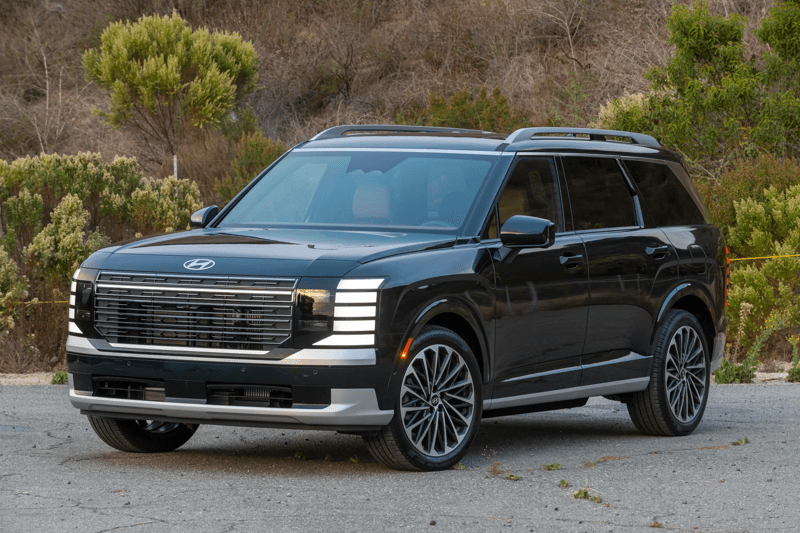

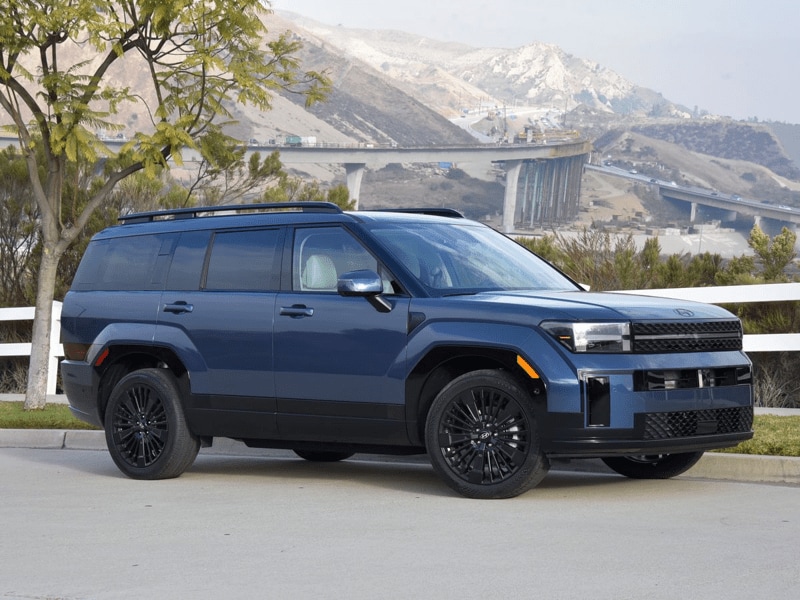
The Hyundai Santa Fe was redesigned for the 2024 model year to be larger, blockier, and roomier, with a third row of seats that can handle more than just emergency carpool duty. Another significant change was the addition of a more efficient hybrid powertrain option.
The 2025 Hyundai Santa Fe presents a compelling option for shoppers seeking a midsize 3-row crossover SUV: Do you prioritize more power or better fuel economy? As a family vehicle, the answer might tend toward the latter, which is one of the reasons why the Santa Fe Hybrid is one of our top-ranked Best Hybrid SUVs.
Car shopping is often more about preference than practicality, and some shoppers might prefer power. Here’s a look at how the two engine options stack up in terms of power, efficiency, cost, and packaging, to help you determine which is the right Santa Fe engine for your needs.
What’s the Price Difference?
There is only about a $1,000 upcharge for the hybrid powertrain. The EPA estimates you could make that up in fuel costs in less than two years of normal driving. But of course, nothing is as easy as that.
The 2025 Hyundai Santa Fe is offered in five trims, starting with the base SE for $35,795 (all listed prices include the mandatory destination fee). There’s also the off-road-adjacent XRT trim, which features a raised ground clearance and all-terrain tires. Neither of these trims is offered on the Santa Fe Hybrid. Instead, the hybrid starts at $39,295 for the SEL trim. That’s $1,000 more than a similarly equipped Santa Fe SEL non-hybrid. The Hybrid’s Limited and Calligraphy trims cost $1,000 more than their gasoline-only counterparts.
Adding all-wheel drive (AWD) costs $1,800 on any model, except on XRT, where it is standard.

Which Santa Fe Is More Efficient?
The hybrid, obviously. The EPA estimates the fuel economy of these two models as follows, in city, highway, and combined mpg formats:
- Santa Fe Hybrid: 36/35/36 mpg
- Santa Fe Hybrid AWD: 35/34/34 mpg
- Santa Fe: 20/29/24 mpg
- Santa Fe AWD: 20/28/23 mpg
- Santa Fe AWD XRT: 19/26/22 mpg
The EPA estimates you’ll save $650 to $700 per year with the Santa Fe Hybrid, based on driving 15,000 miles annually. The gap narrows if you log more highway miles, at speeds where combustion engines are more efficient. Around town and at low speeds, the hybrid’s advantage grows. The more miles you drive, the more money a hybrid saves you in the long run.
Which Santa Fe Engine Is Faster?
The standard Santa Fe is more powerful. The turbocharged 2.5-liter 4-cylinder engine makes 277 horsepower and 311 lb-ft of torque. It’s plenty of engine to motivate this 3-row SUV, and outpowers both the Subaru Ascent and Toyota Highlander. Expect a zero-to-60-mph time in the mid-6-second range. After a slight lag from a stop, the power comes on quickly, and you won’t second-guess single-lane passing moves or highway merging.
Note that for 2026, Hyundai replaced its troublesome 8-speed dual-clutch automatic transmission (DCT) with a more traditional 8-speed transmission featuring a torque converter, paired to the standard engine. Although smooth, the DCT led to a recall requiring new transmissions in certain Santa Fe models.
The Santa Fe Hybrid also uses a turbocharged 4-cylinder, but it’s smaller at 1.6 liters. Paired with a small but robust motor, the hybrid system generates 231 hp and 271 lb-ft of torque. It’s quicker off the line, but the power plateaus at speed. It’s built for comfort and efficiency. Expect it to hit 60 mph in about 8 seconds.
One of the neat tricks of the Santa Fe is its 6-speed automatic transmission. Most hybrids by other automakers utilize an electronically controlled variable transmission, which can be noisy and cause the engine to strain when pushed. The predictable gearing of the Santa Fe Hybrid makes it drive, feel, and sound like an SUV with a conventional transmission (because it is). The hybrids also have paddle shifters to give drivers some control if they want to dig deeper in the rev range. But then, if you switch the drive mode selector into Eco mode, the paddle shifters transform into four levels of regenerative braking to optimize efficiency. Hyundai, its sister company Kia, and its luxury imprint Genesis are among the few automakers to have such a feature in their hybrids.
Which 2025 Hyundai Santa Fe Engine Is Best?
It’s really a choice between power and practicality. Both powertrains have their merits.
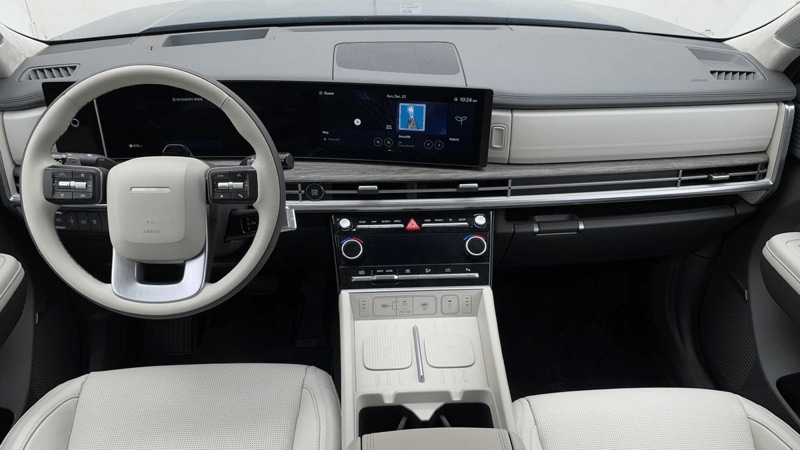
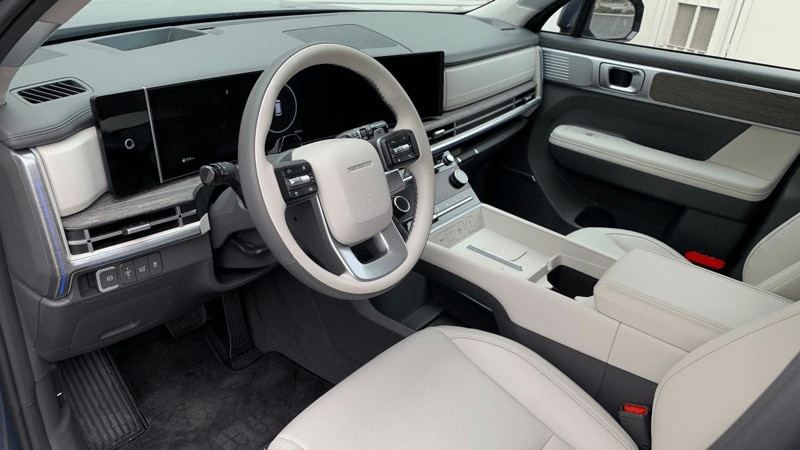
One more thing to consider is the interior space. Sometimes, hybrid components can eat into cargo or passenger space. That is not the case in the Santa Fe Hybrid. Because the high-voltage lithium-ion battery pack is set in the floor frame of the vehicle, under the front passenger seat, there is virtually no difference in terms of space and comfort between the hybrid and gas-only models. A slight hump accounts for the 1 cubic-foot difference in interior volume between the two. That’s practical, and ultimately, we’re a practical people. It’s another nod to the Santa Fe Hybrid.