

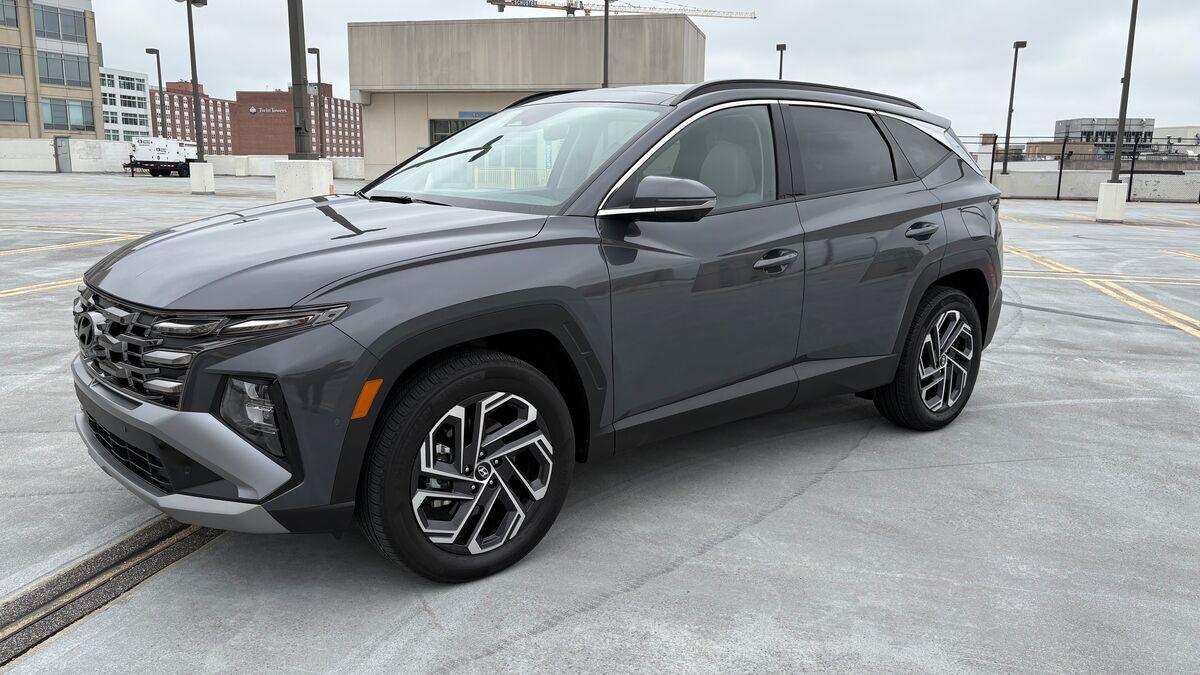
Some cars win you over with evocative styling. Some win you over with stirring performance. Those, however, are the ones that can get you into trouble.
The 2026 Hyundai Tucson Hybrid will win you over with relentless practicality, pleasant day-to-day livability, and respect for your budget. That’s a combination that never haunted anyone.
I spent a week testing the hybrid version of Hyundai’s best-selling vehicle in and around Washington, D.C., and found it awfully hard to marshal any argument against it.
There are other solid choices in the mainstream compact SUV market. I’m not sure, however, that there are any better buys.
The Tucson Hybrid is comfortable, fuel-efficient, reasonably priced, and styled with just a dash of Tabasco. Add in Hyundai’s 10-year/100,000-mile powertrain warranty, and you have one of the most sensible purchases available to car shoppers in 2026.
Which Trim Level
Hyundai builds a lot of Tucsons. You can buy the Tucson as a gas-powered car, a hybrid, or a plug-in hybrid (PHEV). The hybrid model comes in four trim levels. The company loaned me the top-of-the-line Limited model, and while I often talk people out of high-end trims, I won’t do that here. My tester came in well under the price of the average new car and included some creature comforts that made it seem convincingly near-luxury in a few important ways.
New 2026 Hyundai Tucson Hybrid Prices
|
Retail Price
|
Fair Purchase Price (92620)
|
|||
|---|---|---|---|---|
$34,050 |
$32,400 |
Favorite Feature
Americans love to complain about start/stop features in today’s cars, but Hyundai has solved what’s most annoying about them. When the car turns off at stoplights to save fuel, the climate control system doesn’t.
To get technical for just a moment, Hyundai can do this because it uses an electric compressor powered by the battery rather than a belt-driven compressor powered by the engine. In practice, it means you can leave the start/stop system engaged to save fuel and maintain a comfortable, constant temperature in the car, even during a historic heat wave with 103-degree days.
Ask me how I know.
What It’s Like to Drive
I’ve test-driven all three versions of the 2026 Hyundai Tucson — gas-powered, hybrid, and PHEV. The hybrid is the one Goldilocks would pick.
The PHEV out-accelerates it, but not by much, and costs more. The hybrid, with 231 horsepower and the extra low-speed oomph of an electric motor, offers more power than you’re ever likely to need. The EPA says it gets up to 38 mpg in combined driving, and I managed similar numbers in brutal heat, which means you’re likely to beat them in temperate weather.
A handful of competitors beat that, but there’s a limit to how much it matters. The EPA estimates that 2026 Toyota RAV4 drivers, with their 43 mpg average, will spend $1,450 a year on fuel. Tucson Hybrid drivers will spend $1,300. That extra $12.50 per month probably isn’t worth changing your plans over.
Steering is direct, with well-balanced weight that never feels too light or too heavy. Braking is progressive and firm, with none of the early sponginess some regenerative braking systems offer.
Interior Comfort and Technology
Many automakers have adopted the same rough interior design scheme in 2026, Hyundai included. It places the driver’s instrument screen and central touchscreen together in a single bezel so they look like one wide screen surface.
Hyundai does it well in the Tucson, but if you love it, be aware that you can also find it in many rivals.
Hyundai, thankfully, leaves a full set of knob-and-button controls beneath it for those of us that come from the old school. You can adjust most settings here, from volume to temperature, via touchscreen or knob, whichever you prefer.
A Qi wireless charging pad could use a stronger magnet to hold a phone in place, but I’m nitpicking there. The day-to-day user interface of the Tucson Hybrid is quite intuitive and pleasant.
The Limited grade features real leather, but the H-Tex synthetic stuff on other trim levels is a very convincing imitation.
Heated and ventilated seats are a pleasant surprise at this price.
Rear-seat space and cargo space are both near the top of its class, though not quite class-leading.
My favorite feature of the 2026 Tucson Hybrid, however, goes back to that climate control system powered off the battery. I had the car during a headline-making heatwave. I was pleasantly shocked to learn that, in extremely hot weather, it turns the air conditioning on the moment you climb in, before you even start the car. An inanimate object can be considerate.
Limitations
I’m nitpicking, but I wish Hyundai were more adventurous with color. I like the sharp angles and broken planes that make the Tucson Hybrid’s exterior look almost fractal, but shape is the only way to make it look interesting. Hyundai offers just eight colors, six of which are grayscale.
Key Considerations
The Tucson Hybrid is excellent, but has some excellent competition. The Toyota RAV4, Honda CR-V Hybrid, Kia Sportage Hybrid, and Mazda CX-50 Hybrid and more are all at the top of their game this year.