
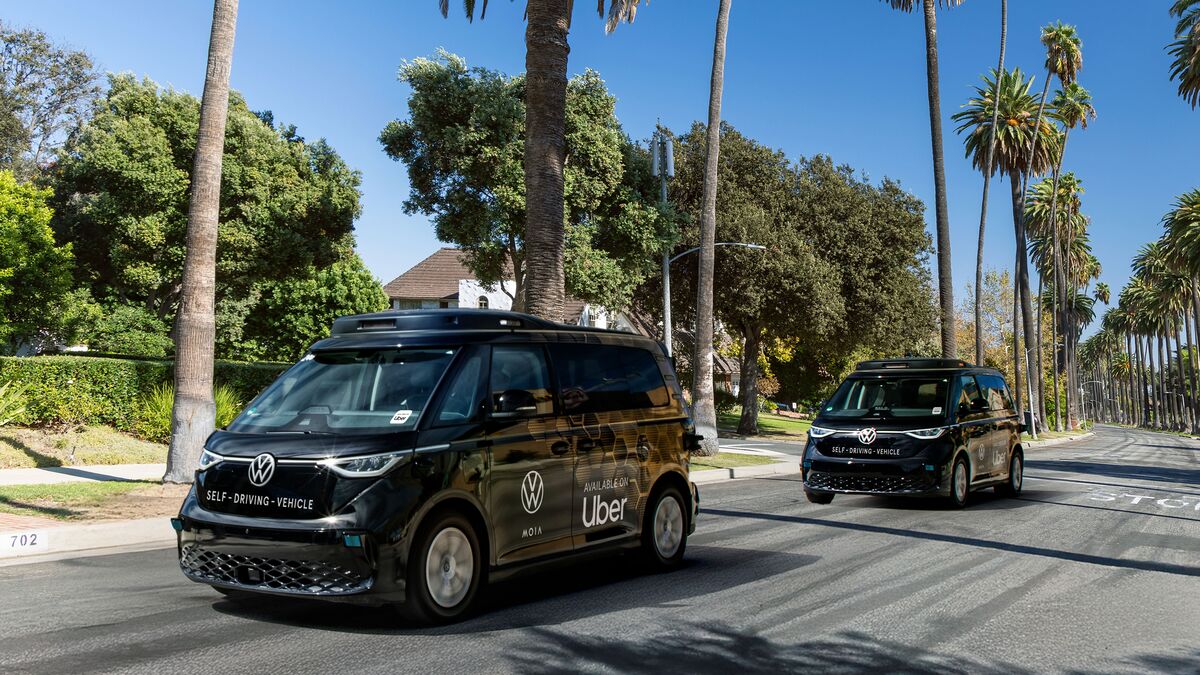
Volkswagen ID. Buzz robotaxis have begun on-road testing in Los Angeles. These robotaxis are hitting the streets before hitting the Uber app later this year.
Volkswagen Uber Partnership
Due to Uber’s mission to go fully electric by 2030, the rideshare app has dabbled in EV partnerships and incentives to meet this goal. Volkswagen and Uber announced their partnership last April.
Eventually, thousands of self-driving ID. Buzz models are planned to offer Uber rides in multiple U.S. cities. Prior to that, over 100 robotaxis with safety operators will be deployed for testing, as is the case in L.A.
A Natural Market
Volkswagen’s Autonomous Driving Mobility and Transport was renamed MOIA America earlier this year.
“Los Angeles is a natural market to introduce MOIA’s autonomous vehicles for ride experiences, given its long history of shaping car culture and embracing new mobility technologies,” says Paul DeLong, President of Commercialization, MOIA America. “Together with Uber, we’re bringing MOIA’s autonomous vehicles and expertise onto a platform millions of riders already use and trust.”
How it Works
The MOIA version of the ID. Buzz features a 27-sensor suite that integrates 13 cameras, nine lidar units, and five radars. The data from these sensors is fed into a computer that determines what the car should do in various scenarios. MOIA claims the ID. Buzz robotaxi meets the SAE Level 4 criteria.
The Inside Buzz
The van has four passenger seats and a luggage rack in place of the front passenger seat. There is a driver’s seat, but that will be empty if/when driving goes fully automated at the end of this year, as Volkswagen hopes.