

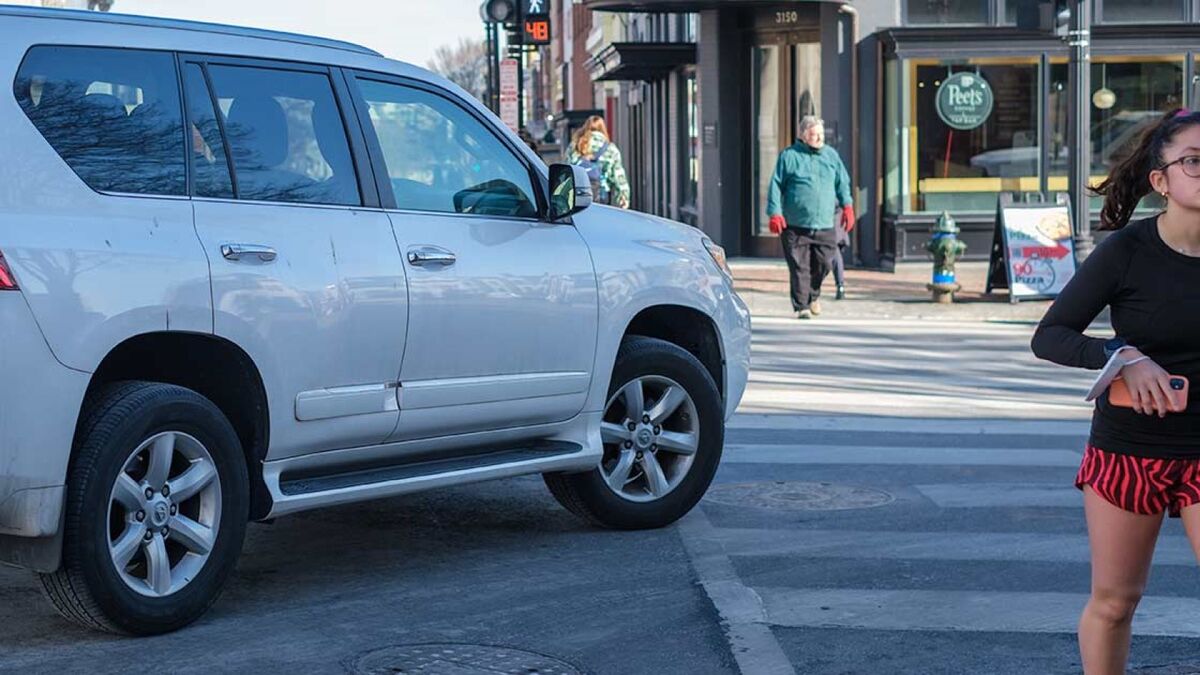
- America has seen a surge in pedestrian deaths in recent years, not matched by similarly developed countries.
- A New York Times investigation puts much of the blame on taller trucks and SUVs.
- It matches the findings of a similar insurance industry study.
The number of pedestrians killed in traffic accidents each year in the U.S. has increased by about 75% since 2009. No other similarly developed country has this problem. A new report from The New York Times blames the ever-increasing height of popular pickup trucks and SUVs.
That matches what an insurance industry study found in 2023.
Safety experts told the Times the problem is twofold: taller vehicles have more blind spots all around, and are more likely to throw pedestrians under their wheels in a crash.
Taller Hoods Mean More Severe Injuries
- Taller vehicles hit pedestrians higher and are more likely to throw them under the vehicle’s wheels.
- A lower vehicle is more likely to throw a pedestrian onto its hood, which is a more survivable accident.
Taller vehicles cause more severe injuries, the Times found.
“Our estimate is that about 200 to 400 pedestrians a year would not have died if vehicles had remained approximately the same size over the past quarter-century,” the authors explain.
When hit by a lower vehicle, the Times notes, pedestrians are often thrown upward, where they come down on the car’s hood. “That looks dramatic, but it’s usually safer for pedestrians than other outcomes, partly because hoods are designed to absorb impact.”
A taller vehicle hits a pedestrian in the head or shoulders, “which is less forgiving than a car’s hood, and the pickup then runs him over.”
“An average U.S. man, who is 5-foot-9, is likely to be knocked down by about 39% of vehicles today. In 2002, that number would have been 29%.”
Blind Spots are Growing All Around the Car
- Today’s cars let drivers see less of the road than those of a generation ago.
Adding to the problem, drivers are less likely to see pedestrians than they used to.
Taller hoods with the upright, blocky grilles popular today leave a large spot in front of the car where drivers can’t see. A-pillars – the first pillar holding up a car’s roof – have also grown to help support the weight of today’s vehicles in a rollover crash. As a result, the Times says, drivers have growing blind spots all around today’s trucks and SUVs.
Researchers “used a three-dimensional scanner to compare sightlines in four of the most common pickups today — the Chevrolet Silverado, Ford F-150, GMC Sierra, and Toyota Tacoma — with their counterparts from the 1990s or early 2000s.”
Today’s Silverado has a blind spot nearly twice as large as that of a generation ago. The Sierra and Tacoma have blind spots about 60% larger than those of their previous generations. “The smallest increase was the F-150’s. Its blind zones grew by about 25%,” The Times notes.
That data also matches an insurance industry study, this one from 2025.
Technology Can Help Some of This Problem
- Automated safety systems like automatic emergency braking may help, but won’t likely solve the problem.
“Automakers say that new technology designed to detect and avoid pedestrians — including systems that automatically apply the brakes — would dramatically improve safety,” the Times notes.
Other studies by safety advocates have found that automatic emergency braking does cut the number of accidents, and is improving over time.
The National Highway Traffic Safety Administration (NHTSA) enacted a rule requiring such systems in 2024, but has since delayed explaining how it will test to ensure automakers have complied.