
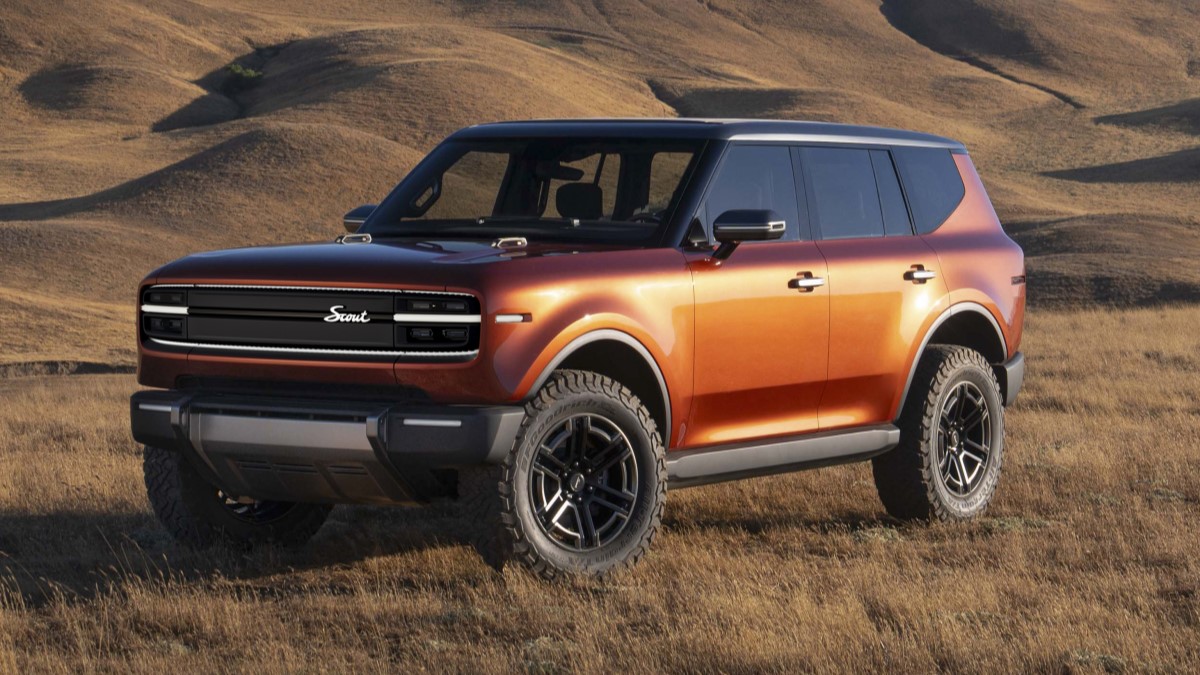
For a vehicle no one outside the company has driven, the forthcoming Scout EVs are making plenty of noise.
Scout Motors recently released a short video titled “The Sound of Scout.” Instead of showing how the upcoming Terra pickup and Traveler SUV drive or accelerate, the company focused on how they sound. The video highlights chimes, alerts, metal switches, and engineered audio cues meant to replace the familiar growl of an internal combustion engine.
It offers an intriguing peek behind the curtain — and, judging by the YouTube comments, an unintentionally funny one.
A Sonic Teaser for a Mysterious Truck
Scout Motors, the Volkswagen‑backed revival of the legendary International Harvester brand, remains at least a year away from letting journalists or customers get behind the wheel of its reborn Scout models. The vehicles did appear up close at the 2026 Los Angeles Auto Show, but Scout currently targets first deliveries of the electric Terra and Traveler models for 2027.
Until then, the company has leaned hard into storytelling. Scout has released factory updates, design documentaries, and brand films. Now it has turned its attention to sound. The company says its UX team traveled to farms with grain silos and recorded vintage Scouts to capture audio textures meant to give its EVs a “distinctly American voice.” That effort produced a catalog of custom sounds designed to convey ruggedness, authenticity, and emotional connection.
The Internet Responds: Is This… Accidental Satire?
On YouTube, viewers weren’t quite sure how seriously to take the presentation.
Some reacted with affection. Others leaned into humor. Several joked that Scout had perfected the art of designing sounds for vehicles that do not yet exist. One commenter summed it up neatly: “The sound of it being delivered to my driveway would be nice.” Others compared the video’s tone to a pitch‑perfect parody of modern EV branding — earnest, cinematic, and deeply invested in feelings.
Sound design, to be fair, plays a real and growing role in electric vehicles. Without engine noise, automakers must create new ways to communicate speed, feedback, and safety. Federal rules require EVs to emit artificial sounds at low speeds through an Acoustic Vehicle Alerting System, which changes pitch as a vehicle accelerates or slows to help pedestrians detect its movement.
Still, for an audience eager for real‑world specs and seat time, a philosophical meditation on grain silo reverb landed a bit sideways.
In Today’s EV Climate, Progress of Any Kind Matters
Context matters. In early 2026, the EV landscape is full of cautionary tales.
Over the past several months, automakers have delayed, scaled back, or canceled EV programs amid slowing demand, shifting incentives, and rising costs. Honda made headlines in March when it canceled three electric models planned for U.S. production, including two next‑generation vehicles and the Acura RSX, while warning of up to $15.8 billion in losses tied to its EV strategy reset.
Honda is not alone. Ford, Volvo, and Stellantis have all pulled back or redirected investment toward hybrids and internal‑combustion vehicles as the EV market cools. According to the last month’s EV Market Monitor report by Kelley Blue Book parent Cox Automotive, new EV sales fell 26.8% compared with the same period in 2025.
Against that backdrop, Scout’s video serves another purpose: reassurance.
The company continues to hire. It continues to build its factory near Blythewood, South Carolina. It continues to refine its vehicles and release updates. In an era when EV silence often signals cancellation, any sign of momentum matters.
Branding First, Driving Later
Scout’s strategy follows a familiar EV playbook: Build emotional attachment long before vehicles reach showrooms. Tesla did it with performance promises. Rivian did it with adventure imagery. Scout is doing it with heritage — and now, with sound.
Its audio design draws directly from original International Harvester Scouts, recorded to preserve mechanical character and blended with rural field recordings and acoustic instrumentation. The goal is simple: give the brand a recognizable voice before customers ever turn a wheel.
What’s missing, for now, is the payoff. No sound design replaces the experience of actually driving the vehicle it belongs to. That does not mean Scout Motors is off track. Factory construction is progressing. Reservations reportedly remain strong (with the majority of buyers opting for the optional gas engine/generator). Production targets have not changed, to our knowledge. But the response to “The Sound of Scout” highlights a broader truth about today’s EV audience. After years of teasers, concept reveals, and brand storytelling, many enthusiasts want something simpler.
They want a steering wheel. A road. And a journalist with a notepad.
Until then, Scout’s future remains something we can hear — but not yet drive. And at a time when many EV programs quietly disappear, that sound may be doing more than setting a mood. It may simply be letting fans know that Scout is still alive, still working, and still planning to show up.