
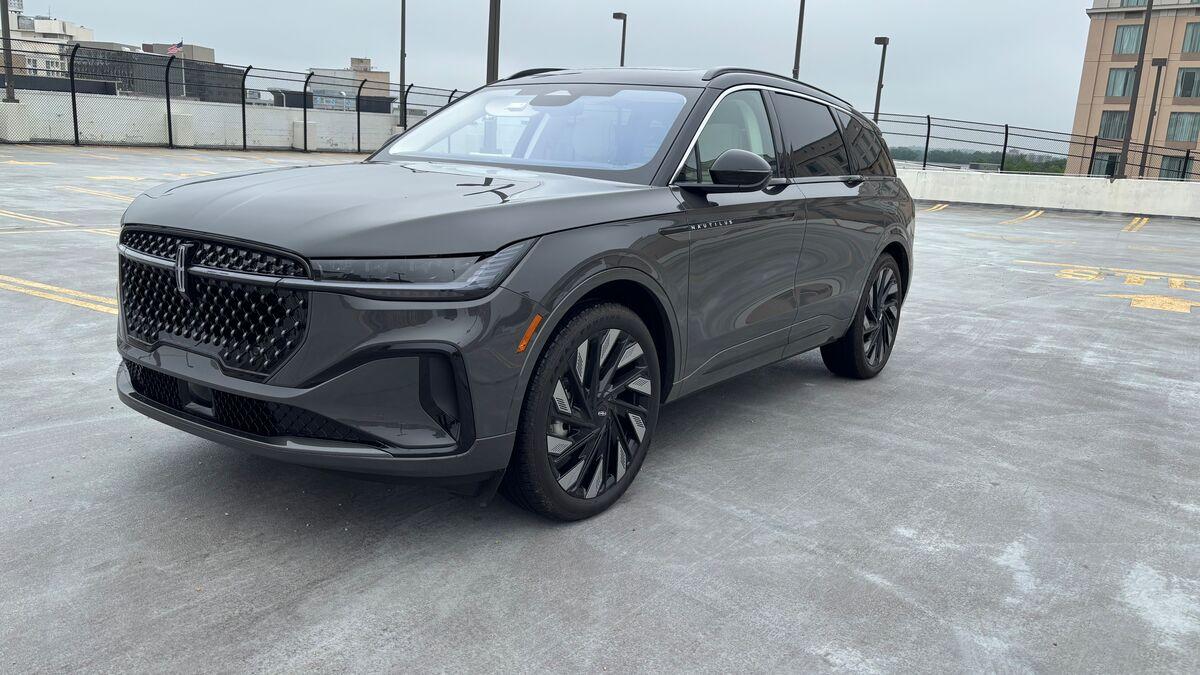
The 2026 Lincoln Nautilus Black Label is a weird car in so many ways. I like weird, especially in luxury cars. A luxury automaker can succeed by shooting for a small niche of the market. This one feels like one of a kind.
That’s partly due to its screen setup. I drive a few dozen cars a year, and Lincoln’s new approach to screens is my favorite piece of car design in years. More on that in a moment.
But it’s also the fact that this is a smaller midsize SUV, bordering on compact, with every luxury feature an automaker knows how to build.
That’s a little unusual. With most luxury marques, size correlates with luxury. To get every possible feature, you have to buy the big one. Some of us don’t need the big one.
But the Nautilus Black Label gives you the usual midsize luxury-class features (leather, a nice audio system, etc.) and some features often reserved for bigger cars (massaging seats, scent diffusion, partial self-driving on the highway, and more).
I spent a week in the Nautilus Black Label, driving mostly suburban streets, with occasional highway drives and some tight urban parallel parking. And though it’s expensive for its class, this car partly competes a class up, offering all the features of a full-size luxury SUV in a more maneuverable package. I’m a fan.
Which Trim Level
Lincoln builds the Nautilus in three trim levels – Premiere, Reserve, and Black Label. My test model was the Black Label, which is almost in a class of its own. It’s pricey for the midsize luxury class, but it’s hard to think of a luxury car feature not found in the Black Label. My tester had the optional hybrid powertrain and the Jet Appearance Package, which darkens many exterior elements for a tuxedoed look.
New 2026 Lincoln Nautilus Prices
|
Retail Price
|
Fair Purchase Price (43085)
|
|||
|---|---|---|---|---|
$55,990 |
$53,800 |
|||
$65,590 |
$63,000 |
|||
$79,655 |
$76,600 |
Favorite Feature
I think Lincoln’s new approach to screens is the future of automotive interior design. Already, BMW has debuted a tweaked version (on its newest electric cars) and celebrated its own genius for the discovery. So did startup Lucid.
Lincoln sits a massive, curving screen not within, but on top of the dashboard. It stretches across the entire dashboard right at the base of the windshield.
It’s not a touchscreen. You use a touchscreen (in the usual place you’d expect a touchscreen) to set it up. Once you’ve done that, you have everything you could need to know in easy view. Speed? On the wide screen. Map and directions? On the wide screen. What song is playing? On the wide screen.
Its location – almost part of the windshield – means you don’t have to look down from the roadway to consult it. If you glance at the screen, your eyes are still partly on the road.
Its immense size means there’s little reason to ever page through a menu to find something. It’s all easy to find all the time.
I hope every automaker decides it invented this. Lincoln did, for what it’s worth.
What It’s Like to Drive
The Lincoln Nautilus has a lot to offer if you want a smooth, unpretentious ride. It’s not a high-performance luxury car.
It pairs a 2.0-liter turbocharged inline 4-cylinder engine with a 100-kW electric motor. The combination delivers 310 horsepower. That could sound like a high-performance setup, but Lincoln has tuned it to be a buttery, unobtrusive one. A continuously variable automatic transmission (CVT) means there aren’t even shifts to feel.
Steering is light and low-effort, with an oblong steering wheel wider than it is tall.
The suspension is similarly tuned for smoothness, not athleticism. Brakes are excellent, with none of the overaggressive braking sometimes found in hybrids, which capture energy from regenerative braking to recharge their batteries.
It’s smooth to drive and smooth not quite to drive – Lincoln’s excellent BlueCruise hands-free highway driving system is like a calm chauffeur in this setup. It works only on pre-mapped stretches of highway, but the company says it has over 130,000 miles in its memory, and that number grows regularly.
Interior Comfort and Technology
The comfy cabin is the Nautilus Black Label’s reason for being.
You sit on well-cushioned, wide seats with built-in massagers and a split knee bolster (it’s surprisingly comfortable to support each leg separately, especially for those of us with surgically repaired knees).
Those seats are heated and ventilated, too.
You grip a nearly elliptical steering wheel – flat on top to better see the 48-inch expanse of screen above it. You shift into drive with buttons, not a wand or dial. That takes some getting used to if you haven’t owned a piano-key transmission before, but disability advocates say pushing motions are easier on the hands than twisting motions.
The Black Label’s Revel Ultima 28-speaker 3D audio system delivers clear, crisp sound at low volumes, with separate settings for live music, studio music, and podcasts.
You can select diffusible scents, engage BlueCruise, and even select special driving meditations recorded just for Lincoln by the app Calm.
Rear seats have among the largest leg- and head-room measurements in the midsize class – impressive in a vehicle shorter than an Infiniti QX60 or Acura MDX.
Cargo space, at about 36 cubic feet before you fold the seats down, is typical for its class.
Limitations
Upscale car makers have to choose between sporting ambitions and calm luxury. This is decidedly at the cushy end of the scale. If a BMW X5 or Mercedes-Benz GLE pulls up to the stoplight, let it go by.
Key Considerations
Most luxury automakers don’t build a midsize SUV with this many features. The Black Label costs as much as some 3-row luxury SUVs, and is meant for those who want all the luxury of one but don’t want to have to park it.