
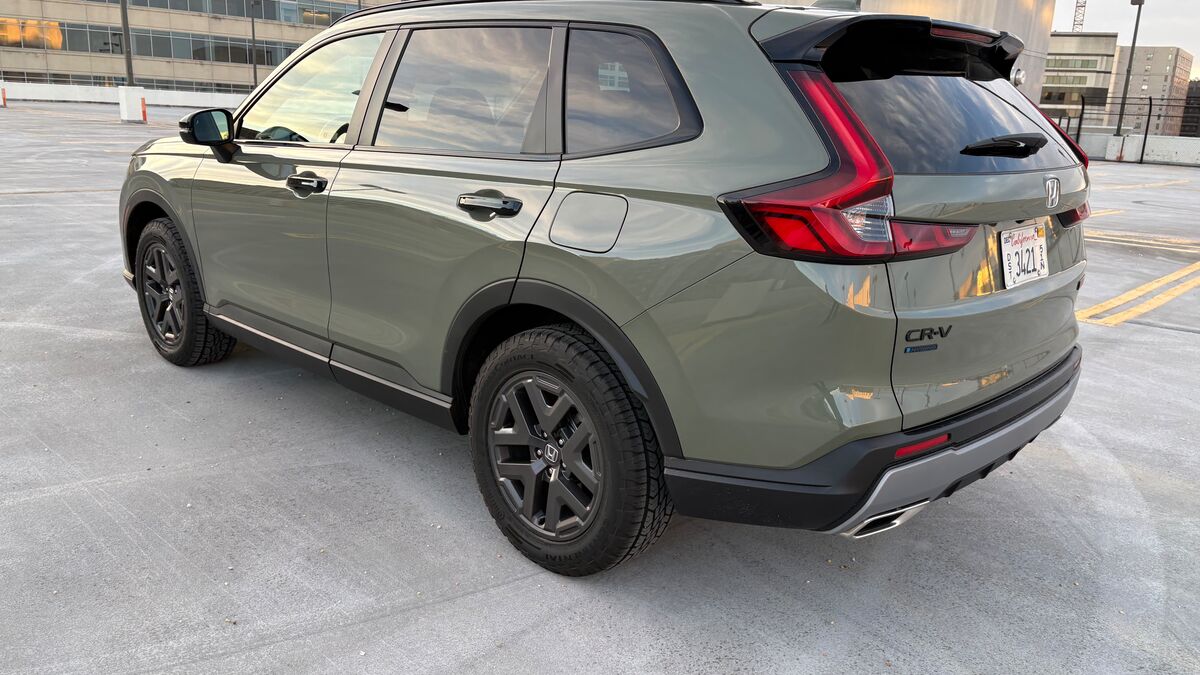
If I had to propose a single vehicle to represent the sort of car Americans buy this year, I might choose the 2026 Honda CR-V Hybrid.
Why? Because compact SUVs are among the best-selling vehicles in America, passing the sales title back and forth with the midsize SUV class month after month. The Honda CR-V is the iconic compact SUV, and the winner of our Best Buy Award in its class. And America has gone hybrid crazy, with hybrids steadily climbing the sales charts even before gas prices started to soar this year.
That makes the CR-V Hybrid a terrific solution for many car shoppers.
For 2026, Honda has made one significant change to the CR-V lineup: a light off-road model called the CR-V TrailSport Hybrid. It’s not designed to tackle crossing the Andes, and it’s not priced like it is. Instead, it’s a CR-V with all-terrain tires, orange ambient lighting and the same color interior stitching, and easy-clean rubber floor mats.
Those are cost-effective upgrades that make a vehicle more distinctive and more usable on mud and sand without breaking the bank.
I spent a week driving the CR-V Hybrid around Washington, D.C., and its suburbs, but I didn’t get the chance to take it off-road.
It proved, once again, to be the benchmark other automakers aim for. There are reasonable alternatives. You might be happy with one of its rivals. But odds are quite good that you would love this one.
Which Trim Level
Honda builds seven CR-V trims in 2026, four of them hybrid. The TrailSport Hybrid sits near the middle of the lineup in price (a pleasant surprise; some automakers charge a lot for their off-road models). Its price can stay under the $40,000 line if you personalize it right.
New 2026 Honda CR-V Hybrid Prices
|
Retail Price
|
Fair Purchase Price (30334)
|
|||
|---|---|---|---|---|
$37,080 |
$36,100 |
|||
$40,175 |
$38,700 |
|||
$40,250 |
$39,300 |
|||
$44,000 |
$42,400 |
Favorite Feature
Hybrid technology has changed. Once, it had tradeoffs – you gave up some power and some driving refinement, and in return, spent less at the gas pump.
There are no longer any tradeoffs.
The CR-V TrailSport Hybrid gets 35 mpg in combined driving, and 38 mpg in the city, despite being more powerful than non-hybrid CR-V models (204 horsepower instead of 190 hp), It comes with grippy all-wheel drive (AWD) and boasts an extraordinarily smooth driving experience.
In a year when the average new vehicle is selling for nearly $50,000 most months, all that for around $40,000 is quietly remarkable.
What It’s Like to Drive
SUVs designed for road tires but mounted with all-terrain tires can sometimes be slightly rough and noisy. There’s no hint of that in the CR-V TrailSport Hybrid. It rides as smoothly as an Accord sedan, just a little higher off the ground.
If you’re familiar with off-road vehicles, you might expect a softer, bouncier suspension from a model with “trail” in the name. I didn’t find much of that in this one. The suspension is not unpleasantly firm.
The added power of the hybrid is more or less canceled out by the added weight of the hybrid battery, so that it accelerates more or less like an ordinary CR-V. That’s a good thing; you’ll never feel like your car is underpowered, even if it’s not winning any stoplight races.
Braking is predictable and confident.
Interior Comfort and Technology
The 2026 Honda CR-V Hybrid TrailSport’s cabin is a pleasant place to spend time. The seats – Honda calls them Body Stabilizing Seats – are comfortable and seem to mitigate some of the fatigue of a long car ride.
One odd choice, however, is that they’re upholstered in cloth. Honda gives TrailSport buyers easy-clean rubber floor mats, but not the kind of faux leather seating that would resist mud as well as the floor mats do.
Years of test-driving many cars for a living have left me picky about screen placement. Honda gets it pretty much right here. The driver’s instrument screen is sized so that the steering wheel never blocks your view of it, and the central touchscreen is mounted high so that you don’t have to look down from the roadway to see the map.
Honda builds its cabins big. Rear-seat accommodations nearly rival some midsize SUVs for space.
The TrailSport model gets orange badging and orange contrast-color stitching, which makes it feel a bit more adventurous than an ordinary grocery getter.
The cabin technology suite has everything you’d expect and nothing particularly exceptional. A wireless charging pad, wireless Apple CarPlay and Android Auto, and dual-zone climate control are standard. An 8-speaker sound system is pleasant but not remarkable.
Its best technology, however, is Honda’s Traffic Jam Assist system. Below 45 mph, it can brake, accelerate, and steer to keep the car’s position in traffic. If you’re buying a commuter car for a place with regular gridlock, it can ease your frustrations.
Limitations
The CR-V Hybrid is simply an excellent buy with few limitations. I would ask a friend considering the TrailSport whether they would ever truly use its dirt-road capabilities. If they wouldn’t, they might save themselves a few thousand dollars by buying the Sport Hybrid model instead, which is also slightly more efficient.
Key Considerations
The CR-V has dueled the Toyota RAV4 at the top of this class for many years. Both are still excellent. A buyer test-driving the CR-V Hybrid might also consider the RAV4 (there’s no separate RAV4 Hybrid model anymore because Toyota no longer builds non-hybrid versions of that car). But the CR-V is in better supply early this year, and might be easier to find at a fair price. As Toyota transitions several factories to build a new RAV4, dealers are receiving lighter shipments than normal.