
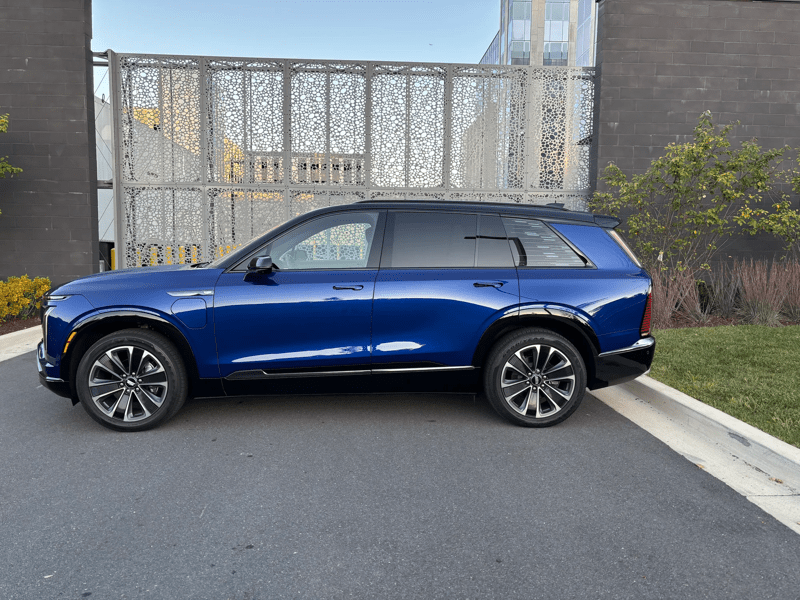
When Cadillac designers first introduced the 2026 Cadillac Vistiq, they called it the “baby Escalade.” At nearly 206 inches long, it’s larger than any Escalade except the current generation. I spent a week driving it around Washington, D.C., and its suburbs, including a one-day road trip. I found the Cadillac you’ve probably heard least about to be a very compelling electric stand-in for the one you have probably heard most about.
I don’t know when cars will stop growing. I’ve been testing them for 25 years, and compact SUVs today are about the size midsize SUVs were when I started. The biggest vehicles, like the Cadillac Escalade, dwarf anything on the road a generation ago.
Today’s gas-powered Escalade has grown to nearly 212 inches, and the all-electric Escalade IQ, the leviathan of today’s car market, measures over 224. Cadillac decided it was time for a baby. A very big baby.
The Vistiq is so new to the Cadillac lineup that you may not have seen many on the road. It’s easy to miss, thanks to the giant cultural footprint of the Escalade. But, in truth, it pretty much *is* an electric Escalade. The gargantuan Escalade IQ is the outlier.
The Vistiq is an electric 3-row SUV longer than a gas-powered Escalade with all the space and convenience a family needs, up to 305 miles of range, and a performance mode that comes as a shock in a relatively practical vehicle.
Which Trim Level
Cadillac builds the Vistiq in four grades – Luxury, Sport, Premium Luxury, and Platinum. All four have the same power and battery, though Sport and Luxury models get sportier suspension tuning, and Platinums get an adaptive air suspension.
My tester was the Sport model, and I never felt any lack of luxury.
New 2026 Cadillac VISTIQ Prices
|
Retail Price
|
Fair Purchase Price (33602)
|
|||
|---|---|---|---|---|
$79,090 |
$75,500 |
|||
$79,590 |
$75,900 |
|||
$93,590 |
$90,500 |
|||
$98,190 |
$95,700 |
Favorite Feature
GM’s Super Cruise hands-free highway driving system may be the benchmark among these early, proto-self-driving setups. It keeps getting smoother.
It’s included in every Vistiq regardless of price, and works on pre-mapped highways. As of publication time, GM states that the system covers over 750 million miles of North American highways.
It accelerates, brakes, and steers to keep the Vistiq in its lane. It changes lanes to find an opening and adjusts its speed when the speed limit changes (staying, for instance, 5 miles above the posted limit).
You must keep your eyes on the road and stay ready to take over when prompted.
Super Cruise took me most of the way from Washington, D.C. to Baltimore, driving smoothly through traffic jams and open, flowing traffic. In testing a year ago, I found it to be hyperactive and likely to change lanes without reason. That problem is already gone, and I suspect the system will keep getting better with time.
What It’s Like to Drive
The “baby Escalade” moniker does the Vistiq a disservice.
Not that the Escalade is unpleasant to drive. However, tying the Vistiq to the Escalade implies weight, size, and the heavy, rugged manners you might expect from a full-size SUV. The Vistiq is surprisingly quick and light on its feet for something genuinely Escalade-sized.
Steering feel is light – I’m not sure I felt any more weight to the 3-row Vistiq’s handling than I did to the compact 2-row Optiq I tested a few months before. It handles suburban parking lots with relative ease for such a big boy.
Braking is firm, and belies not an ounce of the car’s more than 6,000-pound weight.
In Tour mode (the everyday setting it defaults to on startup), acceleration is progressive and brisk. Everything about it feels like a smaller SUV.
Then there’s the surprise. On the steering wheel sits a button with a stylized red V.
V-mode is Cadillac’s performance setting, often reserved for high-performance models with the V moniker in the name. My Vistiq tester was no high-priced Vistiq V. Still, there was the V on the steering wheel.
V-mode gives this family hauler a zero-to-60 time under four seconds, in case you can think of some reason you’d need that. It’s wildly unnecessary here. Cadillac’s just showing off, but it’s a remarkable feat in a 3-row family SUV.
Interior Comfort and Technology
Cadillac’s electric SUVs have been home to some unusual interior design, but the Vistiq’s cabin is an exercise in restraint. Where the Optiq features four-color cabins and contrasting textures, the Vistiq gets tame hues and soft-touch Inteluxe (a faux leather designed to age better) everywhere.
My tester’s cabin was a staid black, but Cadillac offers some interesting colors, including lovely blue seating at some trim levels.
Cadillac provides the driver with a pair of screens mounted as if they were one curved screen surface – a display screen for the driver’s instruments and a central touchscreen. This design is almost ubiquitous among luxury cars in 2026, and works reasonably well here. Another low-mounted screen handles climate control.
A passenger complained that the second-row captain’s chairs were a bit firmer than expected. They’re wide and supportive, but not to all tastes on long drives.
The Vistiq is filled with recessed, dial-a-color ambient lighting, including a feature surrounding its dual-pane panoramic glass roof. I found that a bit distracting in my peripheral vision, but I’m sure you get used to it if you own the car.
Limitations
User-experience designers run most functions through touchscreens, but Cadillac still insists on smooth capacitive touch controls on steering wheels. Many luxury automakers have moved away from those in 2026, as customers tend to prefer tactile buttons that respond with a click.
Accessibility could be a challenge for some. For a vehicle that is essentially Escalade-sized, I’d like to see grab handles at all positions and the option for wide running boards that would make entry and exit easier.
Key Considerations
GM has moved faster than most competitors in electrifying its luxury fleet. The Visti has few competitors as a true 3-row electric SUV from a luxury automaker. Its closest rivals might be high-end trim levels of the Kia EV9 and Hyundai Ioniq 9, at least for now.