
You could use a tool belt to hold up your pants. A tool belt is capable of a lot more than the average belt. But it also does the belt job.
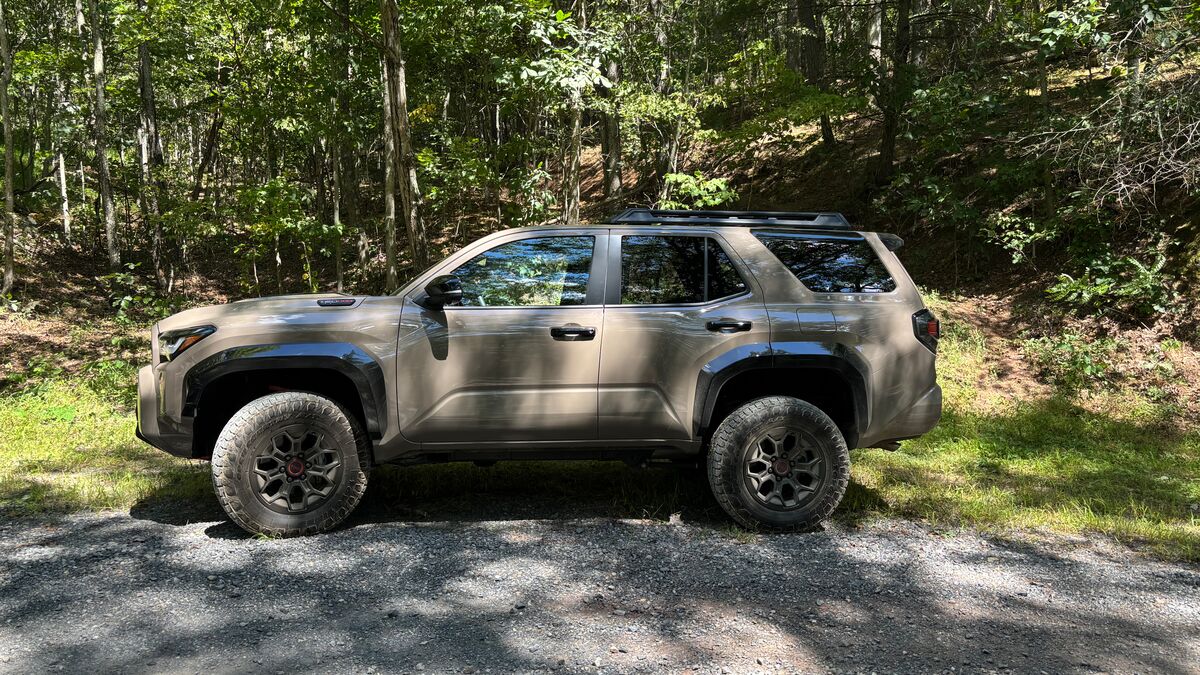
Likewise, I got to work, the grocery store, and the gym in a week of driving the 2025 Toyota 4Runner TRD Pro. But I never felt I was using most of what it could do.
I even took it well outside the Washington, D.C., metro area where I live in search of some dirt roads and stream fords in the West Virginia mountains that I’ve used to challenge other off-roaders before. The 4Runner made light work of them.
Toyota has a lot of very solid vehicles in its lineup, but the automaker is particularly careful with the 4Runner. It has a reputation as one of the most capable off-road vehicles you can buy without paying luxury car prices. Toyota kept it the same from 2010 through 2024 — an unusually long run without a redesign — because they knew it was exactly what it needed to be.
But they couldn’t wait to update it forever. So, for 2025, we get an all-new 4Runner. Toyota loaned me the TRD Pro version – the most capable off-road trim level – for a week of driving. I used it as a family car, just casually wearing a tool belt to hold up my Bonobos, and took it for some light trail work.
I’m happy to report that the 2025 4Runner is surprisingly comfortable in an urban setting, and still a mechanical mountain goat on gravel and mud.
Which Trim Level?
Toyota builds the 4Runner in a remarkable 12 trim levels. The price difference between the base SR5 model and this TRD Pro is a whopping $26,130. 4Runners hold their value well over time. Fetching a higher resale value when you’re done with it could help you justify the expense of a TRD Pro. But I’d only consider one if I were actually going to use the manually-adjustable Fox remote reservoir shocks, stabilizer disconnect, and similar off-road gear.
If you’re not likely to ever take your 4Runner far off the asphalt, a well-equipped mid-trim like the Limited or Off-Road Premium gets you all the same rugged charm for much less.
New 2025 Toyota 4Runner Prices
|
Retail Price
|
Fair Purchase Price (43085)
|
|||
|---|---|---|---|---|
$42,720 |
$38,900 |
|||
$49,200 |
$44,800 |
|||
$51,140 |
$46,600 |
|||
$54,560 |
$49,700 |
|||
$56,920 |
$51,900 |
|||
$57,350 |
$52,300 |
Favorite Feature
Longtime 4Runner lovers have taken to the internet to express skepticism about the 4Runner’s new base engine. 4Runners long came with a standard V6. The new one gets a 2.4-liter turbocharged inline 4-cylinder engine instead. It’s more powerful than the V6 it replaces, but questions about turbo lag and reliability persist.
The TRD Pro, however, adds an electric motor to it for a total of 326 horsepower and hybrid efficiency. Power felt abundant, whether merging on the highway or surging up a steep mountain road. A TRD Pro model is supposed to be all about its suspension, but I enjoyed the power under the hood most.
Honorable mention goes to the compressor built into the cargo area. For serious off-roaders, airing down and reinflating tires anywhere is a smart convenience.
What It’s Like to Drive
The most challenging thing I asked the 4Runner TRD Pro to do wasn’t off the road. It was on it: Could this beast be a comfortable perch in urban traffic?
Yes. It somehow manages to be big without really feeling big (other than when you climb in – I’m 5’6” and could have used a grab handle). I can’t believe I’m saying this, but the new 4Runner is a pleasant urban commuter.
Steering is responsive and easy – shockingly light in a vehicle based on a body-on-frame truck. The brakes are confident, even a touch grabby, until you learn that you don’t need to be firm with them.
Drive modes mostly change throttle response. The impressive off-road suspension is manually adjustable – you have to get out to tune the shocks, though I never felt a need to touch them.
Interior Comfort and Technology
The classic 4Runners of the mid-’80s were essentially pickups with seats and caps. The new one shares enough parts with the Tacoma to make that heritage clear, but it is a much more composed family hauler.
Toyota still builds its driver’s instrument screen and central touchscreen far apart, even in a year when most automakers house them together to look like one large screen. I prefer Toyota’s approach – the steering wheel never blocks your view of anything important. But the 14-inch central touchscreen is comically large at first sight.
The 14-speaker JBL Premium Audio System isn’t luxury sound but borders on it. I was surprised by its range. It also offers a portable Bluetooth speaker that pops out of the dashboard.
In recent years, Toyota has used a subtle camouflage effect on the trim of TRD Pro models. I haven’t been a fan — I’d rather they at least let buyers decide whether to spec that – but it’s toned down here. Toyota’s SofTex faux-leather upholstery remains perhaps the best vegan leather on the market — soft but long-wearing.
The 4Runner has historically had one lovable quirk – a rear window that rolls down. Toyota, thankfully, preserved it.
Limitations
I had just one major complaint in my time in the 4Runner TRD Pro. A prominent hood scoop looks cool from the outside, but seriously harms visibility, particularly when cresting a hill. Most trim levels lack it, but drivers under 6 feet might consider it a drawback on trims that have it.
Key Considerations
Only a handful of vehicles can do family duty and double as supremely capable off-roaders. Compare the 4Runner to the Jeep Wrangler or Ford Bronco, and when you do, notice the resale value difference and history or reliability this one offers. Of the few vehicular tool belts on offer, this might be the one kindest to your wallet over the long run.