
- BMW today showed off the 2027 iX3, an all-electric SUV on an all-new platform
- It’s the first of a new generation of vehicles that will see BMW adopt a fresh design scheme it’s been planning for years
- U.S. deliveries set for mid-2026
“Here it is. The first of a new era. The future of the car.”
That’s how BMW Group CEO Oliver Zipse introduced the 2027 BMW iX3, an all-electric SUV the brand showed off today at Munich’s motor show.
It’s grand language for an electric SUV — something most brands already have on sale today, BMW included. But BMW and its longtime fans tend to see the company’s products in eras. The company has been teasing the start of a new era since late 2023. The iX3 will be the first in a wave of new designs that will see the company’s entire portfolio remade in a new style. BMW says iX3 production will begin in the first quarter of next year, with U.S. deliveries starting in mid-2026.
BMW calls this generation the Neue Klasse designs, resurrecting a name it used in the 1960s for the generation of cars that won it its modern reputation as the performance brand among luxury automakers.
Like those cars, this new one features a cleaner, simpler approach to aesthetics than the cars that preceded it. Unlike them, it also features a new approach to technology based on computing power.
BMW says prices will begin “around $60,000,” but we find automaker estimates this far out from a model’s arrival in dealerships are often low.
Clean Lines, Thin Vertical Kidney Grille
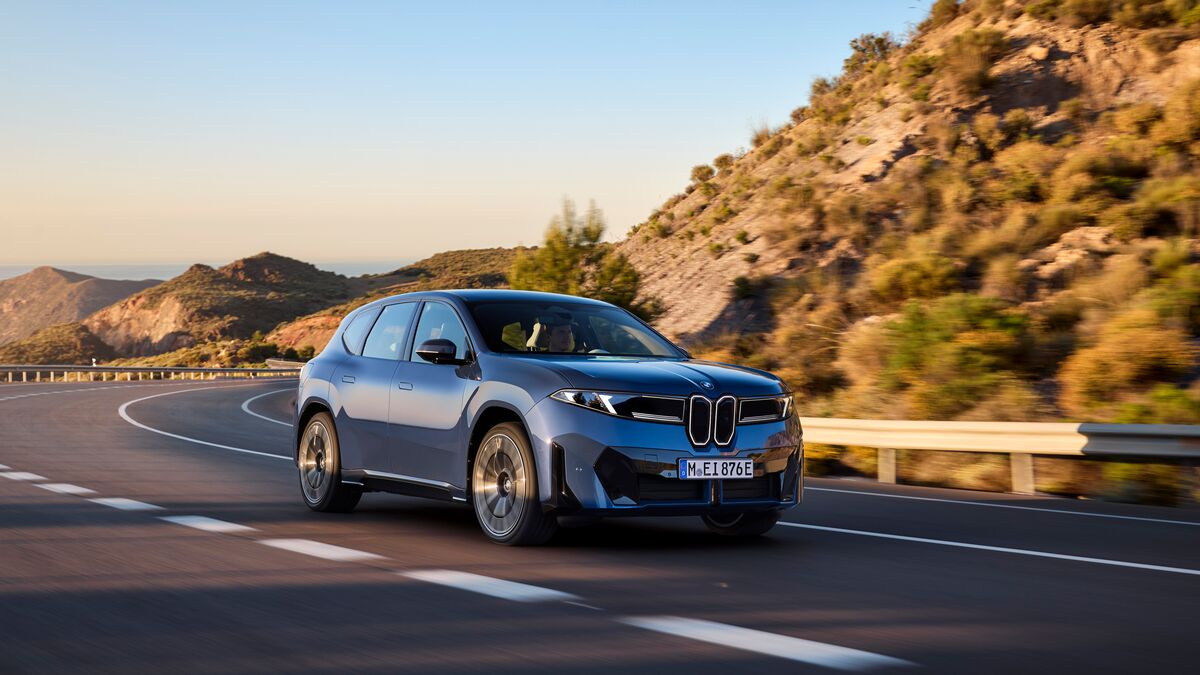
- Designers aimed for a clean, simple design language that saluted BMW cars of the 1960s and ’70s in modern style
- BMW’s ever-evolving two-kidney grille shows up tall and narrow this time
BMW fans have a long history of critiquing each new design scheme, even as they snap it up off dealer lots. However, we feel the Neue Klasse designs will be welcomed.
They borrow a bit from the classic look of 1960s and 1970s BMW cars, with few of the aggressive character lines that have marked recent decades.
It’s electric, so it has little need for a grille or aggressive air intakes. However, drivers associate those features with performance, so BMW has copied them. The signature two-kidney grille, which has grown oversized in some recent designs, is now tall and thin like it was decades ago.
A valley in the hood houses the BMW roundel. In profile, the only character lines are boxy planes defining the fenders. From the rear, there’s a pronounced shoulder line, and the valley effect is mimicked with the roundel between raised taillights.
Panoramic Display, No iDrive Puck
- The cabin is clean and simple, with a thin panoramic display directly underneath the windshield
Inside, designers aimed for “an uncluttered, reduced design.” Character comes from traces of adjustable-color lighting that look like blowing wheat diagonal across the surface of the dashboard.
A parallelogram-shaped central touchscreen handles infotainment duties. Rather than a driver’s instrument display, there’s a single, thin display stretching across the bottom of the windshield that keeps vital information in the driver’s peripheral view. We’ve enjoyed a similar design approach in recent Lincoln models and found it very user-friendly.
BMW veterans will be shocked to find no puck-style iDrive controller. BMW calls its new interface “Panoramic iDrive,” but it lacks iDrive’s signature input device.
A new “Intelligent Personal Assistant” should make voice controls an easy matter.
‘Superbrains’
- The technology suite uses four high-powered processors rather than the hundreds of low-powered ones common to today’s cars
Engineers took a radically new approach to technology in the car, though BMW isn’t the first to try it.
Most of today’s cars are littered with hundreds or even thousands of cheap, low-powered computer chips. Often, each handles just a simple task like raising and lowering windows. This has left automakers unusually vulnerable to disruptions in the microchip supply chain.
Instead, BMW has wired the iX3 with just four very high-powered processors. It calls them “superbrains.”
The company explains, “They pool their processing power for driving dynamics, automated driving, infotainment, and basic and comfort-enhancing functions.”
Rivian pioneered this approach to software, which intrigued the rest of the industry enough that Volkswagen made a $5 billion investment in the startup to access the design. We expect it to spread through the automotive industry over the next decade.
It could also help pave the way for an idea that makes many drivers nervous. BMW isn’t shy about saying the approach “creates the foundation for the next-generation Software-Defined Vehicle (SDV).” That’s industry terminology for a car automakers can adjust on the fly with software downloads.
Many hope to use it to create a constant revenue stream, offering drivers subscriptions for everything from extra horsepower to improved audio. BMW hasn’t announced plans for feature subscriptions. However, it does take pains to point out that the iX3 has the architecture for them.
‘Heart of Joy’ Drivetrain
- The first model offered will be all-wheel drive with 463 hp
- Other variants will be announced later
BMW calls one of those “superbrains” — we’re not making this up — the “heart of joy.” It’s a brain and a heart, we guess? Even marketers sometimes mix metaphors.
“This high-performance control unit is responsible for the drivetrain, brakes, energy recuperation, and steering functions, and processes information up to ten times faster than conventional control units,” the company says.
Mechanically, the first model offered will use a pair of electric motors, one per axle, for all-wheel-drive (AWD) grip and 463 horsepower. The company says it will get to 60 mph in 4.7 seconds and has a top speed of 130 mph. Other variants will follow.
The company projects “a range of up to 400 miles.” It’s too soon for EPA testing to give an official figure. A Tesla-style NACS charging port will allow it to use Tesla Superchargers. An 800-volt architecture should make it capable of charging quickly.
BMW says, “A maximum charging rate of 400 kW enables users to add up to ~230 miles of range in just 10 minutes at an 800V DC charging station.” However, we should note that there are very few public chargers capable of more than 350 kW in the U.S.
The company promises “unmatched poise, assurance, and precision.” BMW lovers will be happy to hear that the car gets there through largely mechanical, not electronic, means.
BMW explains, “The double-joint spring strut front axle with torque arm and anti-roll bar in the BMW iX3 has its steering gear located ahead of the axle. The kinematics of the front axle were developed with an increased caster offset and firmer rubber mounts to give drivers better steering feel and achieve more precise vehicle response. At the back, a new type of five-link rear axle with separate arrangement of springs and dampers creates space for a larger luggage compartment.”