
- BMW today unveiled the much-anticipated electric future of its 3 Series line, the 2028 i3 sedan.
- The company claims a range of up to 440 miles.
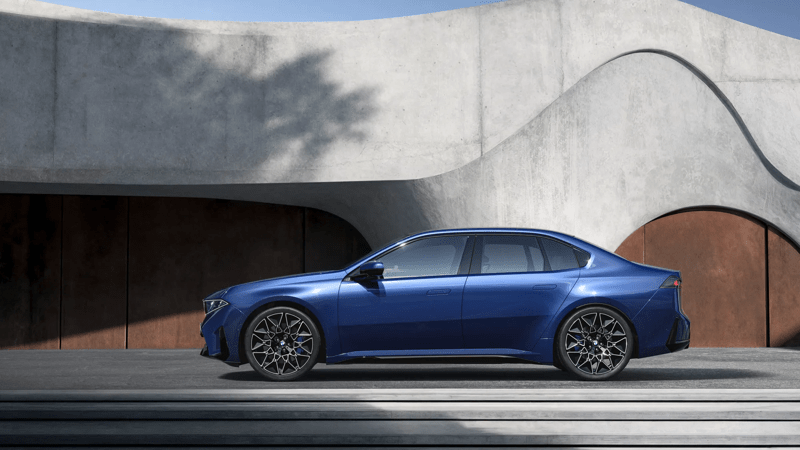
- Its design harkens back to the classic BMWs of the 1960s and 1970s.
BMW designers have it hard. There’s an old auto industry joke that no one hates BMW more than BMW fans. Designers routinely roll out radical new designs just to see longtime brand enthusiasts react angrily, and buy the car anyway.
Look up “flame-sided,” “Bangle butt,” or take a look at the oversize nostrils…er, grille…on much of the current lineup to get a taste of what we mean.
That’s why the reaction to today’s news has been so remarkable. BMW today raised the curtain on the future of its sedan lineup. By and large, longtime fans have cheered.
Meet the all-new 2027 BMW i3 – an all-electric sports sedan with up to 440 miles of range, advanced cabin tech that looks user-friendly and simple, and a look inspired by the classic BMWs of the 1960s and 1970s. It’s the long-awaited “electric 3 Series,” and it looks the part.
BMW says the new i3 will be available in the U.S. starting next year.
Classic Inspiration
- Clean, simple lines recall BMW sedans of the 1960s and 1970s, but updated for the electric vehicle (EV) age.
BMW made its retro intentions clear back in 2023 when it first began teasing this model. The company resurrected a name from BMW history for its next generation designs: Neue Klasse (New Class).
The company originally used that name for a series of sedans built from 1962 to 1972 that helped rescue it from financial struggles and gave it a foothold in the U.S. market. The name came back for a pair of concept cars that became the iX3 and this new i3.
This one is nothing like the squat, cute little i3 BMW sold from 2013 to 2021. The new i3 has 3 Series proportions and classic 3-box sedan looks with simple lines. The faux grille (EVs don’t need the airflow) is thin, housed with LED headlights to keep the front end simple.
Flush door handles – an increasingly controversial design that can raise safety concerns – keep the sides clean as well. The taillights are wide, but don’t quite meet in the middle to make a single line.
As with many EVs, designers have used lighting to hint at its high-tech nature. As the driver approaches, BMW says, the i3 detects its key and a “Welcome Light Animation begins on the exterior of the vehicle and continues in the interior.”
High, Thin Panoramic Screen Puts Everything in Easy View
- Inside, the standout feature is a thin panoramic screen at the base of the windshield that should help minimize touchscreen tapping.
Inside, BMW has adapted an idea we’ve seen elsewhere to great effect. The cabin’s standout feature is a high, thin screen mounted at the base of the windshield that keeps nearly anything the driver would want to know – speed, navigation, cabin temperature, what song is playing – in easy view.
Set above the steering wheel, it’s in the driver’s peripheral view when they’re looking at the road. That means your eyes barely have to adjust to glance at the screen. Lincoln rolled this out first in its Nautilus and Navigator SUVs, and we’ve loved the feature there. Lucid adopted something similar for the Gravity.
BMW’s version is a much thinner panoramic screen, which could be even less obtrusive.
You set it up through a 17.9-inch touchscreen mounted about where you expect a car’s touchscreen to sit. That one, oddly, is rhombus-shaped, which seems to be purely for flair. Once underway, you’ll probably find yourself touching it less than you do the screens of most modern cars.
A head-up display is optional, but seems like overkill with the panoramic screen mounted where it is.
Otherwise, the cabin is pleasantly minimalist, with a nearly octagonal steering wheel and colored lighting elements that shine through fabric-look dashboard panels.
The company says the car uses just four “superbrain” high-powered computer processors, with responses “ten times faster” than the infotainment displays in prior BMW vehicles.
440 Miles of Range and Standard All-Wheel Drive (AWD)
- Two electric motors, one per axle, make AWD standard
- BMW promises up to 440 miles of range, though we expect future trim levels with varying power and range figures
This is, of course, a BMW. So performance is at the forefront of the design.
It will launch in a single trim level, BMW i3 50 xDrive, with an electric motor on each axle for AWD grip. The company promises 463 horsepower in that setup.
BMW offers most of its vehicles in multiple configurations, so we would not be surprised to see a rear-wheel drive (RWD) setup and a high-performance M edition eventually.
The company estimates 440 miles of range even under EPA test conditions (which tend to yield the shortest estimates worldwide). An 800-volt architecture enables rapid charging, BMW says, with charging speeds “30% faster” than those of previous BMW EVs. The company has not provided timing estimates.
A Tesla-style North American Charging System (NACS) port should enable it to use most public chargers.
It can also provide a charge to other electric devices and even homes through vehicle-to-load and vehicle-to-home bidirectional charging functions.
The company promises “effortless and assured handling,” with vehicle dynamics controlled through a new processing computer BMW calls the “Heart of Joy.”
BMW has provided no guidance on pricing. We’ll bring more as we get time in the vehicle and question executives on the pricing plan.