

How long you keep a car is highly individualized. Some people like to keep their cars for hundreds of thousands of miles or until there’s a catastrophic failure, while others frequently trade in their vehicles so they’re always driving something new or different. Some combination of finances, lifestyle factors, and personal preference all plays into the decision.
When you’re assessing your own situation to determine whether a trade-in is right for you, consider factors such as the equity you have in the car, your vehicle’s depreciation, the timing of your trade-in, the details of the vehicle’s warranty — if it has one — and the broader economic landscape.
Trade-in Car Pros and Cons
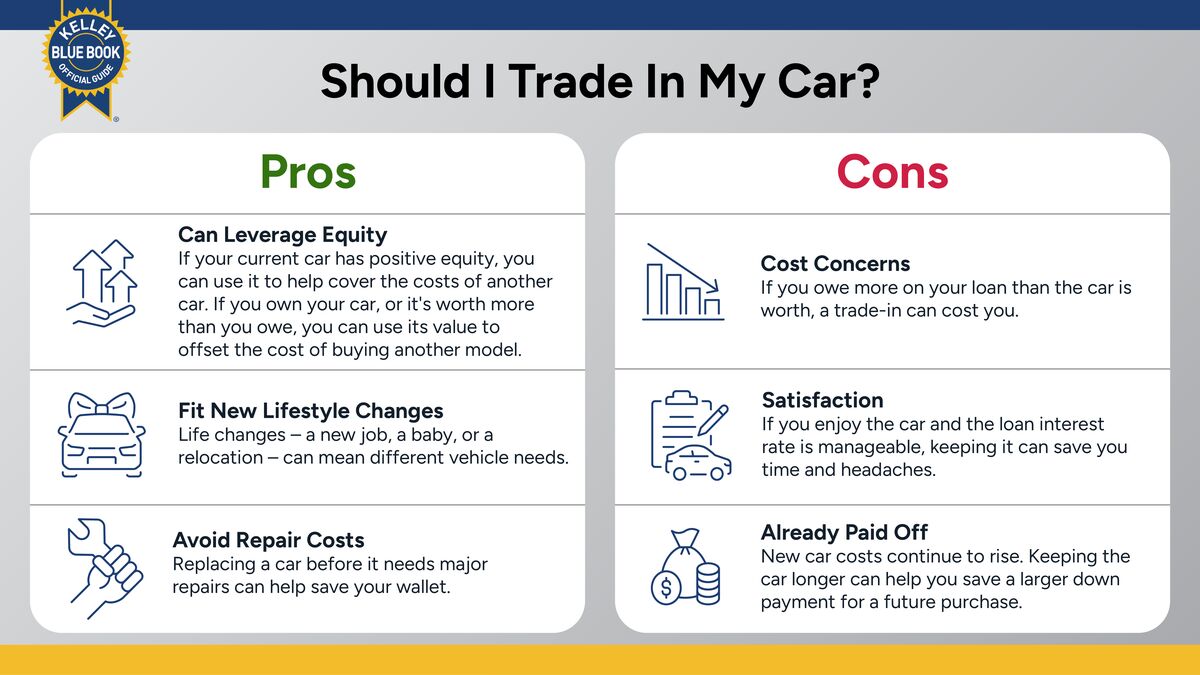
A car trade-in means selling your current car to a dealership. A dealer rep will assess the car and provide an appraised value. If you accept this amount, you can apply it toward the purchase of a new or used car. There are pros and cons to this process, so here are some major factors to consider.
How Long Should You Keep a Car?
According to data from Kelley Blue Book parent company Cox Automotive, the average transaction price (ATP) for a new car at the end of March 2026 was $49,275. This is a tough number for the average car buyer, and Cox Automotive analysts estimate that the average age of cars in the United States at the end of 2025 was about 12.8 years. People are keeping their cars longer than ever before. This also means that certain used vehicles are retaining more value as more people seek affordable used cars and inventory tightens.
If you like driving your car and it’s a good fit for your finances and lifestyle, keeping it can be a wise choice. However, if you are looking to trade in your car, there are some fundamentals to consider to help maximize value when purchasing a new vehicle, including depreciation and mileage.
MORE: Car Maintenance Guide: Everything You Need to Know
Car Depreciation Rate
A car’s depreciation rate, especially during the couple of years, is the best gauge for deciding whether to keep your ride or trade it in. Every car depreciates, at least for a while. At a point, some automobiles might begin to appreciate again, such as rare or vintage vehicles. However, in nearly every case, if you keep a car long enough, it will eventually depreciate to its scrap value. In other words, keep a car long enough, and its only value will be to a junkyard.
Using Cox Automotive’s March 2026 ATP of $49,275, we can calculate the estimated depreciation over five years for a car purchase at that price.
| Percentage Loss | Dollar Loss | Residual Value | |
| Year 1 | 16% | $7,844 | $41,391 |
| Year 2 | 12% | $5,913 | $35,478 |
| Year 3 | 11% | $5,421 | $30,057 |
| Year 4 | 9% | $4,434 | $25,623 |
| Year 5 | 7% | $3,450 | $22,173 |
Related: Is Now the Time to Buy, Sell, or Trade In a Used Car?
Average Car Mileage
Across the automotive industry, 12,000 miles is the annual mileage standard. Most leases are based on that 12,000-mile annual number, as are most new-car warranties. Likewise, when evaluating a used car’s value, 12,000 miles per year is considered average. In other words, a 3-year-old vehicle should have about 36,000 miles on the odometer.
Mileage does enter the used-car value equation, but it isn’t always the best or only consideration when calculating a used car’s worth. For instance, a 3-year-old, well-maintained car with 50,000 mostly highway miles is likely to be in better shape than a neglected 3-year-old car with 36,000 city miles. Furthermore, some car models simply last longer than others, with fewer reliability issues along the way, and have higher resale value.
MORE: Car Trade-in Tips: How Can I Maximize My Car’s Value?
When to Trade In a Car
Determining the sweet spot for trading in a car at its peak value is a mixture of art and science. Here are some key points to consider when making your decision:
- Get the vehicle’s book value. You can discover what your vehicle is worth today with Kelley Blue Book’s valuation tool. The figure it generates is widely known in car transactions as the “book value.” You need to know this value to trade in or sell your car. Use the number to compute the current value against the loan payoff amount on your car’s financing.
- Know your equity. When the book value is more than the loan balance, the difference is your equity. Any time there is equity in your current car, it can become a partial payment in another car transaction during a trade-in. In other words, equity helps reduce the amount to be financed on the new purchase. This is what a trade-in should do.
- Consider broader economic factors. The tricky part is guessing whether a used car’s value will rise or fall in the future. Usually, this isn’t a major undertaking because used car prices nearly always fall. However, used car prices (and values) soared during 2022 amid supply chain issues and other economic constraints, and we’re still seeing higher prices and tighter inventory. Keep an eye on these trends to help inform your decision.
If you are determined to trade in your car, the best time will be any time after its book value exceeds its loan payoff amount. What about the best time of the year to trade? If forced to pick, we’d say earlier in the year rather than later. In terms of its model year, the car will seem newer at the beginning of a year than toward its end. Consequently, it will be more appealing.
RELATED: Can I Finance an Older Car?
When Not to Trade In a Car
There might be some exceptions, but generally speaking, don’t trade in a car that is worth less than what you owe. In other words, if you would receive less for the trade-in than the loan payoff amount, don’t do it. In the finance world, this is called being “upside down” or “underwater.” The result of trading in a vehicle when you are underwater is that you transfer that same issue to your next vehicle. That’s because the difference between what you owe and your car’s value is rolled into the amount financed on your next car. Consequently, you start the new loan deeper underwater.
Moreover, average new car prices remain high. Replacing your current vehicle with an overpriced new one may not make fiscal sense.
Editor’s Note: We have updated this article since its initial publication. Russ Heaps contributed to the report.