
Quick Facts About Truck Protection During a Boat Launch:
- Asking your truck to wrangle a load heavier than its ratings can end badly.
- Before leaving the cab while you’re on a boat ramp, put your transmission in Park and engage the parking brake.
- Your boat floats; your truck doesn’t. Know where the boat ramp ends.
Using a truck to tow and launch a boat from a ramp is no mean feat. Yes, people do it every day without drama or incident. However, accomplishment requires preparation and strict attention to detail. Although longtime boaters make the process look easy, it is just that: a process. Establishing and carefully sticking to a methodology is essential to a successful towing and launching experience. We have a comprehensive towing handbook for your reference, so we won’t reinvent the wheel here, but we will provide some pointers for preparing your truck for towing, launching a boat. and avoiding some common mistakes. Use the jump links below to skip ahead.
- Picking the Right Truck for Towing
- How to Prep a Truck for Towing a Boat
- 4 Common Mistakes When Launching a Boat
Picking the Right Truck for Towing
The first rule for picking a tow vehicle is that more towing capability is better than insufficient capability. In other words, you won’t go wrong buying a truck with a higher maximum towing weight limit than you think you’ll need. Besides a higher cost to own, there is no penalty for having more towing-weight capacity than your load requires. If you skimp on your estimated towing weight needs, you can wind up with less capability than your load demands. This could damage your truck’s drivetrain, reduce its stability, or even cause a crash.
TIP: When determining your truck’s towing capacity requirements, consider the weight of the trailer, boat, and any cargo you typically load into the boat when towing.
RELATED: Maximum Towing Capacity For Every Truck
How to Prep a Truck for Towing a Boat
To protect your truck when towing and launching a boat, nothing beats common sense. Here are our top common-sense tips:
- Make sure you have the appropriate hitch: Automotive hitches come in five classes. Trucks most often use Class III through Class V hitches. As the size of the vehicle and the weight of the load increase, so should the hitch classification. Adding a tow hitch can increase your car’s value and utility. However, always check your owner’s manual for your vehicle’s tow rating before installing a hitch.
- Don’t cut corners with your ball mount and ball: The shank is the portion of the ball mount platform that fits into your truck’s hitch receiver. It must be the same size as the truck hitch receiving tube. Each hitch classification has a specific size receiving tube. For Class III and IV, it’s 2 inches. Class V has a 2.5-inch receiving tube. A prime responsibility of the ball mount platform is to keep the tongue of your loaded trailer level. An adjustable mount platform simplifies this task. The ball must exactly match the size of the trailer coupler opening. Most trailer manufacturers put the coupler size on a label on the trailer’s tongue. Cutting corners with any aspect of the ball mount platform, ball size, weight requirement, or leveling the load will make towing and launching more difficult and less safe.
- Check and top off all essential fluids: Pulling a trailer puts a strain on a truck’s powertrain, so ensure that your truck’s engine oil, coolant, and transmission fluid are at optimum levels. While you are at it, top off the windshield washer fluid, too.
- Double-check tire pressure: Even if your truck has a built-in tire pressure monitor system alerting you to low tire pressure, use a hand gauge to verify that every tire has the owner’s manual-recommended tire pressure. While you’re checking the pressure, verify that the lug nuts are tight.
- Invest in towing mirrors: If your truck didn’t come with them, invest in larger towing mirrors. A cheaper but still effective alternative is exterior mirror extensions which attach to the standard outboard mirrors, providing a wider field of view. A broader view is critical for towing and comes in handy when backing a boat trailer down a bustling boat ramp.
- Manage your load: Evenly distribute the cargo loads in your truck’s cargo box and boat to ensure maximum towing stability. An uneven load affects not only stability but also steering.
- Have tow lines on hand: The wrong time to begin worrying about tow lines is as you watch your truck sink into the water at the end of a boat ramp. Have a couple of tow lines ready before you need them.
TIP: Although it has more to do with driver than truck preparedness, if you haven’t clocked multiple instances of steering a trailer in reverse, find an empty parking lot and practice. Buy four small, inexpensive orange traffic cones at the big-box home improvement store, set them to form a rectangle representing a traffic lane, and practice backing into it from every angle. Future you will thank you.
MORE: What Are Trailer-Towing Technologies?
4 Common Mistakes When Launching a Boat
- Forgetting to set the parking brake: In a rush to hop out of the cab and dash back to release the boat once it’s in the water, forgetting to shift into Park or set the parking brake can quickly become a costly and hazardous oversight. It can allow the truck to roll back and take a little dip in the surf. The tow lines we mentioned earlier will be a big help here.
- Transferring gear: The time to transfer gear from your truck’s cargo box to the boat is before you are on the ramp. Moreover, if you haven’t done the appropriate size-and-shape calculations, you may discover that you must leave the extra gear in your truck’s bed unattended.
- Jackknifing: Drivers newer to trailer towing require some practice to master steering while in reverse. The newer breeds of trucks offer some reverse steering assistance (for example, Ford‘s Pro Trailer Backup Assist or Ram‘s Trailer Reverse Steering Control). To some degree, these systems can send appropriate steering inputs to the trailer. Otherwise, the driver must compensate for the trailer turning in the opposite direction of the steering wheel input. In other words, when backing up, turning the steering wheel to the right causes the trailer to turn to the left. Overcompensating when attempting to correct the trailer’s trajectory can end in jackknifing. This condition occurs when the trailer becomes perpendicular to the truck, causing the trailer tongue to come into contact with the truck’s rear bumper. Jackknifing can cause damage to both the trailer and the truck.
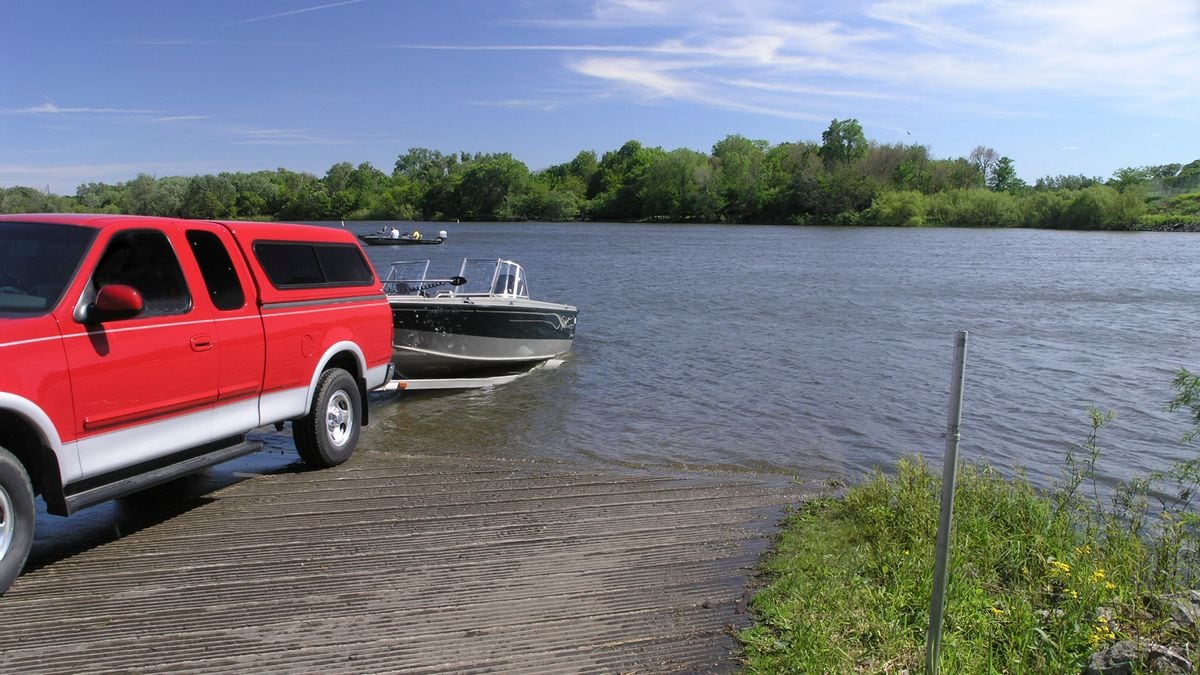
- Backing too far down the ramp: Put those bigger mirrors to use. Back down the ramp only as far as required for the boat’s stern to float off the trailer. Continuing in reverse beyond that point exposes you to the danger of the trailer wheels dropping off the end of the ramp. This can cause the trailer wheels to become mired in the soft mud found at the end of most ramps. Your truck may not have enough traction to pull the trailer out. Stay on the ramp and avoid another reason to use those tow lines.
TIP: We recommend always walking down the ramp before backing your trailer onto it. Establish where the ramp ends. Inspect the ramp surface to judge its condition. Is it slick or dry? Reduce the surprises you might encounter when launching.
Editor’s Note: We have updated this article since its initial publication.